
Development of quantification methods for seaweed polysaccharides, especially fucoidan
セクションアウトライン
-
-
Introduction
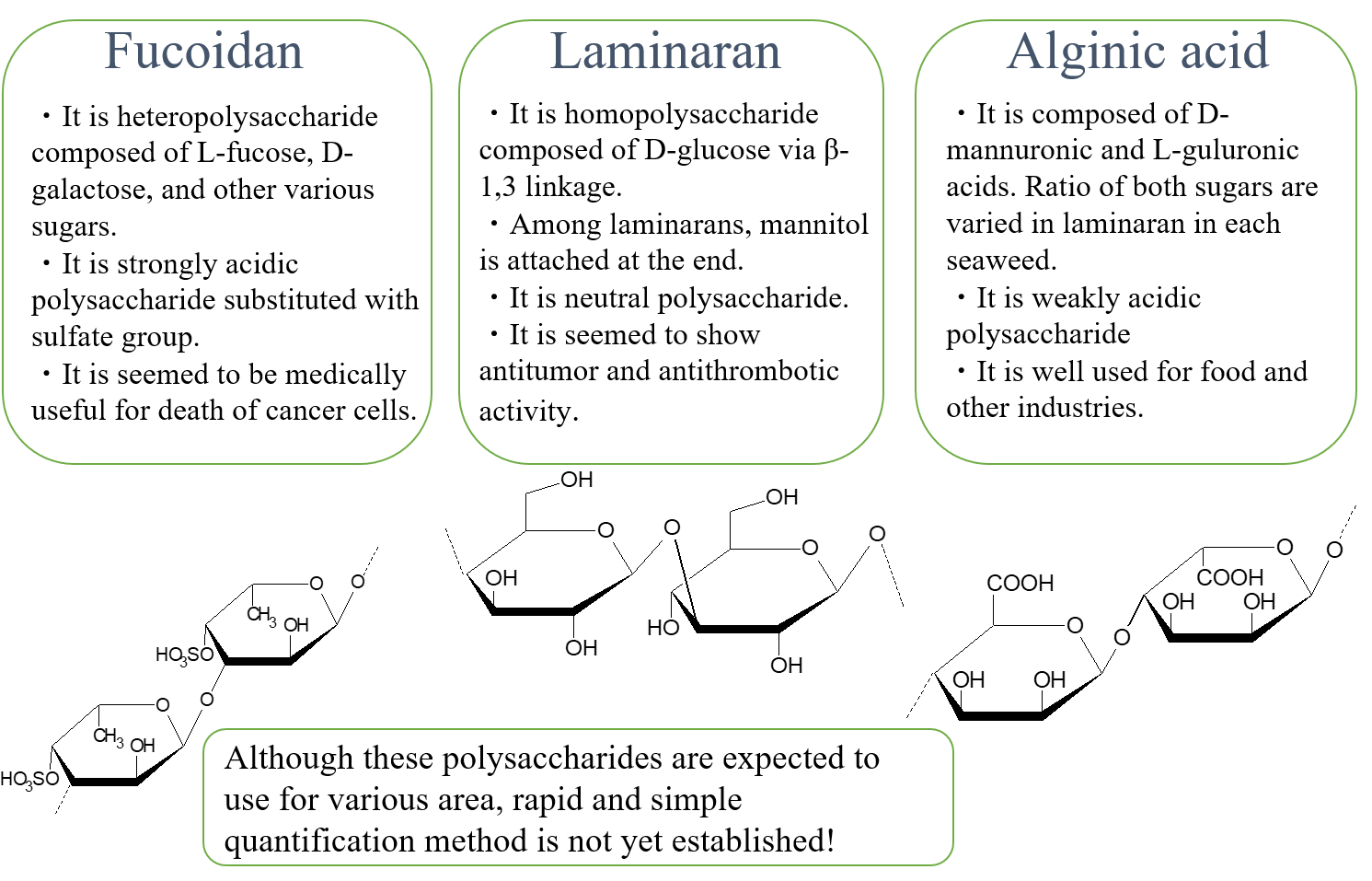
Among seaweeds, brown algae, including Kombu (sea tangle) and Wakame (sea mustard), contain laminaran, fucoidan, and alginic acid as polysaccharides. These polysaccharides have already been reported for various functions and are known as health-benefitial effects for humans. However, while it says, "How much of these polysaccharides are in seaweed?" there is no easy way to determine how much they are in the seaweed. This is partly due to the complex structure of fucoidan, which shows chemical variety of fucoidan depending on the type of seaweed.
For this purpose, we are developing a new method to easily measure the amount of laminaran, fucoidan, and alginic acid extracted from seaweeds. This method aims to establish a measurement method that can be used anywhere by using inexpensive measurement devices.
Method
Since it is difficult to extract laminaran, fucoidan, and alginic acid separately from brown algae, we have studied a simple method to separate polysaccharides from seaweeds after extracting polysaccharide mixtures from seaweeds. Subsequently, we are developing a simple method for measuring the amount of polysaccharides in each polysaccharide fractions.
Result
We have established a simple method for separation of polysaccharides by ion exchange. Research is currently underway to establish a method for easily measuring polysaccharides in separate segments.
Since we are not researching functions of polysaccharides, we are aiming to establish important analytical methods before use of their functions
-