

Functional Constituents derived from seaweeds
セクションアウトライン
-
-
 Introduction
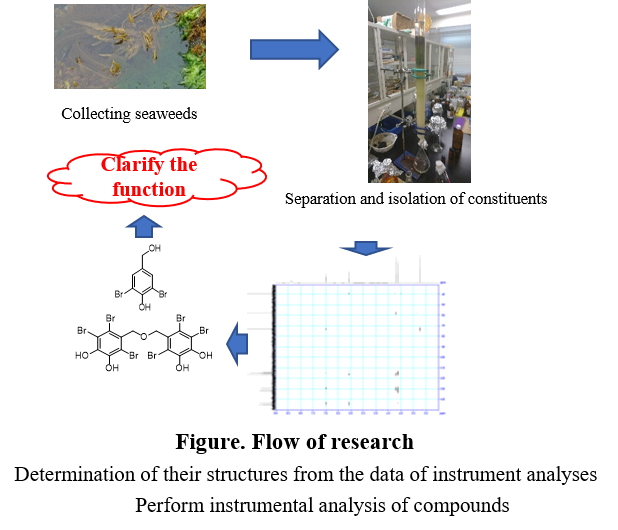
My research group has investigated to obtain and identify enzyme inhibitors derived from low-available seaweeds collected around Hokkaido, as functional constituents. We separate pure functional compounds by using various techniques and determine their structures by instrumental analyses. Seaweeds do not move by themselves like land plants and microorganisms. So they synthesize and use various compounds as self-protection and communication tools. Among these compounds, we aim to find new compounds that are useful for humans and seafood industry.
The enzymes targeted for research include α-glucosidase related to postprandial hyperglycemia, β-glucuronidase related to delayed excretion of xenobiotics, glucosidase 6-phosphate dehydrogenase related to production of bioreductants and nucleic acid constituent sugars, xanthine oxidase related to uric acid production, lipoxygenase related to inflammation, and tyrosinase involved in blackening of shrimp and crabs. We are searching for substances that inhibit their function.
Methods
We collect seaweeds by ourselves in various areas of Hokkaido. Return to the lab and create an extraction product (extraction) using organic solvent. The extract is screened by enzyme inhibition tests. The inhibitors are separated by various chromatographic techniques to obtain pure inhibitors. They are analyzed by various instruments to determine the structure.
Result
A series of bromophenols were obtained from the seaweeds belonging to red algae of the family Rhodomelaceae. In addition, phlolotannins, alkapolyenes, and chlorophyll-related compounds were obtained from the seaweeds as lipoxygenase inhibitors.

You can collect seaweeds yourself in the future and disclose new compounds
-