
Karenia selliformis Eastern Hokkaido strain
セクションアウトライン
-
The East Hokkaido strain of Karenia selliformis, which caused a red tide in East Hokkaido in the fall of 2021, has caused significant damage to a wide variety of organisms, including salmon, sea urchins, octopus, and whelks. On the other hand, bivalves and crustaceans have not been affected as much. It is not yet fully clear whether the damage is caused by toxic substances or by other factors, such as clogged gills or low dissolved oxygen. However, the pattern of affected organisms is consistent with the pattern of red tide damage caused by K. selliformis to date, and production of some toxic substance is strongly suspected.
When samples collected in Nemuro, Hokkaido in December 2021 were analyzed for the presence of gymnodimine reported in the K. selliformis New Zealand strain, none was detected. On the other hand, analysis of a compound with a molecular weight of 836 reported in the K. selliformis Patagonia strain, which is a gymnodimine non-producing form, showed two peaks, similar to those observed in previous studies. The structure of this substance is unknown, and it is also unknown if it is the main body of the toxicant, but we plan to purify it and conduct bioactivity studies to determine its structure.
-
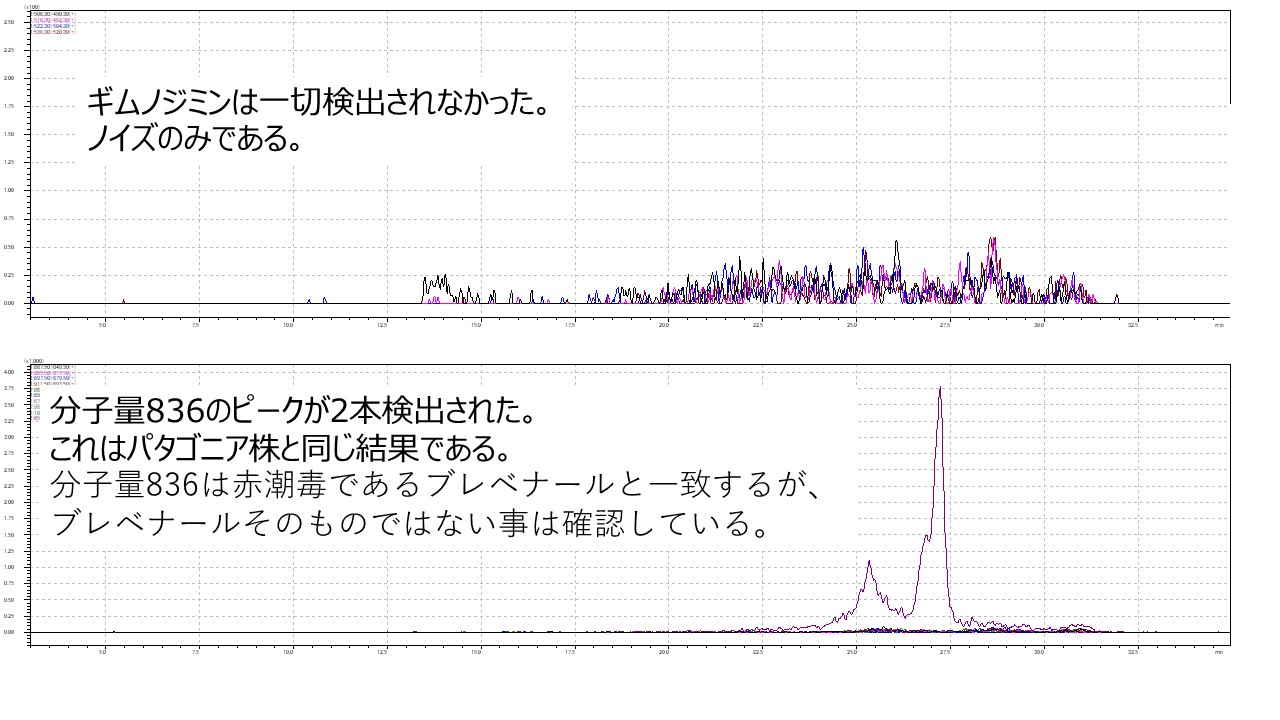
(upper figure)
No gymnodimine was detected at all.
Only noise.
(lower figure)Two peaks with a molecular weight of 836 were detected.
This is the same result as for the Patagonian strain.
Molecular weight 836 is consistent with brevenal, a red tide toxin, but we have confirmed that it is not brevenal itself.
-