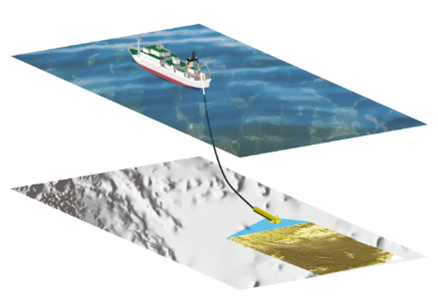
Side scanning sonar is a type of sonar that produces three-dimensional images of undulations on the seafloor and is mainly used to research structures such as wrecks and fishing reefs, as well as the topography of the seafloor. An acoustic beam is transmitted obliquely downward from a transducer attached to the ship's bottom or towing structure, and the sound waves that return after hitting the unevenness of the seafloor are received to visualize the undulations of the seafloor. The name "side scan" comes from "Scanning" the "Side" of the transducer.
With echo sounding machine, which transmits and receives waves from the bottom of a ship, the greater the depth, the longer the time between transmission and reception of echoes becomes, limiting the number of observation points per unit time and resulting in a "coarse" seafloor topographic map. On the other hand, side scanning sonar can transmit and receive waves at a higher frequency by towing the transducer near the seafloor, thus enabling it to capture the undulations of the seafloor in greater detail.