セクションアウトライン

    • By using sound waves, it is possible to quickly and extensively capture what is going on in a large area of the ocean. Sound waves are waves (coarse and dense waves) generated when a vibrating object changes the density of a medium, such as air or water, and the change in density is transmitted through the adjacent medium. Sound that is higher (in frequency) than that which can be heard by our ears (audible sound: 20Hz~20kHz) is especially called ultrasonic sound.

      Sound waves have the characteristic of bouncing back when they hit the boundary of a material, and the bounced sound wave is called an echo (echo). Sonar (Sound Navigation and Ranging) is a device that can detect objects at a distance by determining the distance to the object from the time it takes between the transmission of a sound wave signal and the return of the echo.

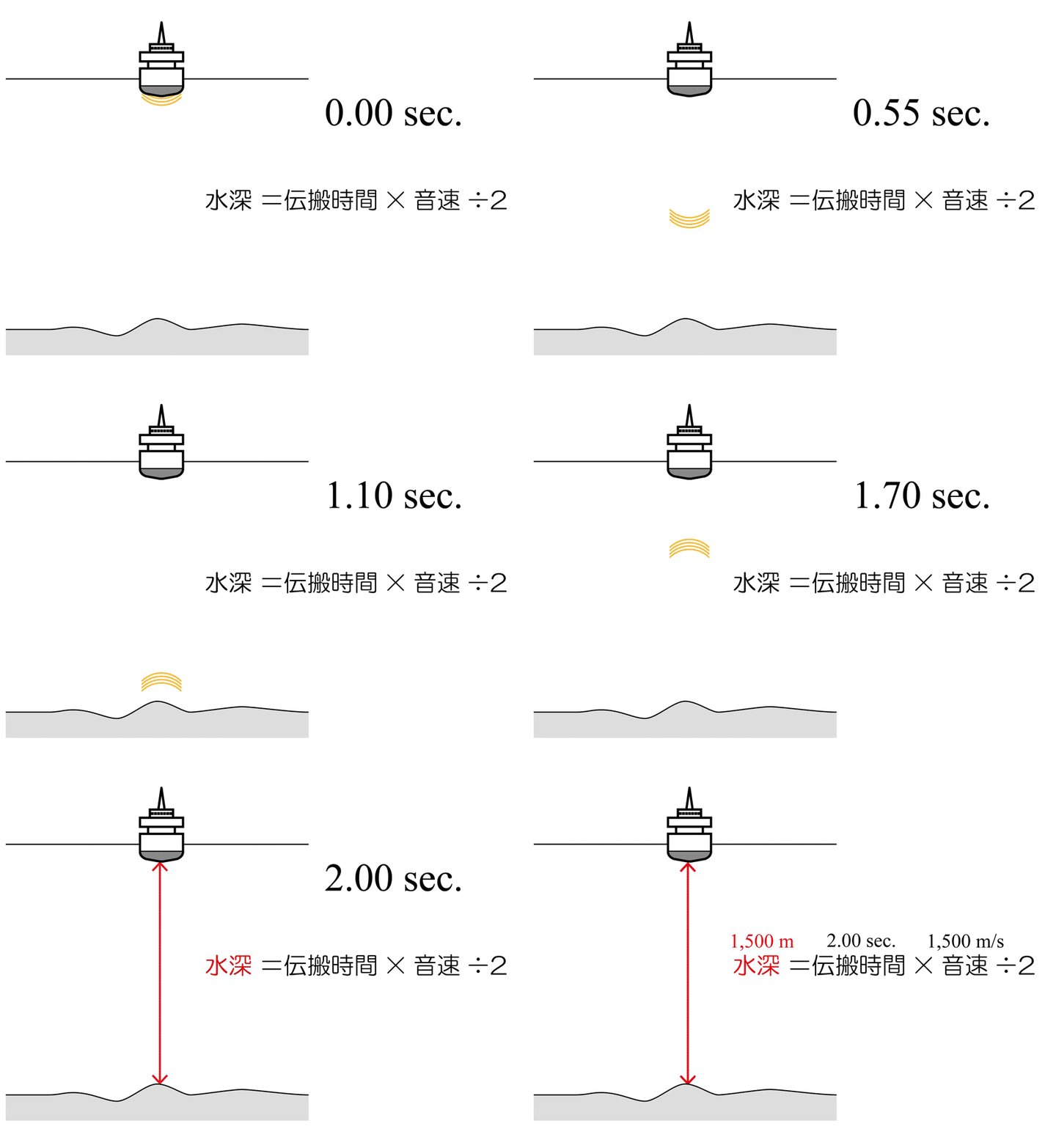
      In the old days, depth measurement was done by extending a rope or steel wire from the surface of the water to the seafloor (weight measurement method). With the emergence of the "echo sounding machine" developed by applying sonar technology, the accuracy and efficiency of depth measurement has improved dramatically, and even large depths of several thousand meters can be measured in a matter of seconds. Figure 1 shows a conceptual diagram of an echo sounding machine. Sound waves emitted from a transducer placed near the water surface, such as at the bottom of a ship, propagate through the water and are eventually reflected by the seafloor surface. The echoes reflected back are received, and the distance between the transducer and the seafloor (propagation distance) is calculated by multiplying the time taken from transmission to reception (propagation time) by the speed of sound, and half of this is the water depth. Fish finders, which extend the detection range from the seafloor to fish and other aquatic organisms, are widely used by fishermen as indispensable equipment for efficient fishing.

    • 音響測深機 仕組み

      Figure 1. Outline drawing of Acoustic Bathymetry

      水深:depth 伝搬時間:propagation time 音速:speed of sound

      The speed of sound in seawater varies with water temperature, salinity, and depth (pressure), but is approximately 1,500 m/sec. If the propagation time is 2 seconds, the water depth is calculated as follows.


                                     Depth = 2.0 sec x 1,500 m/sec ÷ 2


                                                = 1,500 m

    • Since echoes contain information about the objects that reflect them, by capturing and analyzing the echoes, it is possible to determine the state of distant locations.By applying this underwater acoustic technology, measurement devices have been developed, such as the "quantitative echo sounder," which estimates the species, size, and number of fish, the "multi-narrow beam echo-sounder," which draws a topographic map of the sea floor, and the "ADCP," which measures the direction and speed of ocean currents.This section introduces these representative acoustic measurement technologies for oceanographic observation.