

MTD Horizontal Net (Motoda Horizontal Net)
セクションアウトライン
-
A closed net for marine zooplankton that can be horizontally towed to collect plankton at any depth.
After attaching several nets to a single wire extending from the vessel, the vessel is slowly sailed and the wire angle is maintained at 45 degrees, so that several attached nets are towed horizontally and simultaneously in multiple layers at a given depth (Fig. 1).
By dropping a messenger (a weight that falls through the wire) through the wire, the triangular frame and net ring of the MTD net are separated, and the wire that connects the triangular frame and net ring and wraps around the outside of the center of the net is squeezed to close the net. This structure ensures that the plankton collected up to that point are not lost and collected.
It is characterized by its ability to simultaneously collect stratified samples of zooplankton in the ocean from multiple layers, without the use of electrical signals, but only by means of a single wire with a mechanical mechanism.
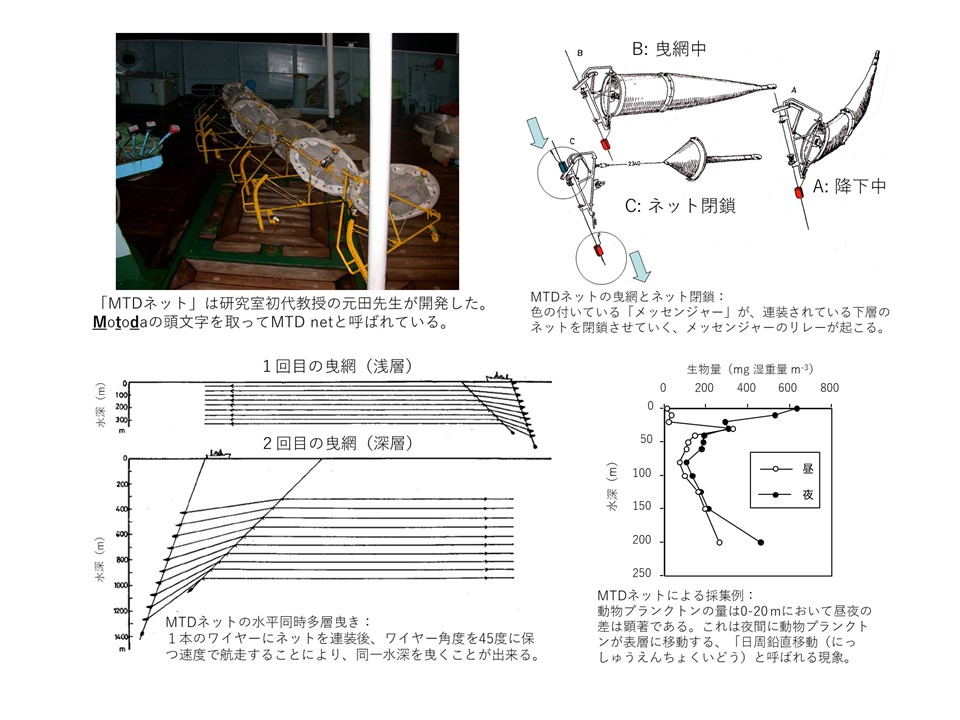
(upper left)
“MTD net” was developed by Dr. Motoda, the first professor of the laboratory.
It is called MTD net after the initials of Motoda.
(upper right)
Towing and net closure of MTD nets:
A relay of messengers occurs, with the colored “messengers” closing the lower net that has been strung together.
(lower left)
First tow (shallow layer)Second tow (deep layer)
Horizontal simultaneous multi-layer towing of MTD nets:
After a series of nets are attached to one wire, they can be towed at the same depth by towing at a speed that maintains the wire angle at 45 degrees.
(lower right)Example of collection by MTD net:
The difference in zooplankton abundance between day and night is remarkable at 0-20m. This is a phenomenon called “diurnal vertical migration”, in which zooplankton moves to the surface during the night.
-
459.3 KB · アップロード 23年 04月 26日 16:06
-