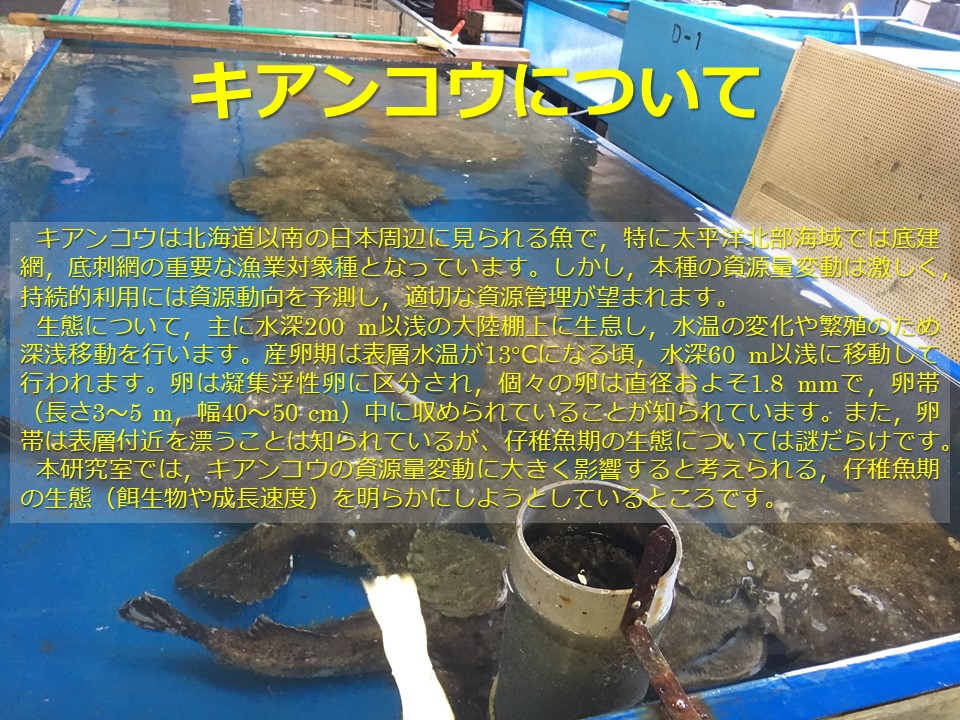
The yellow goosefish, Lophius litulon, is found around Japan south of Hokkaido, and is
an important target of bottom setnet and bottom gillnet fisheries, especially
in the waters of the northern Pacific Ocean. However, the abundance of this
species fluctuates rapidly, so it is desirable to predict
the trend of the stock and to manage resource appropriately for sustainable
utilization of the species.
This species lives mainly on the continental shelf at depths
shallower than 200 m, and migrates to shallower depths due to changes in water
temperature and for reproduction. When the surface
water temperature reaches 13°C, they migrate to depths of 60 m or shallower and
spawn. Eggs are classified as agglutinated floating eggs, each of them
is approximately 1.8 mm in diameter, and are contained within an egg veil (3 to
5 m long and 40 to 50 cm wide). The egg veil is known to drift near the
surface, but its biology during the larval and juvenile stages is still a mystery.
We are currently trying to clarify the ecology (prey and growth
rate) of the larval and juvenile stages, which is thought to have a great
influence on the fluctuation of the abundance of yellow goosefish.