

Potassium 40, Rubidium 87
章节大纲
-
-
【Potassium 40, Rubidium 87】
Potassium-40 (40K) and Rubidium-87 (87Rb) are discussed as natural radionuclides.
Both of these nuclides have existed since the beginning of the earth, just like uranium.
Potassium 40 (40K)
Potassium-40 (40K) is dissolved in seawater with stable Potassium-39 (39K).
The proportion of potassium-40 (40K) in total potassium is 0.0117%, which is a significant amount for a radionuclide. It is always present in a constant proportion to stable potassium everywhere on earth. Therefore, we humans also contain a considerable amount of potassium 40 (40K), and in terms of becquerels, an adult weighing 60 kg contains several thousand becquerels.
Of course, seawater also contains a significant amount of 40K, 12 becquerels (Bq)/liter. Since cesium 137 (137Cs) is 0.001 to 0.002 becquerel/liter, the becquerel concentration is 1000 times higher.
Potassium is one of the salts of seawater, so it moves in line with the salinity distribution.
Rubidium 87 (87Rb)
Rubidium (Rb) is one of the alkali metal elements with atomic number 37. There are two types of naturally occurring rubidium: Rubidium 85 (85Rb), which is stable with a natural abundance of 72.2%, and Rubidium 87 (87Rb), which is present at 27.8%. 87Rb is a radionuclide with a terrifyingly long half-life of 49.2 billion years, but seawater has a becquerel concentration of 0.11 becquerel (Bq)/liter, similar to that of uranium-238 (238U), and potassium-40. Similarly, it moves in the same way as salt in seawater.
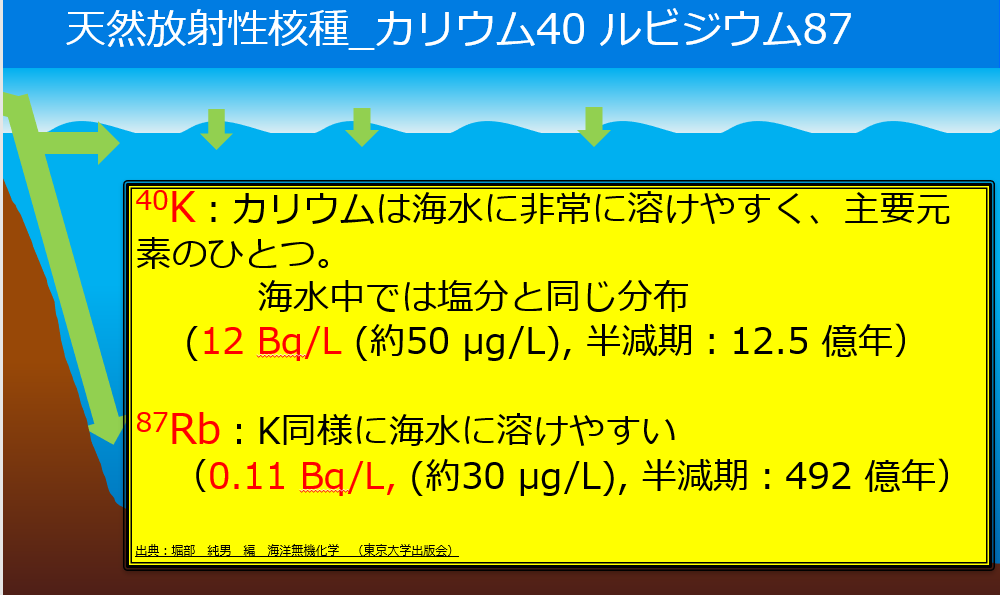
天然放射性核種natural radionuclides
カリウムは海水に非常に溶けやすく、主要元素のひとつ
Potassium is very soluble in seawater and is one of the main elements.
海水中では塩分と同じ分布 Same distribution as salinity in seawater
約about 半減期half-life 億年x100 million years
K同様に海水に溶けやすいEasily soluble in seawater like K
-