KEIRI Imai, KENJI Oguma, and KOUKI Sawada, Oshoro-maru Marine Science Department, School of Fisheries Sciences, Hokkaido University
A type of CTD that stores measurements in an internal recording device is called a "self-recording CTD" or "memory CTD". Because they are compact and lightweight, and do not require a special winch with armored cable wound around it, they are simpler and more versatile instruments than CTD water sampling systems. Observations can be continued even when weather conditions worsen, as long as the vessel can maintain its observation system. This section introduces the observation method using the self-recording CTD used on the Oshoro Maru as an example.
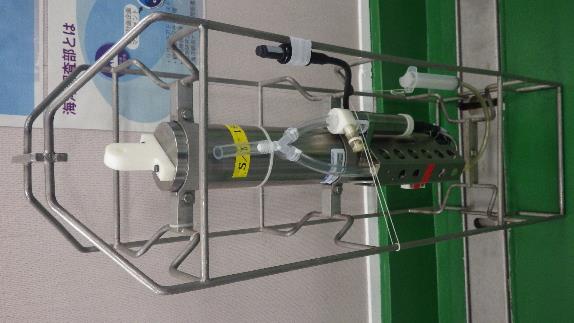
Figure 1 shows the appearance of the self-recording CTD. The sensor is housed in a stainless steel protective frame, with a battery (dry cell) and recording device (nonvolatile flash memory) in the cylindrical body at the center.
Before starting observations, connect the "Data Collection and Processing" PC to the self-recording CTD with a communication cable, and use terminal software to make the initial settings and check the battery capacity (remaining capacity) for running the observation (Figure 2). After that, the communication cable is disconnected and the connector is tightly capped so that it can be put into the sea.
Figure 2 Self-recording CTD configuration diagra
船上部 Onboard operation section
ターミナルソフト Terminal emulator
データ回収・処理PC Data collection and processing PC
通信ケーブル Communication cable
水中部 In-water section
ウィンチワイヤ Winch Wire
自己記録式CTD Self-recording CTD
重錘 Weight
As a rule, CTD observations are conducted while the vessel is stationary. The instrument is connected to the end of a wire rope wound around a winch, and the winch is lowered to the desired observation depth by uncoiling the wire rope. The self-recording CTD is turned on before being put into the water, and turned off after being lifted into the water. After landing, the self-recording CTD is connected to the PC again with a communication cable, and the measurement data stored in the instrument is retrieved using terminal emulator.
Fig 3 Self-recording CTD
観測用ダビット Observation davits
滑車 Pulley
ワイヤーロープ Wire rope
ウィンチ Winch
メモリ式CTD Self-recording CTD
By incorporating a self-recording CTD into a seafloor-mounted observation system called a mooring system, it is possible to continue to measure water temperature and salinity trends at the same location over a long period of time.
Fig 4 Mooring observation system
耐圧フロート Pressure-resistant float
セジメントトラップ Sediment trap
自己記録式CTD Self-recording CTD
音響切離し装置 Acoustic Isolation Device
シンカー(錘) Sinker(Weight)
【Note on the observation】
・Unlike a wired CTD, the depth of the instrument under observation cannot be determined in real time, so the approximate depth of the instrument is determined by relying on the length of the wire rope (line length) that has been unrolled. The greater the horizontal distance between the instrument and the ship, the greater the difference between the wire rope length and the depth of the instrument (wire rope length > depth of the instrument), so it is necessary to unroll more wire rope than the desired observation depth depending on how the instrument is being swept away. However, the wire rope should not be extended beyond the depth because the sensor will be damaged if it hits the seafloor. ・Self-recording CTDs are powered by batteries. To avoid running out of battery power during observation, the measurement interval, remaining battery capacity, current consumption, etc. must be taken into consideration when planning the observation. Batteries should be replaced well in advance. ・This instrument does not have the ability to record position information (GPS signals). It is necessary for the observer to accurately record the ship's position and time.