Section outline

    • Review of error propagation (official version)


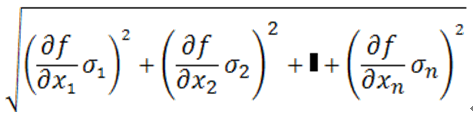
       The numbers x1, x2, ,,,,, xn have errors σ1, σ2, ,,,,,,, σn, respectively.

      The error σ when performing the operation f is expressed by the following formula.


         σ =  ±   


    • Applied problem 1)

      10.0 mg of potassium iodate was weighed out using an electronic balance and placed in a volumetric flask (100 mL).Fill the volumetric flask with water up to the mark (fill it up), dissolve it completely, and mix well. When this solution is weighed out using a whole pipette (10.0 mL), calculate the mass of solute contained in 10 mL of the solution, including the error. The accuracy of the balance and each capacity device is as follows.


      Accuracy of precision electronic balance:±0.05mg

      Accuracy of whole pipette (10mL):±0.02mL

      Accuracy of volumetric flask (100mL)   :±0.12ml


       When potassium iodate (10.00±0.05mg) is dissolved in water (100.0±0.12mL) in a volumetric flask, the weight concentration of the solution is (10.00±0.05mg)/(100.0±0.12mL) mg/mL.
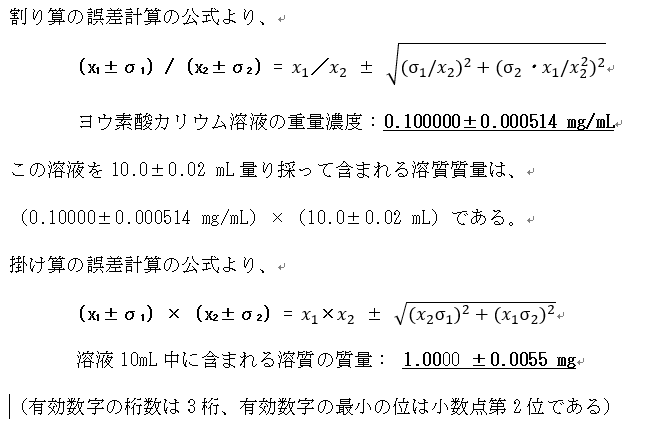


      割り算の誤差計算の公式より、From the formula for calculating the error in division,

      ヨウ素酸カリウム溶液の重量濃度Weight concentration of potassium iodate solution

      この溶液を10.0ml±0.02ml量り取って含まれる溶質質量はWeigh out 10.0ml±0.02ml of this solution and find the mass of solute contained in it.

      掛け算の誤差の公式よりFrom the multiplication error formula
      溶液10ml中に含まれる溶質の質量Mass of solute contained in 10ml of solution
      有効数字の桁数は3桁、有効数字の最小の位は小数点第2位であるThe number of significant figures is 3, and the smallest significant figure is the second decimal place.


    • Applied problem 2)

       Using a cheap electronic balance, 10 mg of potassium iodate was weighed out and placed in a volumetric flask (100 mL). Fill the volumetric flask with water up to the mark (fill it up), dissolve it completely, and mix well. When this solution is weighed out using a whole pipette (10.0 mL), calculate the mass of solute contained in 10 mL of the solution, including the error. The accuracy of the balance and each capacity device is as follows.


      Accuracy of a cheap electronic balance ±0.5mg

      Accuracy of whole pipette (10mL):±0.02mL

      Accuracy of volumetric flask (100mL)   :±0.12ml


       When potassium iodate (10.0±0.5mg) is dissolved in water (100±0.12mL) in a volumetric flask, the weight concentration of the solution is (10.0±0.5mg)/(100±0.12mL) mg/mL.

            Weight concentration of potassium iodate solution0.100±0.005 mg/mL


      Weigh out 10.0±0.02 mL of this solution, and the mass of solute contained is

      0.100±0.005 mg/mL)×(10.0±0.02 mL)= 1.00 ±0.05 mg

      It is calculated as follows.

             (The number of significant figures is 2 digits, and the smallest significant figure is the first decimal place.)

      The poor precision of the balance was reflected in the precision of the measurement results.


    • Applied problem 3)

       10.000 mg of potassium iodate was weighed out using an ultra-high precision electronic balance and placed in a volumetric flask (100 mL). Fill the volumetric flask with water up to the mark (fill it up), dissolve it completely, and mix well. When this solution is weighed out using a whole pipette (10.0 mL), calculate the mass of solute contained in 10 mL of the solution, including the error. The accuracy of the balance and each capacity device is as follows.


      Accuracy of ultra-precise electronic balances ±0.0005mg

      Accuracy of whole pipette (10mL):±0.02mL

      Accuracy of volumetric flask (100mL)   :±0.12ml


       When potassium iodate (10.0±0.0005mg) is dissolved in water (100±0.12mL) in a volumetric flask, the weight concentration of the solution is (10.000±0.0005mg)/(100±0.12mL) mg/mL.

            Weight concentration of potassium iodate solution0.100±0.00012 mg/mL


      Weigh out 10.0±0.02 mL of this solution, and the mass of solute contained is

      0.100±0.00012 mg/mL)×(10.0±0.02 mL)= 1.0000 ±0.0023 mg


      In example 1), the balance accuracy was ±0.05 and a result of 1.0000 ±0.0055 mg was obtained.

      In example 2), the balance accuracy was ±0.5 and a result of 1.00 ±0.05 mg was obtained.

      In example 3), the balance accuracy was ±0.0005 and a result of 1.0000 ±0.0023 mg was obtained.


      Compared to the balance in example 1), example 3) used a balance that was 100 times more accurate, but the error was only reduced by half.

      A balance that is 100 times more accurate will cost more than 100 times as much.


    • Applied problem 4)

       50.0 mg of potassium iodate was weighed out using a precision electronic balance and placed in a volumetric flask (500 mL). Fill the volumetric flask with water up to the mark (fill it up), dissolve it completely, and mix well. When this solution is weighed out using a whole pipette (10.0 mL), calculate the mass of solute contained in 10 mL of the solution, including the error. The accuracy of the balance and each capacity device is as follows.


      Accuracy of precision electronic balance          :±0.05mg

      Accuracy of whole pipette (10mL):±0.02mL

      Accuracy of volumetric flask (500mL)  :±0.3ml


       When potassium iodate (50.0±0.05mg) is dissolved in water (500±0.3mL) in a volumetric flask, the weight concentration of the solution is (50.0±0.05mg)/(500±0.3mL) mg/mL.

            Weight concentration of potassium iodate solution0.1000±0.000117 mg/mL

      Weigh out 10.0±0.02 mL of this solution, and the mass of solute contained is

      0.1000±0.000117 mg/mL)×(10.0±0.02 mL)= 1.0000 ±0.0023 mg

       By increasing the amount weighed on the balance and using a volumetric flask with a larger capacity, I was able to measure twice as accurately as in example 1) using the same electronic balance. This is the same accuracy as when using a balance 100 times more precise in Example 3). It can be seen that if done properly, highly accurate analysis is possible.


       The accuracy of the measuring instruments listed above is the value obtained when a whole pipette in the best condition is weighed by a pipette professional. Accuracy, which is guaranteed by proper handling of glassware, is greatly reduced if the pipette is dirty or if the pipette is inexperienced.