

Error propagation (official version)
Garis besar topik
-
-
In the previous course (Calculations Including Significant Figures - Simple Version), we simply calculated how much the error (±0.5 or ±0.05) included in the digits below the significant figure propagates through calculations. Depending on the capacity instrument used in analytical chemistry, the capacity error may vary from ±0.1 to ±0.02. What should I do if it involves exponentiation or logarithmic calculations?
To more accurately calculate the error propagated in an operation, use the following formula:
Error (σ) propagated by calculation of numerical values (x1 to xn) including error σ1 to σn:σ =
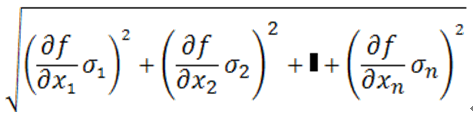
■ in the root means that ( )2 is included in x3 and below as well. -
Somehow, I don't quite understand it.You can understand this by looking at a concrete example.
Example 1) Find the propagation of the error (σ) when adding two numbers using formal rules.
The number x1 has an error of ±σ1.
The number x2 has an error of ±σ2.
What is the error when adding the numbers x1 and x2?
In other words, we want to find the error "±σ" of the numerical value (x1 + x2) when calculating the following formula.
(x1 ± σ1) + (x2 ± σ2) = (x1 + x2 )± σ
As f = x1 + x2,Formal rule: Substitute σ =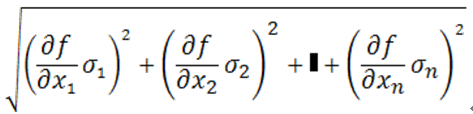 . Use only for n=1 and n=2.σ = ±
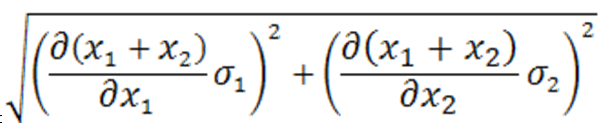 = ±
= ± 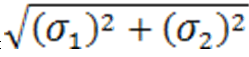 The same goes for subtraction.
 -
Example 2) Subtract the numbers x1 and x2 that have an error.
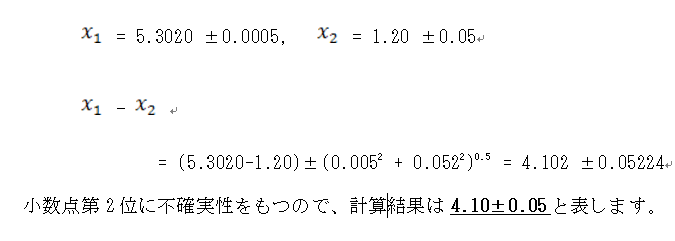
小数点第2位に不確実性を持つので、計算結果は4.10±0.05と表します。Since there is uncertainty in the second decimal place, the calculation result is expressed as 4.10±0.05.
Example 3) Multiply the two numbers x1 and x2 with errors.
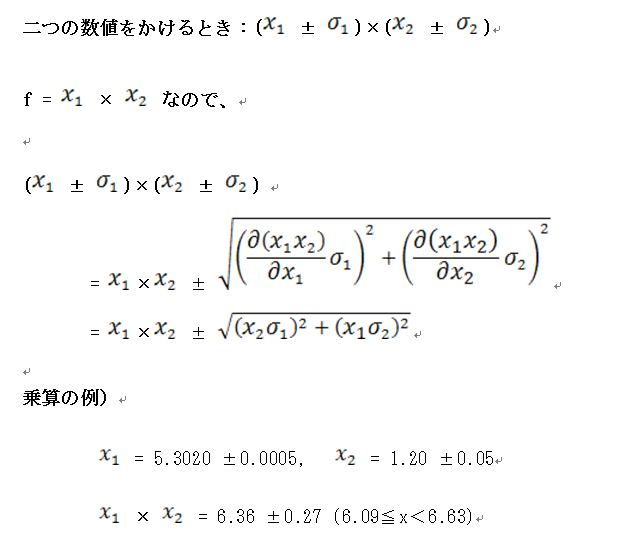
二つの数値をかけるときwhen multiplying two numbers なのでso 乗算の例Multiplication example
(Please calculate and confirm the route by yourself)
Find the maximum value (x1 + σ1, x2 + σ2) and minimum value (x1 - σ1, x2 - σ2) of two numbers with errors, x1 and x2.
If you multiply the minimum values together, the calculation result will be the minimum. Multiplying the maximum values will yield the maximum result. The minimum and maximum values are the calculation results including errors.
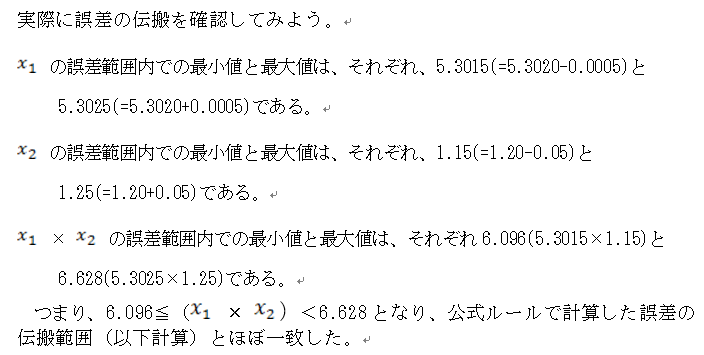
実際に誤差の伝搬を確認してみよう。Let's actually check the error propagation.
XXの誤差範囲内での最小値と最大値は、それぞれYYとZZである。The minimum and maximum values within the error range of XX are YY and ZZ, respectively.
つまりCCとなり、公式ルールで計算した誤差の伝搬範囲(以下計算)とほぼ一致した。In other words, it was CC, which almost matched the error propagation range (calculated below) calculated using the official rules.
-
Example 4) Please divide numbers that include errors.
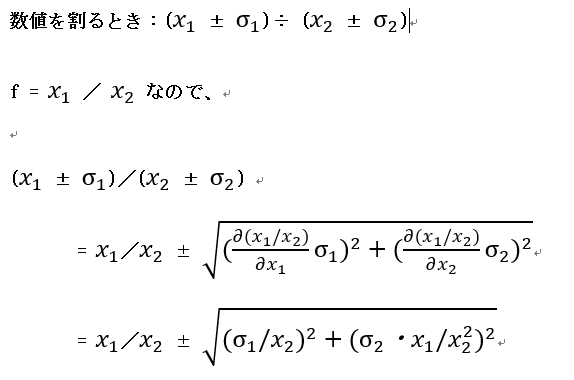
数値を割るときwhen dividing numbers
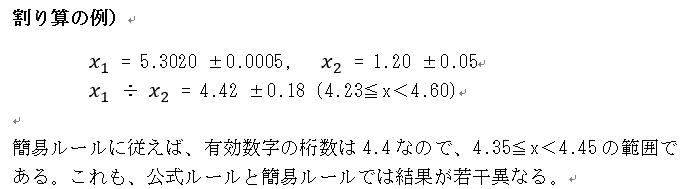
割り算の例)Division example
簡易ルールに従えば、有効数字の桁数は4.4なので、4.35≦x<4.45の範囲である。これも、公式ルールと簡易ルールでは結果が若干異なる。According to the simple rule, the number of significant figures is 4.4, so the range is 4.35≦x<4.45. Again, the results are slightly different between the official rules and the simple rules.
-