

Calculate the amount of entropy change
Section outline
-
-
Using the entropy change equation above, let's actually calculate the amount of entropy change.
First, for one mole of ideal gas, the entropy change when the temperature is kept constant (Ln(T1/T0) = 0) and the volume is increased tenfold is ⊿S = R・Ln(10) = 19.3 (J/K). When the volume is restored, ⊿S = -19.3 (J/K) as well.
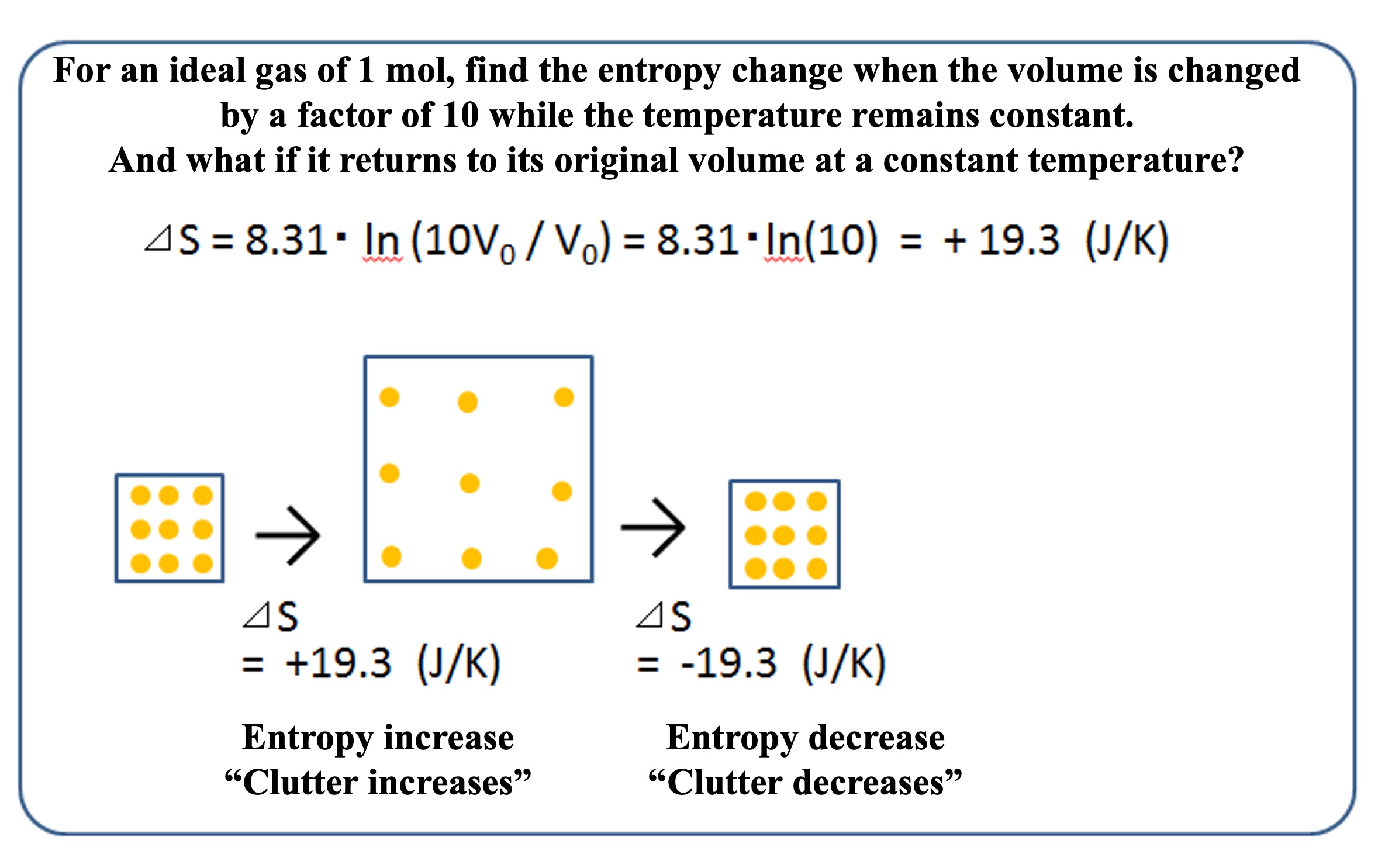
Earlier, I mentioned that entropy always increases, and this is only true for adiabatic systems. It is possible to decrease the entropy of a substance, and in doing so, heat must be transferred to the outside world.
Examples of calculations of entropy change are still to come.
-
Example of calculation of entropy change
Gas A (1 mol) is in a 1 m3 container. Adjacent to it, gas B (1 mol) is in a 1 m3 container (see picture below). Calculate the entropy change when the partition between containers AB is removed and gases A and B are mixed.
For gas A, the volume in existence has increased from 1 to 2 m3, and for gas B, the volume has increased from 1 to 2 m3. The entropy changes (SA, SB) for gas A and gas B, respectively, are then,
The entropy change of the entire system is,SA = 1・8.31・Ln(2/1) = 5.76
SB = 1・8.31・Ln(2/1) = 5.76.
SA + SB = 11.52 (J/K).
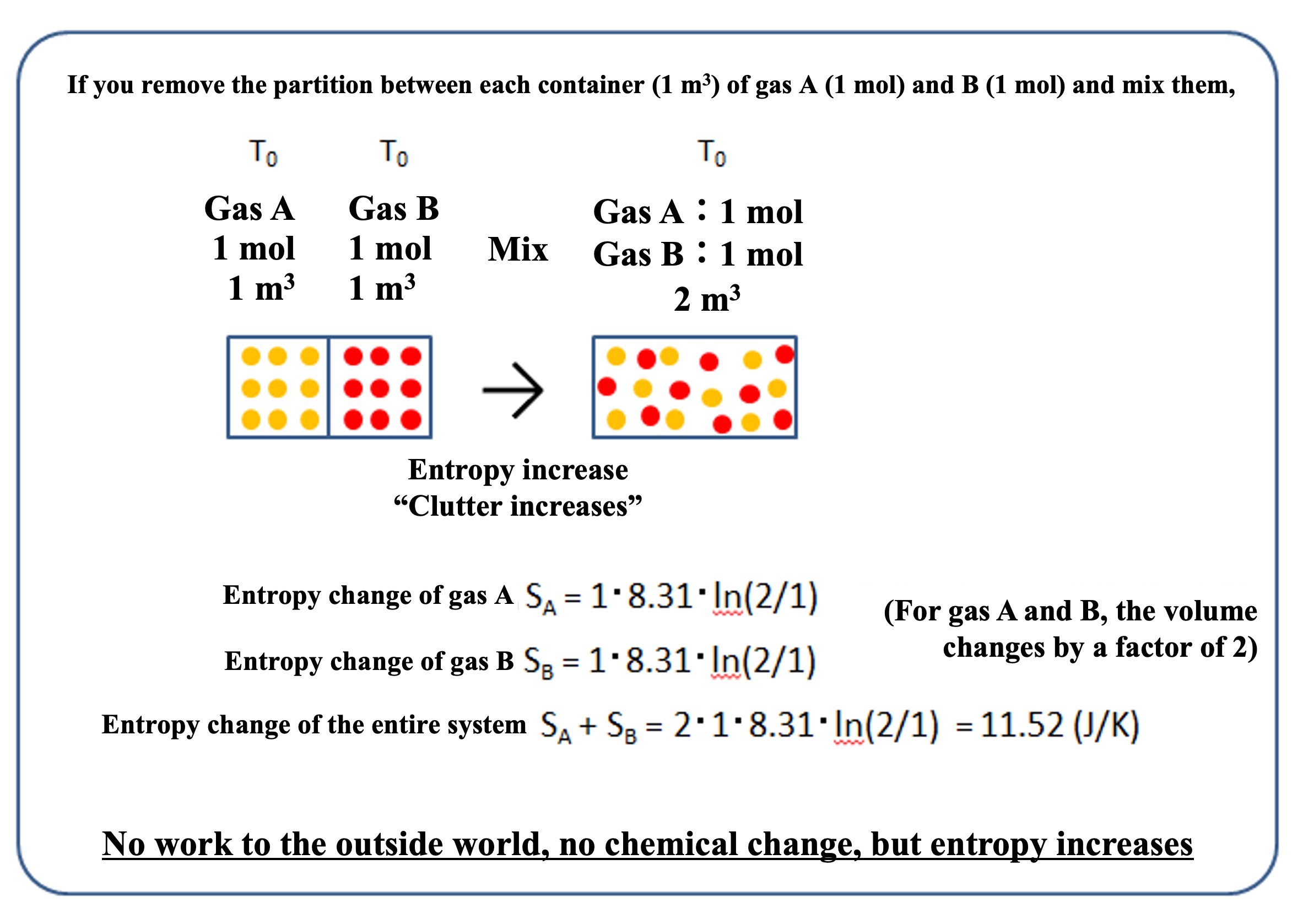
We simply removed the partitions between the spaces in contact and mixed the respective gases.
No work was done on the outside world, no chemical changes occurred, but entropy increased.
-