

Electrochemistry (Introduction)
Perfilado de sección
-
-
A redox reaction is a chemical reaction that involves the transfer of electrons between substances. When living things respire, the transfer of energy obtained by decomposing organic matter always involves the movement of electrons. Redox reactions are important when considering biological metabolism, so we will learn the basics of them.
By the way, when electrons move, there is always a potential difference between the source and the destination. Even when electrons move between substances in a redox reaction, a potential difference is created between the substances. This redox potential determines the chemical form of a substance (oxidation ⇆ reduction). The amount of reaction can also be determined from the amount of electron movement (current). By precisely measuring the changes in current and voltage that accompany reactions, it is possible to follow chemical changes moment by moment. In this way, there are many good things that can be achieved by linking electricity and chemistry, which is why the academic field of "electrochemistry" was born.
I drew the flow of electrons during sulfuric acid respiration (figure below). Each half-reaction has a unique standard electrode potential, so measuring the potential of the reaction system can help identify the reactants. By measuring the amount of electron movement (current), the amount of reaction can be determined. In this way, the amount of substances involved in the redox reaction can be determined by measuring the potential of the reaction system (adjusting the potential) or measuring the current (voltammetry method).
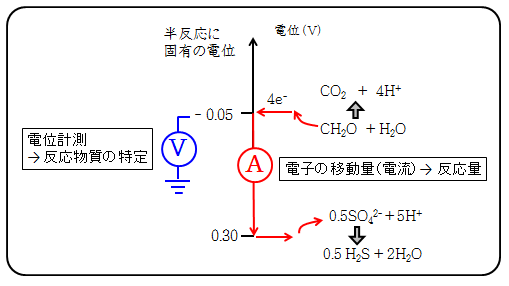
半反応に固有の電位Potential specific to half-reaction 電位potential 電位計測Potential measurement 反応物質の特定Identification of reactants 電子の移動量Amount of electron movement 電流current 反応量reaction amount
-