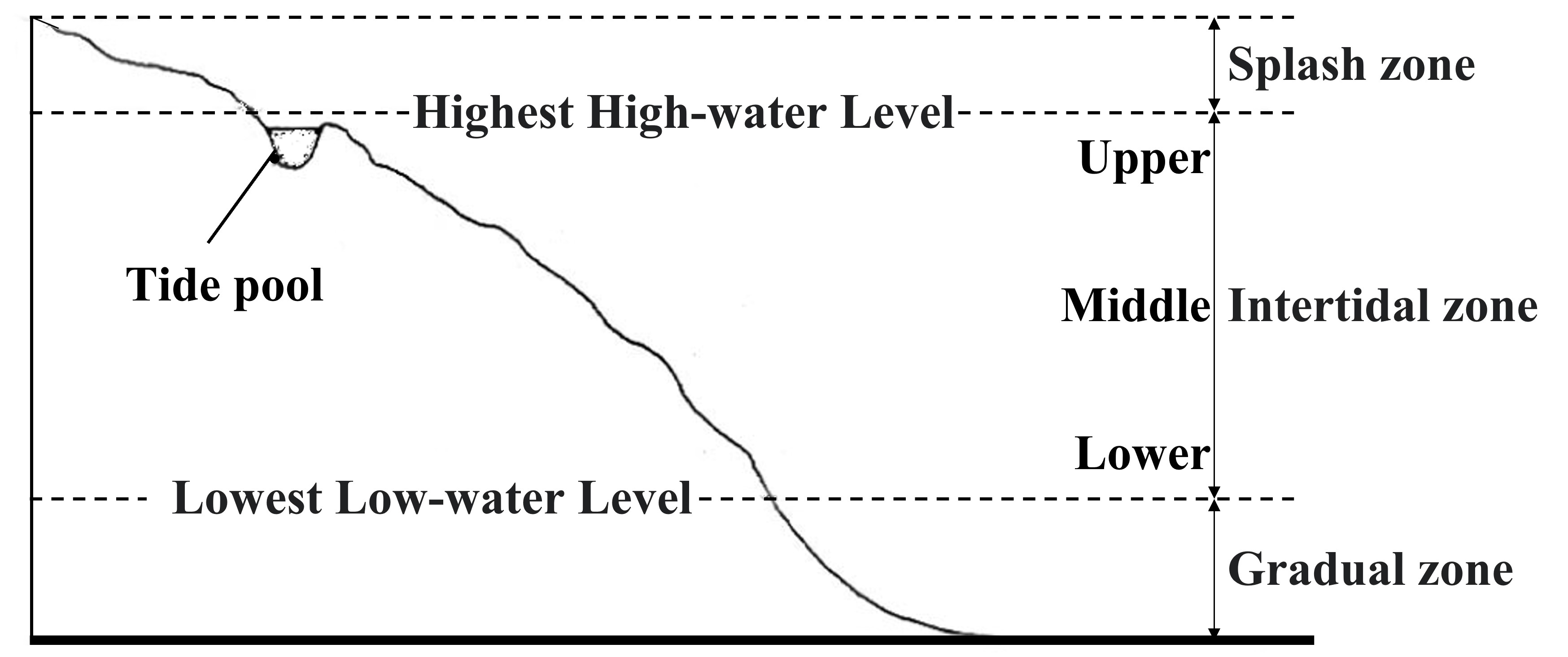
The part of the beach sandwiched between the high tide line and the low tide line (strictly speaking, the high tide line and the low tide line) is called the intertidal zone.
This narrow band of no more than 2m wide (the number on the Pacific coast, this width varies depending on the region) is home to a surprisingly wide variety of organisms, most clearly recognizable in the rocky intertidal zone. The first feature of the intertidal zone is that it is submerged in the sea and exposed to the air due to the ebb and flow of the tides that occur twice a day, so it can be said that the organisms that inhabit it are forced to live both in water and on land. It is readily apparent that the higher up in the intertidal zone, the longer the exposure to air, the longer the biozone is exposed to dry conditions. Conversely, the lower you go, the longer you are submerged in the seawater, and the more moist the organisms will be.
In this way, the intertidal zone has a remarkable gradient of environmental conditions from the upper part of the intertidal zone to the lower part of the intertidal zone. Each organism occupies a niche in the most favorable environmental conditions of the intertidal zone (of course, organism interactions also influence). As a result, they are distributed in a band shape with a narrow width (band-like distribution). A zonal distribution is seen in both seaweed and animals, with dry-tolerant species occupying the upper part of the intertidal zone, and plants and animals that prefer moist conditions are distributed in the lower part of the intertidal zone. In addition, it is considered that this zonal distribution structure is also affected by erosion pressure and wave strength.