Section outline

    •  Associate Professor YAMAGUCHI Atsushi of the Graduate School of Fisheries Sciences, Hokkaido University, and his research group at Woods Hole Oceanographic Institution and the University of Rhode Island analyzed time series of plankton net samples collected at fixed stations on ice in the Arctic Ocean during 1997 and 1998, and established an identification method to distinguish the early developmental stages of five species of particle-eating zooplankton, Aetideid copepods, and clarified their life history. 

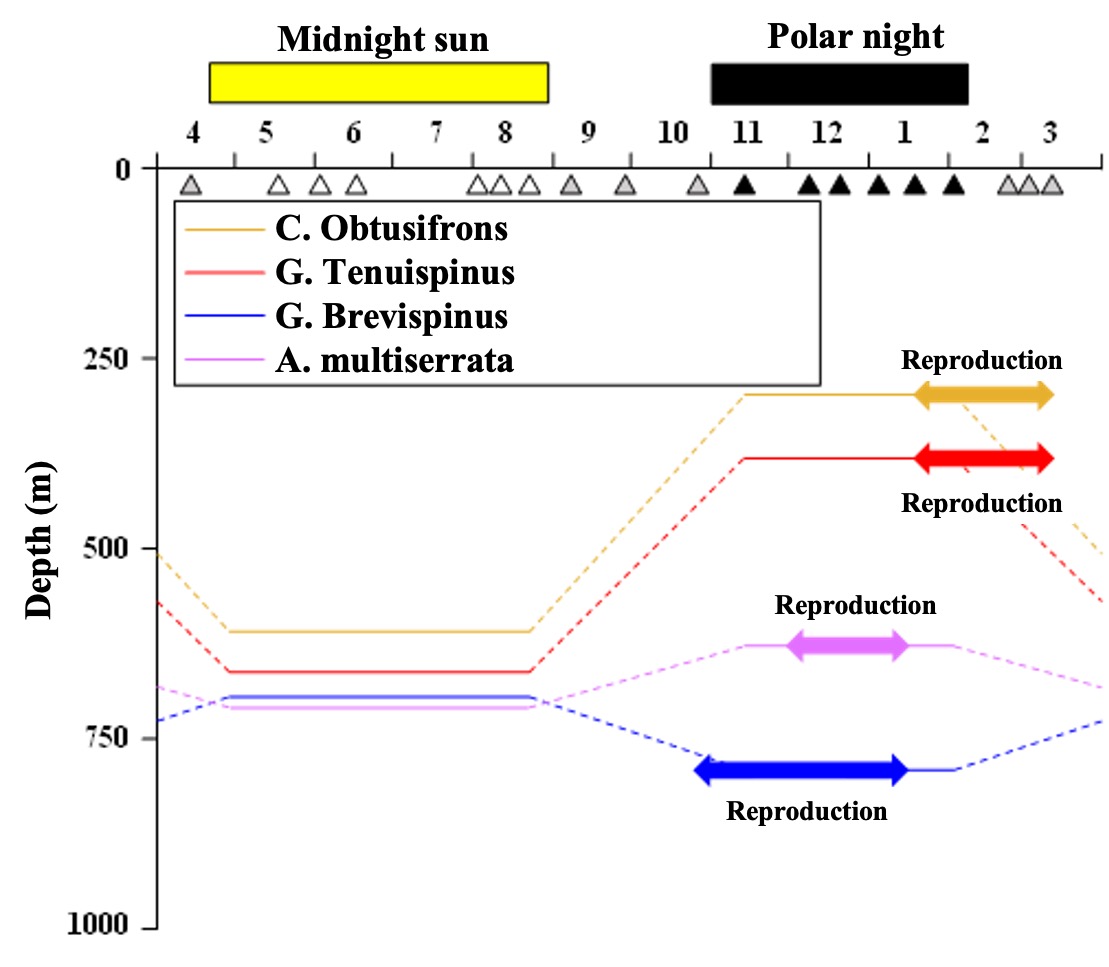
       The Arctic Ocean is frozen over in winter, making it difficult to collect zooplankton samples throughout the year, and knowledge of zooplankton life histories is scarce. In this study, using samples from the SHEBA, the most successful ice station time-series plankton collection in history, we analyzed five species of Aetideid copepods that occur at depths deeper than 200 m, which had not been analyzed previously. The results showed that the five particle-feeding species of the family were all distributed at the same depth during the midnight sun when food was abundant, whereas during the polar night when food was scarce, they reproduced while mitigating competition for food by changing the depth of distribution for each species.

       The results of this study are expected to be important knowledge for future polar biological oceanography, as it shows that biological production is active even at polar nights when there is no sunlight, and it establishes a method for species identification of five species belonging to the same family of copepods that dominate the deep-sea zooplankton fauna in the Arctic Ocean and clarifies their life history.

       The results of this research were published online in Frontiers in Marine Science on Friday, August 19, 2022.

    • Fig. 1

       Distribution depths and timing of reproduction during midnight sun and polar night of four Aetideid copepods as assessed by time-series sampling at fixed stations on ice in the Arctic Ocean.

       The solid lines indicate the distribution depths during the midnight sun and polar night, and the dotted lines indicate the distribution depth shifts during the conversion periods between the two periods. Arrows in both directions indicate the time of reproduction for each species, as inferred from population structure. The upper triangle indicates the date of sampling. Of the five Aetideid copepods for which species identification was possible, the species with the deepest depth of distribution (A. rostrata) is not included in the figure because the population density was too low to determine the time of reproduction.