

Summary
單元大綱
-
A research group led by Associate Professor Atsushi Yamaguchi and Assistant Professor Kohei Matsuno of the Faculty of Fisheries Sciences, Hokkaido University has developed a new method for analyzing the quantity and size of zooplankton faecal pellets in the field using zooplankton samples collected in the southern Sea of Okhotsk during the summer season by stratified sampling at depths between 0 and 1000 m. The samples were collected by day and night, and a large number of zooplankton faecal pellets were found in the samples.
Material cycles in the oceans influence global environmental change. In addition to physical diffusion, sedimentation and transport by faecal pellets excreted by zooplankton are known to play a major role in driving the material cycle in the oceans. Until now, the quantitative evaluation of zooplankton faecal pallets have been conducted using a sediment trap, which is moored at a given depth in the ocean for a certain period of time and collects sedimentation particles from the upper layer of the ocean. However, the collection by sediment traps requires a mooring period of at least 2 to 3 days, and it has remained unclear whether there are day-night differences in the amount and size of zooplankton faecal pallets in the field. The research group conducted stratified sampling with a fine-mesh (63 µm) plankton net and analyzed the collected samples using an imaging scanner to successfully evaluate the amount and size of zooplankton faecal pallets in the field.
The results of this study provide important knowledge in oceanography as a method that leads to accurate quantitative evaluation of zooplankton faecal pallets, which are the driving force of material cycles in the ocean.
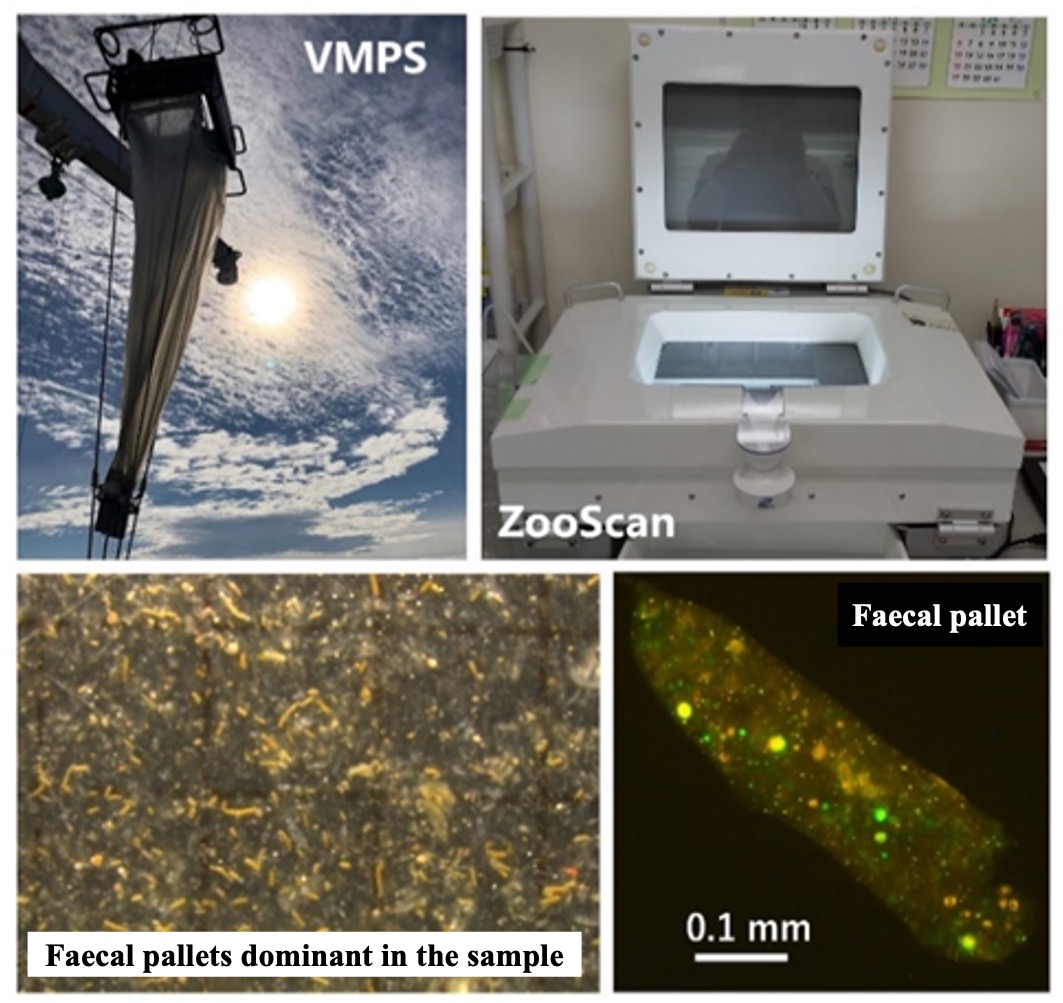
upper left: Vertical Multiple Plankton Sampler (VMPS). Fine mesh (63 µm) allows for layer-by-layer sampling.
lower left: Zooplankton faecal pallets that appeared in large numbers and were dominant in the sample.
upper right: Imaging scanner for zooplankton (ZooScan). Capable of quantifying the exact size and number of faecal pallets.
lower right: Fluorescence micrograph of zooplankton faecal pallets. Phytoplankton cells with fluorescent ability in faecal pallets appear like stars.