
Research results
單元大綱
-
Two carnivorous copepods were dominant in the samples: one was the large-sized Paraeuchaeta glacialis and the other was the small-sized Heterorhabdus norvegicus. Both species are carnivorous, but their feeding and reproductive patterns are known to be very different. Paraeuchaeta glacialis is an ambush feeder, holding relatively large eggs until they hatch. Heterorhabdus norvegicus, on the other hand, has a poisonous needle for feeding that allows it to feed on zooplankton that are large relative to its body size, but its eggs are very small and it lays many small eggs in the water without incubating them. The reproduction of both species was found to occur during the polar night in the Arctic Ocean, when there is no sunlight. The growth rate of Heterorhabdus norvegicus, which uses a poisonous needle for feeding and lays a lot of small eggs, is rapid, whereas that of Paraeuchaeta glacialis, which uses an ambush feeding pattern and holds relatively large eggs until they hatch, is slow (Figure 3).
The life histories of two carnivorous copepods, which are important as a zooplankton link between vegetivorous zooplankton and fish, were clarified using SHEBA samples.
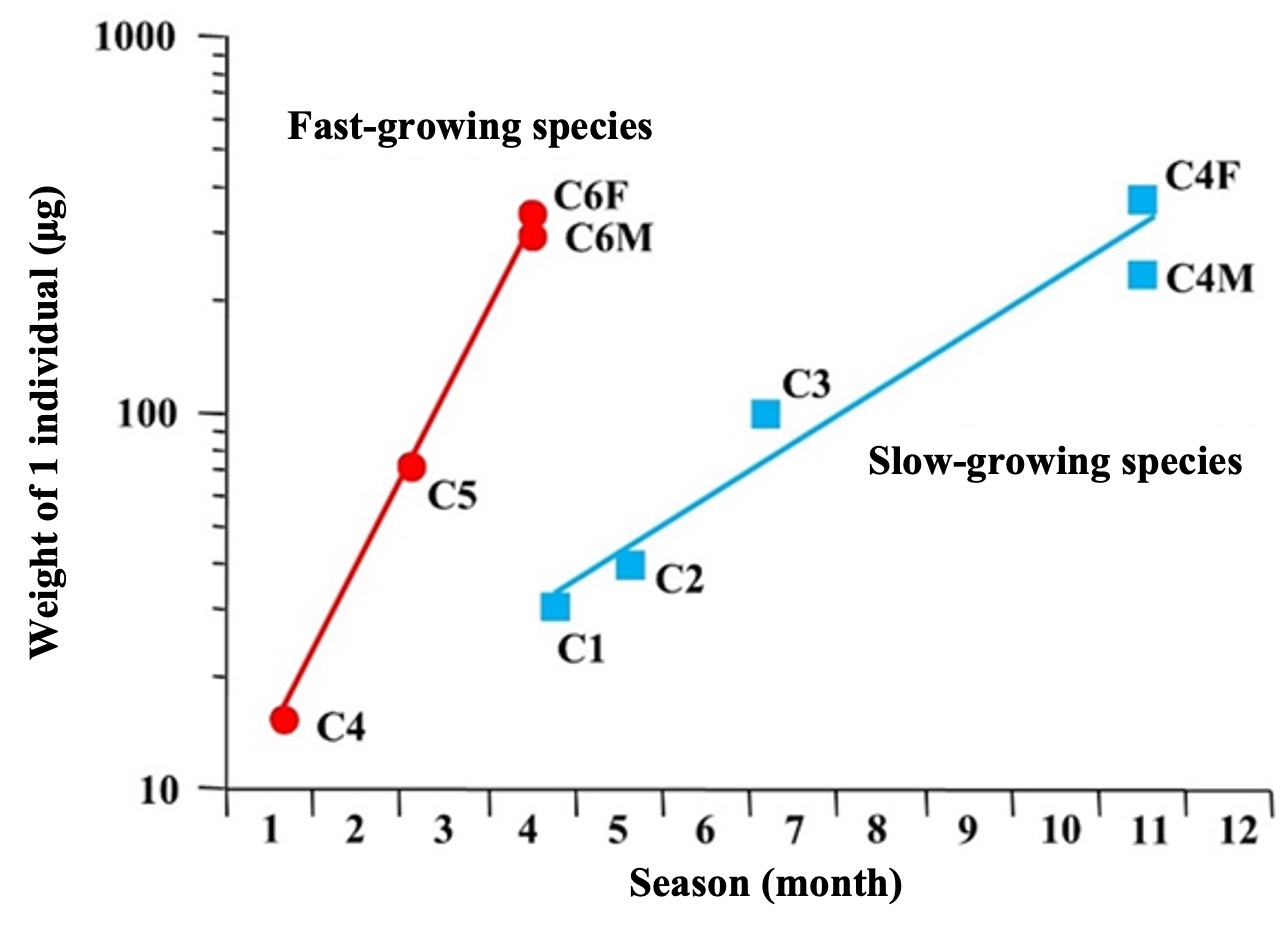
Fig. 3. Two carnivorous copepod species exist: a fast-growing species (red: Heterorhabdus norvegicus) and a slow-growing species (blue: Paraeuchaeta glacialis).