

Summary
セクションアウトライン
-
Associate Professor YAMAGUCHI Atsushi of the Graduate School of Fisheries Sciences, Hokkaido University, and his research group from Woods Hole Oceanographic Institution and the University of Rhode Island in the United States analyzed zooplankton samples collected over a one-year period from 1997 to 1998 at fixed points on ice in the Arctic Ocean to clarify the life history of two carnivorous species of zooplankton that are dominant in the Arctic Ocean zooplankton fauna.
Since the Arctic Ocean is frozen over during the winter, it is difficult to collect plankton samples throughout the year, and samples collected throughout the year are extremely rare, and knowledge of zooplankton life histories has been scarce. The time series of plankton samples collected from 1997 to 1998 from an icebreaker in Canada as a stationary base on the ice are known as SHEBA samples. The research group analyzed the SHEBA samples to clarify the life histories of two carnivorous copepod species that are dominant in zooplankton. In the Arctic marine ecosystem, carnivorous copepods not only feed on fish, which are higher-order predators, but also play an important role in influencing the material cycle in the lower marine ecosystem by preying on early-stage individuals of larger, particle-eating copepods.
The results of this research will provide important information on past marine lower-order ecosystems for assessing future changes in the Arctic Ocean marine ecosystem expected to occur due to climate change. The results of this research were published in the Journal of Plankton Research on Saturday, April 23, 2022.
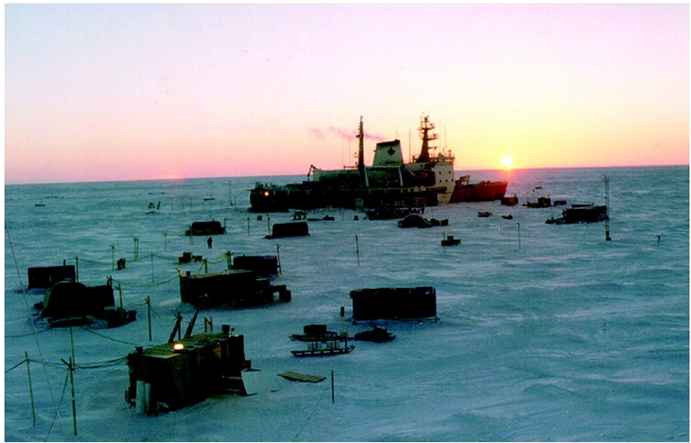
Ice fixed station established in the Arctic Ocean from October 1997 to October 1998. The Canadian icebreaker that served as the base for observations and sampling (photo by Dr. Donald K. Perovich)