
Conclusion
Section outline
-
-
The cycle of organic iodine gas in seawater and sediments is summarized in Figure 5. (1) Phytoplankton absorbs iodide ions (I-) from seawater and then (2) settles to the sediment surface. (3) Iodic acid ions (IO3-), which are abundant in seawater, are reduced to I- at some depth in the sediment. (4) Diatom aggregates on the sediment surface produce ethyl iodide (C2H5I) and methyl iodide (CH3I) from I- in their bodies. (5) Diatom aggregates can also use the I- produced in the sediment to make these organic iodine gases. (6) I- in the sediment seeps into the water directly above. (7) C2H5I and CH3I that seep into bottom water are decomposed by microorganisms relatively quickly and their concentration is thought to decrease.
Translated with DeepL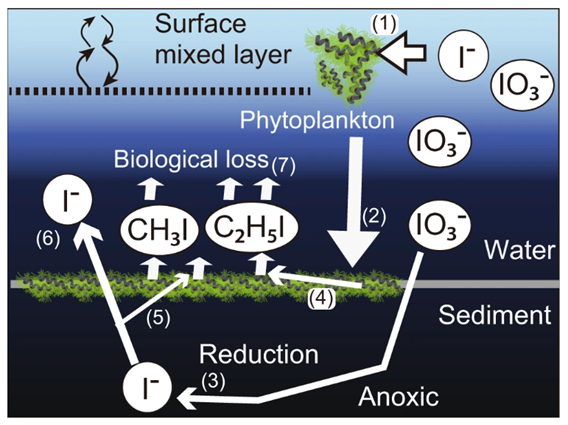
-