

Impact of mesoscale eddies on interannual variations in organic carbon fluxes
섹션 개요
-
-
We investigated how phytoplankton blooms, the main cause of the organic carbon flux maxima, occurred. Based on the distribution of oceanic mesoscale eddies and sea surface chlorophyll concentrations captured by satellite observations, we found that a total of 9 out of 12 organic carbon flux maxima were affected by horizontal transport by mesoscale eddies (Figures 2 and 3). As introduced in "Oceanic Mesoscale Eddies: Oceanic Highs and Low Pressures”, it is indicated that mesoscale eddies enhanced biological production in the open ocean by transporting nutrients and phytoplankton from the coastal regions to the open ocean through horizontal transport. It is also suggested that a large amount of organic carbon was transported to the deep layer as a result. These results indicate that the mesoscale eddies had a significant influence on the interannual variation of organic carbon fluxes in K2.
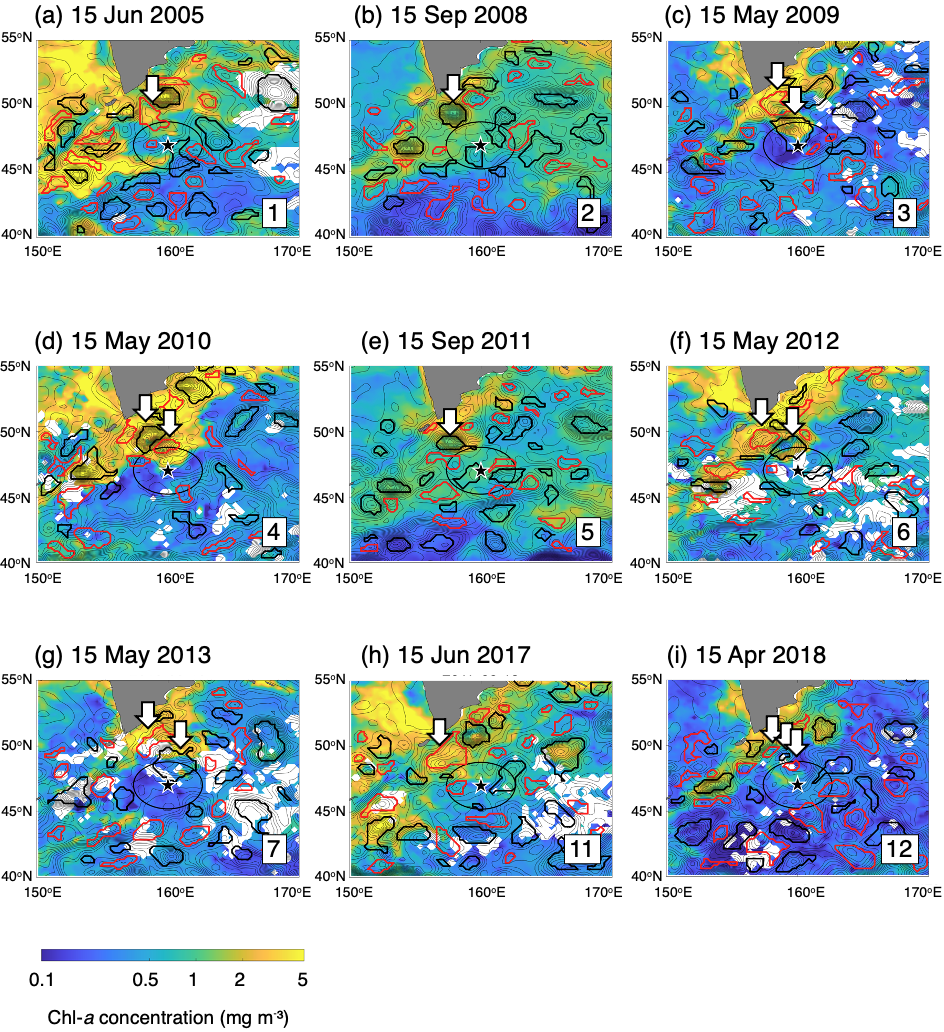
Figure 3. Images of the monthly Chl-a concentration (colors, units: mg m−3) and absolute dynamic topography (thin black contours, interval: 5 cm). White areas indicate the absence of chlorophyll measurements due to cloud cover. Thick black (red) lines indicate the peripheries of anticyclonic (cyclonic) eddies. White arrows indicate the eddies that were considered to affect the Chl-a concentration around K2 in this study. Star indicates the location of K2. Numbers in the lower right of each figure correspond to the organic carbon flux maxima in Figure 2.
-