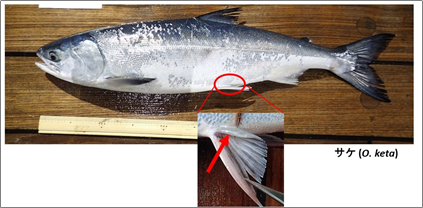
Salmons have a lobe-like structure called
an axillary process near the ventral fin. Although their existence has been
known for some time, the function of axillary processes remains unclear.
Previous studies have reported that the axillary process elongates during
smoltification (adaptation to seawater) associated with oceanic descent and
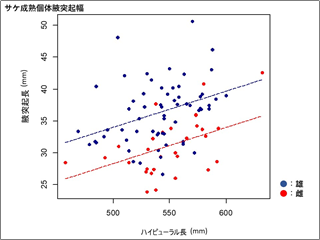
that males are slightly wider than females in mature individuals, suggesting
that it may be involved in swimming in the ocean or be a secondary sexual characteristic.
Therefore, our research group is analyzing the effects of excision of axillary
processes on swimming using a device called a gyration tank, and at the same
time, we are investigating their involvement in swimming and secondary sexual
characteristics by detecting male hormone receptors through tissue staining and
genetic analysis.
As described above, various things have
been learned through detailed examination of the “shapes” of the various
secondary sexual characteristics. It is hoped that the biological significance
of each structure will be further clarified.