Section outline

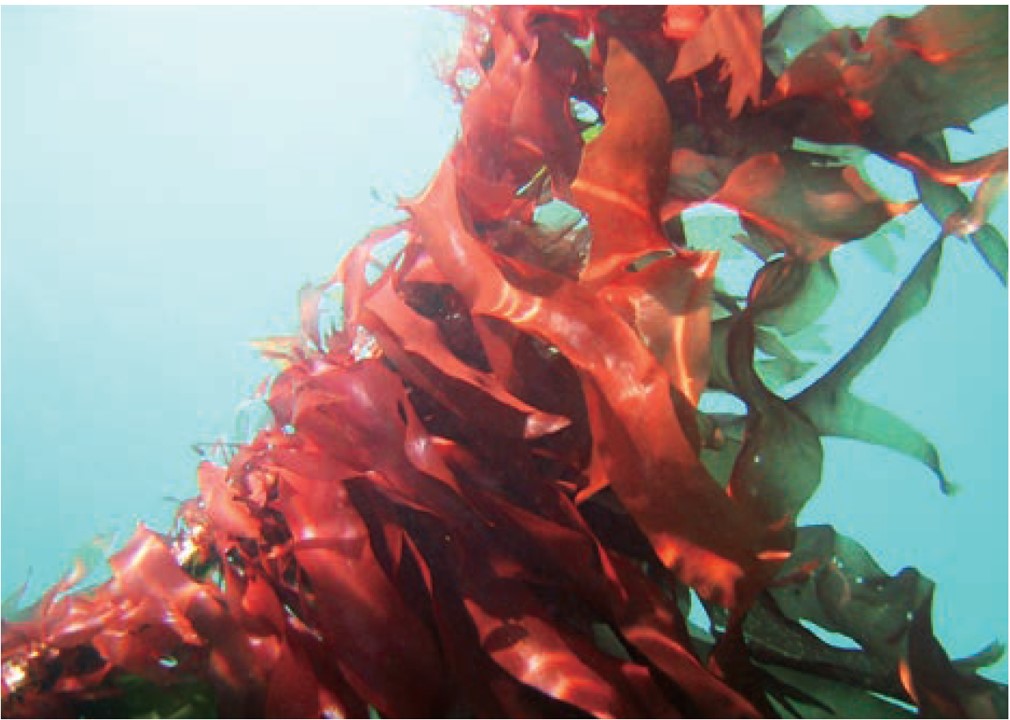
    • The body of a typical seaweed is less differentiated than that of a land plant and is composed of three parts: the holdfast, which is specialized for the function of attachment; the thallus blade, which provides nutrients and energy; and the stipe, which connects the two parts. The dulse we see has a reddish to purplish-brown body and uses a small discoidal holdfast to anchor its body to the substrate, a rock or a rope (Fig. 1). The short (<5 mm) stipe connects the blade and holdfast, and a flattened, membranous, blade 0.3~0.5 mm thick is formed at the top of the stipe. The blade elongates in a palmate or forked shape, and some older blades have new leaves extending from the margins, while others have branchlets from the margins. The mature thalli are about 50 cm long, but can grow to over 1 meter. It is perennial, showing new growth each year, but its maximum life span is unknown.

    • 図l. 2月函館近郊のコンブ養殖ロープ上に繁茂するダルス(水深1m) 写真:安井肇(昭55ゾ)提供


      Fig. 1 Dulse thriving on a kelp cultivating rope near Hakodate in February (depth: 1 m). Photo: courtesy of YASUI Hajime (Sho 55 Zo)


    • This species belongs to the genus Palmaria, the family Palmariaceae, the order Palmariales, the class Florideophyceae, and is called “Darusu” in Japanese, and its scientific name is Palmaria palmata (Linnaeus) Kuntze (see Note 1). It is named after the Latin word “Palma”, which means human palm. In other countries, it is often referred to as “Dulse”, but in Ireland and the UK it is called “Dillisk”. In Norway, it is called “sousoll”, meaning sheep's food, because sheep like to eat dulse by the sea at low tide. Like these, there are various names for it depending on the regions.

      Dulse is a cold-water species of the North Atlantic and North Pacific, although some researchers argue that further study is needed to determine whether it is identical to the Pacific and Japanese species (see Note). In the North Atlantic, it is distributed from Spitsbergen Island and Greenland at 80°N to Portugal and New Jersey at 40°N, and is common on many reefs in Ireland and the British Isles. In the Pacific Ocean, it is known to occur from Alaska to the Pacific coast of Northern California and along the coasts of east Russia, the Kuril Islands, Hokkaido, and Tohoku.

      Typically, dulse can be found in the lower intertidal zone and tide pools, where it grows to depths of up to 20 meters. Dulse in European waters can also be observed as a red alga often attached to the stipe of Laminaria hyperborea and Laminaria digitata, a species of brown algae in the genus Laminaria. Dulse production in Ireland is at most around 100 tons per year (wet weight), but due to growing demand, aquaculture projects are underway in the open sea of Northern Ireland. In France, mass cultivation in tanks is also being conducted on a trial basis.


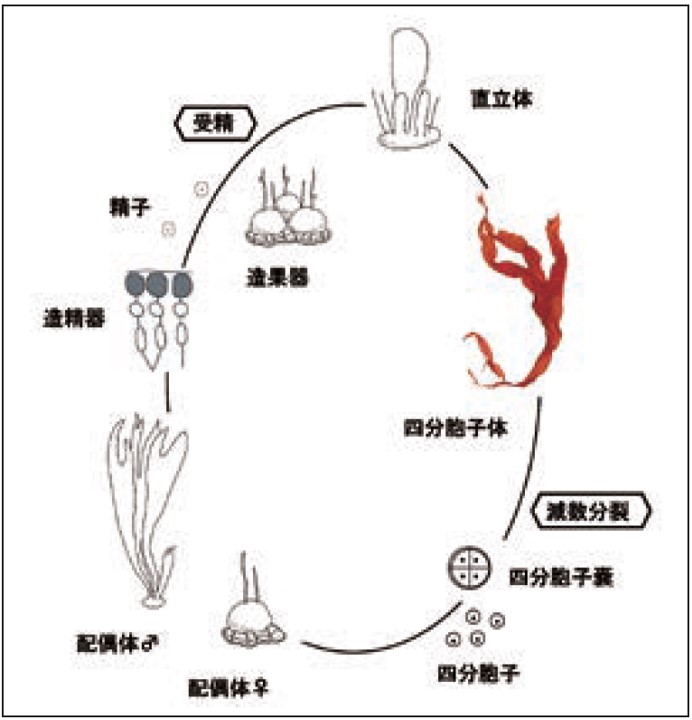
    • The life history of most seaweeds consists of a sexual monophasic generation with one set of chromosomes (gametophyte) and an asexual biphasic generation with two sets of chromosomes (sporophyte) produced by fertilization, where the tetraspores (meiospores) are produced by the meiotic reduction of chromosomes in the sporophyte. The life history of dulse (Fig. 2) was described by J.P. van der Meer and E.R. Todd in 1980.


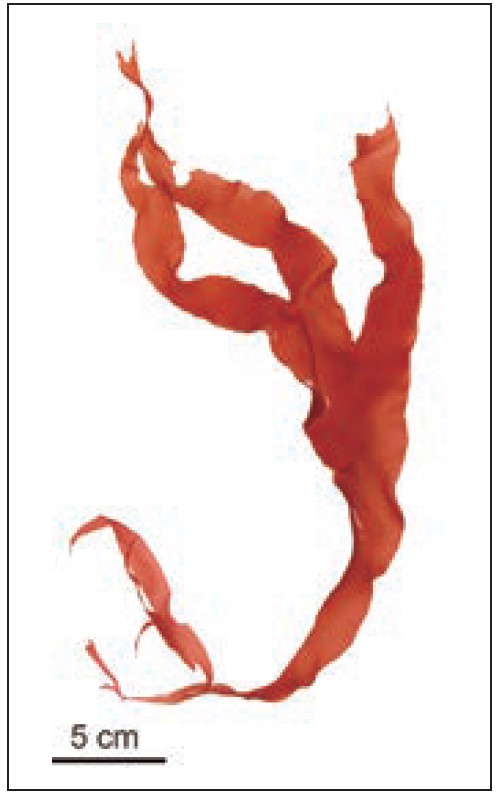
    • 図2. ダルスの生活史 図:安井肇(昭55ゾ)提供                                                                                     図3.ダルス葉状体 写真:安井肇(昭55ゾ)提供  

      Fig. 2 Life history of dulse. Figure: courtesy of YASUI Hajime (Sho 55 Zo)

                                                                                                                                         Fig. 3 Dulse thallus. Photo: courtesy of YASUI Hajime (Sho 55 Zo)


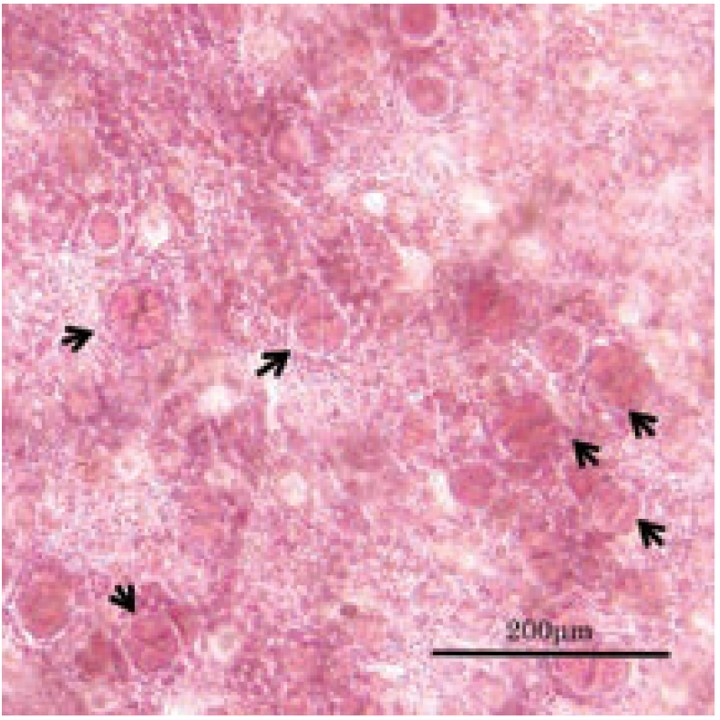
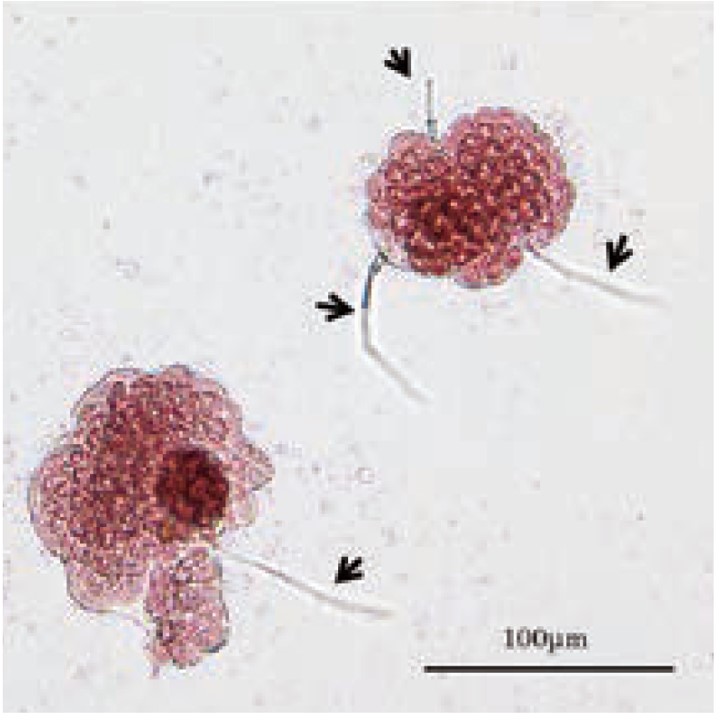
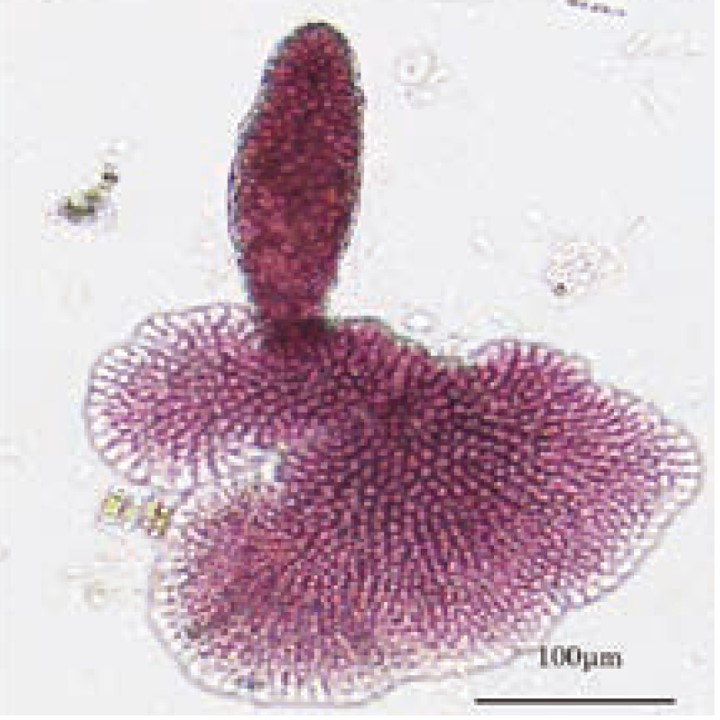
    • The dulse, which is a target for fisheries resources, is a tetrasporophyte (sporophyte) and male gametophyte, which exhibit a thallus morphology (Figs. 1 and 3). These thalli appear on rocks in the lower intertidal zone around December near Hakodate, and thrive from January to May. Many individuals disappear in June. When the tetrasporophytes mature, they form tetrasporangia, which are reproductive organs within the epidermal tissue (Fig. 4), and four spores (tetraspores) are formed through meiosis and released. The released tetraspores begin to divide immediately after settlement, forming a discoid germling that grows in a 1:1 ratio on the female and male gametophytes (Figs. 5 and 6 ). The female germling does not become an erect thallus like the tetrasporophytes and male gametophyte, but remains a discoid 100-200 µm in diameter, and at maturity, the cells in various parts of the discoid become carpogonium with extended fertilizing hairs.
      On the other hand, erect blades are formed from the male discoid, which becomes the macroscopic male gametophyte. When the male gametophyte matures, spermatangium are formed on the surface of the body and immobile sperm are formed and released. The released sperm adhere to and fuse with the fertilizing hairs, and the sperm nucleus passes through the fertilizing hairs into the carpogonium. Fertilization is then completed by nuclear fusion, resulting in the formation of numerous tetrasporophytes on the female gametophyte. The life history of the dulse comes full circle in this way, and it remains in a microscopic state for about half a year, and when the environment is suitable for the formation of an erect body, it grows into a thallus at once and is visible to us

    • 図4. 四分胞子体に形成された四分胞子嚢(矢印)


      Fig. 4 Tetrasporangia formed in a tetrasporophyte (indicated by arrows)


    • 図5 .雌性配偶体(匍匐盤状体)と受精毛(矢印)


      Fig. 5 Female gametophyte (creeping scutellum) and trichogynes (indicated by arrows)


    • 図6 .雄性配偶体(直立体)を形成した匍匐盤状体


      Fig. 6 Discoidal germling forming a male gametophyte (erect frond)