

Toward industrial applications
單元大綱
-
-
Our efforts to date have revealed that dulse has characteristics that are not easily found in other foodstuffs. However, unless their taste and texture are widely accepted by consumers, it is difficult to use them as food products. Therefore, in February 2014, dulse harvested in the Minami-Kayabe area of Hakodate were boiled and salted processed, and they were sold on a trial basis to gather comments from general consumers. As a result, the dulse was highly praised for its laver-like aroma and crispy texture not found in other seaweeds. We believe these comments are significant in accelerating the industrial use of dulse.
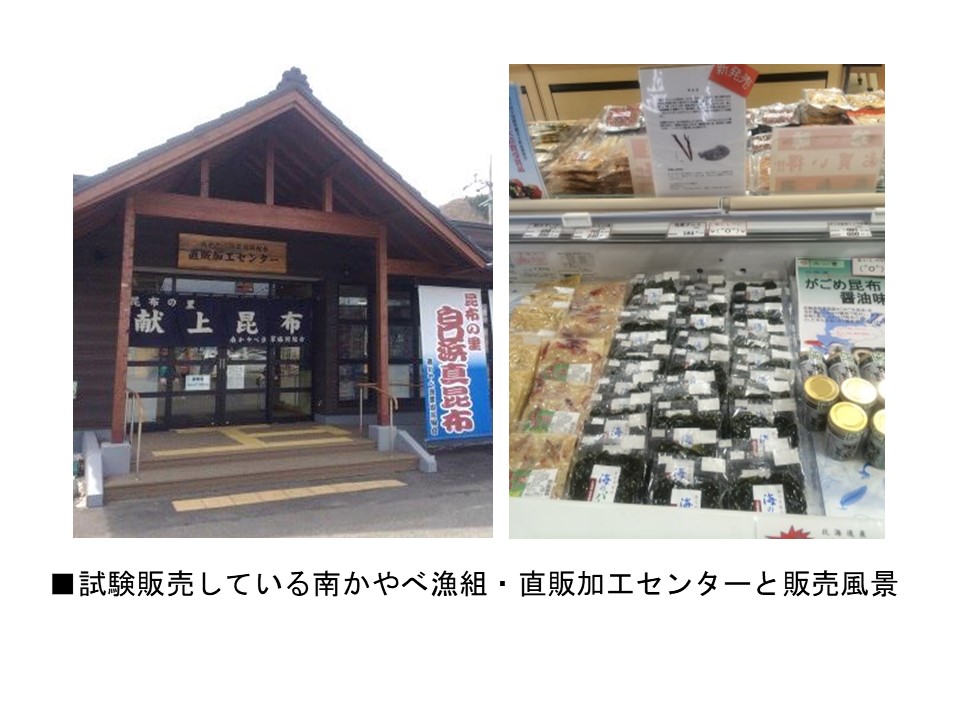
figure: Minami-Kayabe Fisheries Cooperative direct sales and processing center, where test sales are being conducted, and a view of the sales scene
In recent years, sales of retort pouch foods and chilled foods are said to be growing steadily as consumers become increasingly convenience conscious.
Retort heating is an excellent sterilization technology that enables long-term storage and distribution at room temperature, even for foods with high moisture content. However, the Food Sanitation Act requires that retort pouch foods produced by this method undergo a severe heat treatment with a central temperature of 120°C for 4 minutes or more. Chilled foods, which are often found in prepared foods, are often packaged and then subjected to secondary sterilization at 100°C or lower for several minutes to several dozen minutes to ensure a certain level of shelf life. Because of the constant heat treatment applied to all of these products, it is said to be difficult to maintain their vivid colors. In particular, it is said that retaining the green color in retort pouch foods is considered to be an eternal challenge.
The results of this study confirmed that the color tone (green color) of dulse, which has been turned green by boiling and other heat treatments, is sufficiently resistant to retort heating. We therefore believe that dulse is a very interesting material that offers new business opportunities for the food industry, which is seeking to create high value-added products that focus on color tones. We would like to develop meaningful applications for industrial use in the future with suggestions from people in related industries.
-