

Investigating new ways to use the Japanese experience
섹션 개요
-
-
Dulse is a type of cold-sea seaweed classified in the same red algae family as laver, and has a reddish-purple color immediately after harvesting. It is said to be widely distributed along the Atlantic coast of North America and in northern Europe. In Ireland and Canada, dulse has long been eaten fresh as a salad, and its dried form has been used as a seasoning. Thus far, the use of dulse has been limited to fresh or dried products. Perhaps for this reason, academic research seems to be almost entirely limited to nutritional findings on the raw algae or on their drying characteristics. On the other hand, Japan has a technology for boiling and salting seaweeds, which is rare in the world, and we have excellent knowledge and much experience. Therefore, as a new direction for the development of new applications, we have attempted to explore the characteristics of the material and its suitability for use from a new, uniquely Japanese perspective.
As mentioned above, dulse has a reddish-purple color when raw, but it is not known what tint it develops when boiled. We first observed the color change of dulse when it was heated in boiling seawater. We found that dulse changed from the reddish-purple color of the raw algae to a greenish-green color. However, there are many green-colored seaweeds such as sea mustard and kelp, and vegetables such as chives and leeks, which are commonly used in our daily lives. Therefore, we further investigated to obtain a characteristic that is unique to dulse. As a result, we found that the green color of dulse, which is produced by boiling and heating, has a characteristic of being heat-resistant.
Only some of the results are shown here, though, boiling commercially available boiled and salted kelp and sea mustard in artificial seawater at 95°C for 4 hours causes grayish-browning and color degradation, but a similar experiment conducted on boiled and salted dulse confirmed that the beautiful green color was retained even after 4 hours of boiling. Next, in order to determine the extent to which this green color is resistant to heat, we observed the color tone after retort heating. Although the results are not shown here, it was confirmed that the green color of dulse, which had been once turned green by boiling in artificial seawater at 95°C, was not significantly degraded even after heating, when it was packed in packaging materials with 20 times the amount of the same solution and retorted at 120°C for 10 minutes. These results indicate that the green color of dulse can be retained even after retort heating, indicating that dulse has excellent heat resistance.
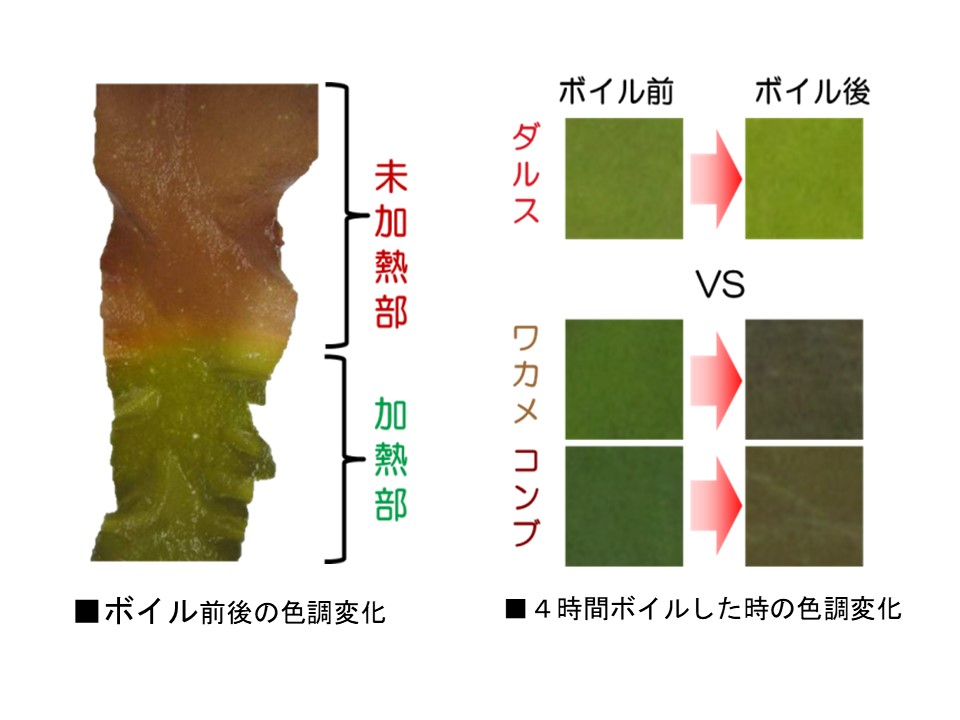
■left figure ボイル前後の色調変化: Color change before and after boiling
未加熱部: unheated part 加熱部: heated part
■right figure4時間ボイルした時の色調変化: Color tone change after boiling for 4 hours
ボイル前: before boiling ボイル後: after boiling
ダルス: dulse ワカメ: sea mustard コンブ: kelp
-