

Background for industrial applications
Section outline
-
-
Kelp has been used in Japan since ancient times and is one of the foods that Japanese people should be proud of. Currently, 80-90% of its domestic production takes place in Hokkaido, of which approximately 30% is produced in the Hakodate area, where the Graduate School of Fisheries Science, Hokkaido University is located. One of the main features of this area is the vigorous and stable aquaculture production, mainly of Japanese kelp.
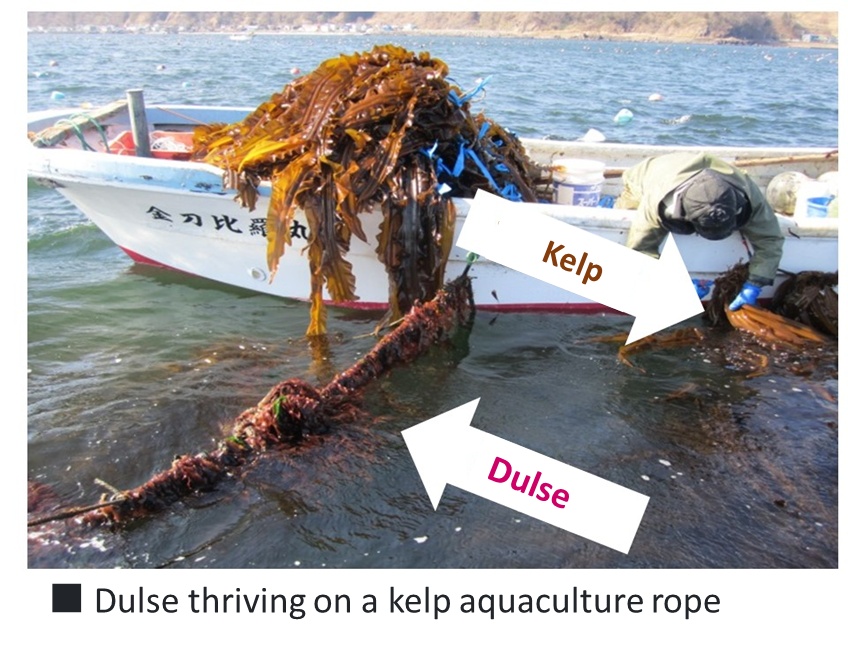
The largest production in this region is in the Minami-Kayabe area, where seaweeds of the genus Palmaria (called dulse) are known to thrive naturally in kelp aquaculture facilities. However, so far in Japan, it has not been harvested dulse and there are no examples of its industrial use.
Dulse is said to grow wild in Japan, mainly in Hokkaido and northern Honshu and northward, and is known to be eaten in some areas under the name “akahada” or other names. It is estimated that the annual amount of its resources in this region alone is approximately 1,000 to 2,000 tons, and the development of utilization technology is strongly desired, as well as the utilization as a new industrial species is expected. Therefore, with the support of professor YASUI Hajime, director of the Graduate School of Fisheries Sciences, Hokkaido University, and other professors, we have been studying the characteristics of dulse, an underutilized resource, and developing new applications for its use.
-