

How a vapor-liquid equilibrator works
Garis besar topik
-
-
Vapor-liquid equilibrator to extract dissolved gas components in seawater
Principle of silicone membrane tubing type vapor-liquid equilibrator
Air flows inside the gas permeable membrane tube and seawater flows vigorously outside. Dissolved gases in the seawater permeate the membrane and are transferred to the gas phase side. If the air- membrane-liquid phase contact time is long enough, the VOCs in the sample air reach equilibrium with the seawater. The equilibrium sample air is then introduced on-line into the analyzer (Groszko and Moore, 1998). By continuously introducing that sample air into the analyzer, the dissolved gas components in seawater can be continuously monitored.
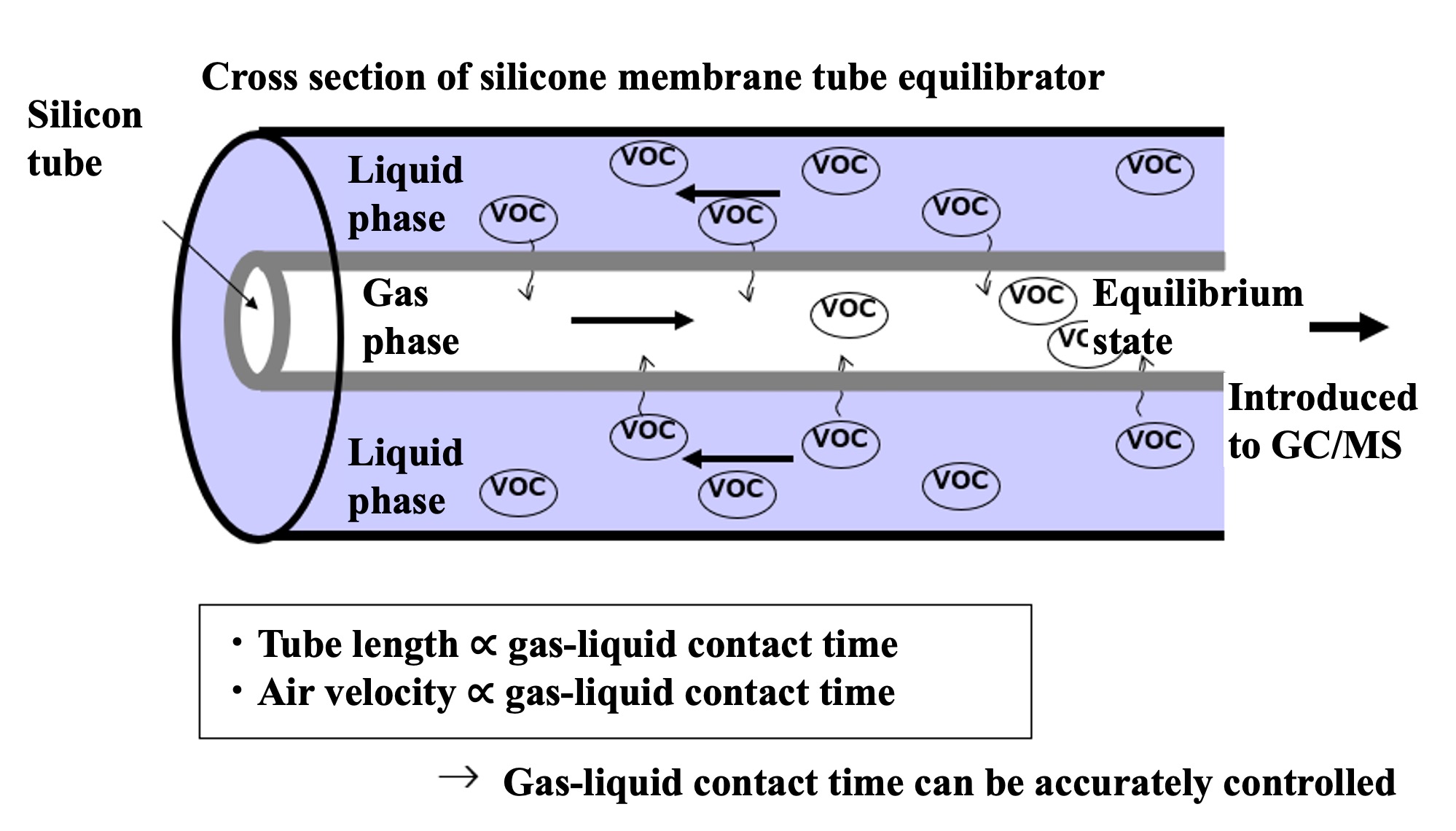
The advantage of the membrane tube method is that contact time can be simply increased by lengthening the tube or slowing the air velocity. Also, if the air velocity and internal pressure are precisely controlled, it is easy to check whether equilibrium has been reached. The disadvantage is that the more complex the tube structure, the more likely it is to become clogged with suspended solids. There are two types of membrane materials: Gore-Tex membrane made of PTFE with a porous surface and silicone membrane made of silicone. The former is suitable for treating inert gases (such as carbon dioxide), but not for adsorptive gases due to adsorption loss on the porous surface. Silicon materials have been developed that are suitable for permeation of organic substances, and silicon membranes are suitable for the measurement of multi-component VOCs. Since VOCs dissolve in silicon and reach equilibrium in the liquid-silicon-vapor phase, the concept of adsorption loss on the membrane surface does not apply. Incidentally, even if some organic matter adheres to the surface of the silicon membrane, it does not affect the permeability of halocarbons much. It is important to increase the chance of contact between the tube surface and seawater by flowing seawater vigorously. If the silicon surface is covered with metal oxides, the performance of the equilibrator will deteriorate, so care must be taken to avoid iron rust from the water piping. Hollow fiber membrane cartridges with thousands of ultra-thin silicone tubes bundled together are also available. While these are excellent for earning contact efficiency, their durability would be problematic for continuous treatment of seawater. Currently, silicone membrane tubes of about 2 mm in diameter are suitable for use (explained in the next section), but since they are not commercially available as vapor-liquid equilibrators, the only way is to procure the materials and make your own. Since this production is time-consuming, it has not yet been established as a method for continuous measurement of gases in water samples. In both the bubbling and membrane tube types, it takes a certain amount of time for the VOC partial pressure of the delivered seawater to respond to the vapor phase side. In the case of the silicon tube type vapor-liquid equilibrator, which will be described later, it seems that the VOC partial pressure in seawater responds to the gas phase side in the silicon tube with a time lag of about 10 to 20 minutes. Therefore, it is difficult to monitor VOC partial pressure with higher time resolution.
-
Since we aimed for simultaneous on-line measurement of multiple components ranging from highly volatile VOC (CFCs, isoprene, chloromethane, etc.) to adsorbable VOC (bromoform, chloroiodomethane, diiodomethane, etc.), we employed a silicon membrane tube type vapor-liquid equilibrium method.
Measurement method
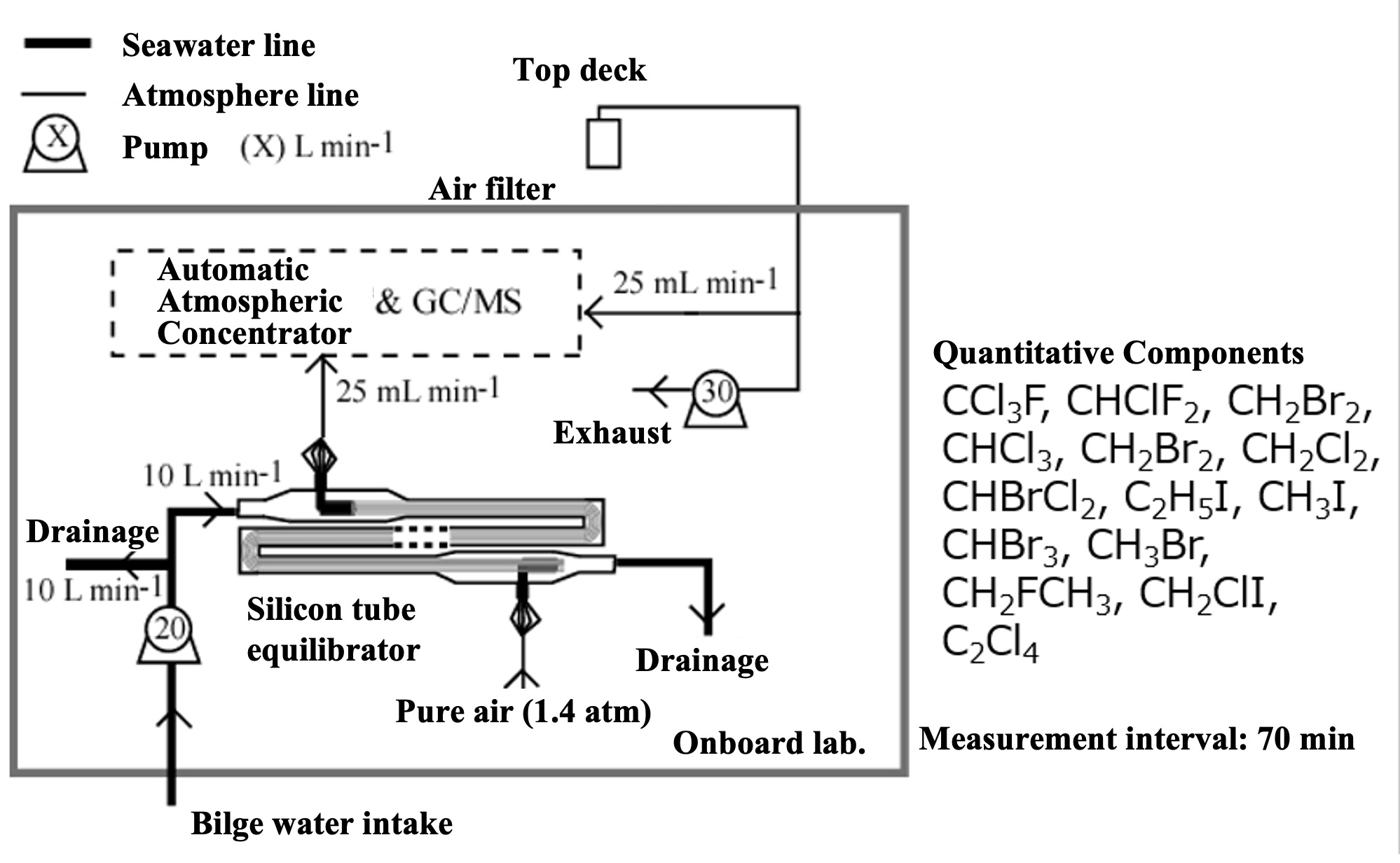
To measure alternating halocarbon partial pressures in air and surface seawater, we applied automated air concentrator-gas chromatograph-mass spectrometer (GC-MS) technology. This is based on the National Institute for Environmental Studies' system for unattended monitoring of atmospheric VOCs on remote islands (Yokouchi et al., 2006). A custom-made automatic air concentrator manufactured by Taiyo-keishoku-sha was used and linked to a GC-MS (Agilent 5973/6890). First, seawater was constantly pumped from the bottom of the research vessel for surface seawater samples ( seawater for research). To continuously extract VOC dissolved in seawater, a silicon membrane tube vapor-liquid equilibrator was developed (Ooki and Yokouchi, 2008). An overview of the entire system is shown in Figure 1, and the structure of the vapor-liquid equilibrator is described below. Six silicone tubes (Fuji Systems, material Q7-4780, 80SH), each 2 mm in diameter and 10 m long, were bundled together and passed through a polyvinyl chloride (PV) pipe. Pure air flowed through the silicon tubes, and sample seawater flowed constantly outside the silicon tubes (inside the PV pipes). The pressure inside the silicon tube was maintained at 1.4 atm and the air velocity at 25 mL min-1. Since the pressure value is proportional to the partial pressure, highly accurate pressure control is necessary. In this system, a piezo-valve type pressure controller (Horiba Estec, PV-1000) was used. The reason for setting the pressure higher than atmospheric pressure is to ensure high-precision pressure control and to prevent seawater from entering the analyzer side through the silicon tube in case the silicon tube is damaged.
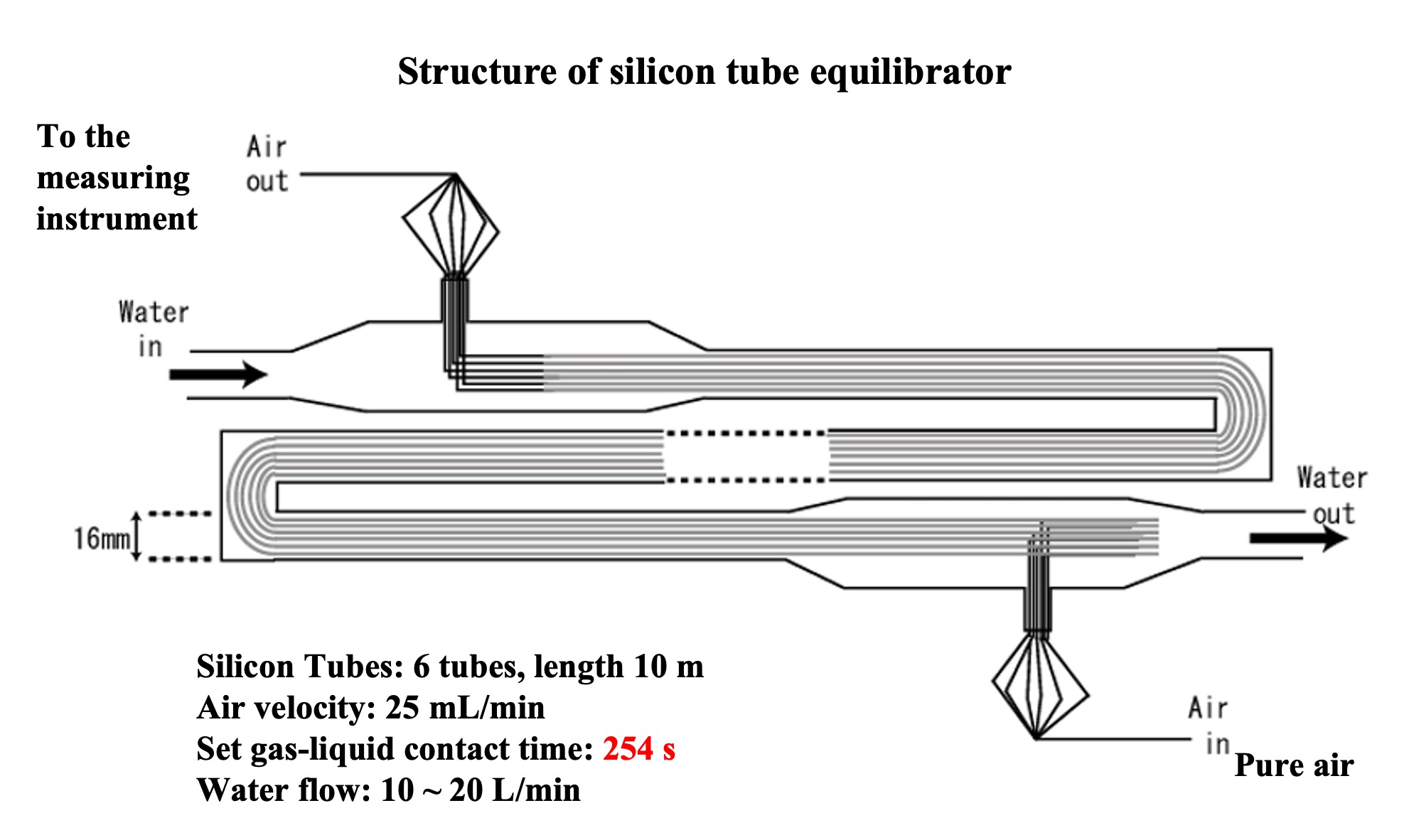
VOC in the sample seawater permeate the silicon and move to the air side of the tube. If the contact time between the silicon tube and seawater is long enough, the VOC partial pressure in the seawater and air will reach equilibrium (a confirmation test of the equilibrium state is described in the next section). The sample air was then introduced into an automatic air concentrator to cryo-focus the VOCs in two steps, and halocarbons were detected by GC-MS. In addition, outdoor air was suctioned continuously to the onboard laboratory for atmospheric samples. Since the air suction line extends several tens of meters, it is necessary to minimize the adsorption loss of VOC in the air line. Therefore, the sample was once aspirated by a high-flow pump (30 L/min) and introduced into a metal bellows pump by splitting the atmospheric line just before the analyzer. The metal bellows pump constantly introduced the atmospheric sample into the atmospheric concentrator while suctioning and pressurizing it. Halocarbons in the atmospheric sample were detected by the GC-MS system in the same way. Six sample lines were connected to the air concentrator: a vapor-liquid equilibrator line, an air line, two standard sample air lines, and a helium line (blank measurement), which could be switched by computer control. VOC in mixed VOC standard air (100 pptv halocarbons - 10 ppb isoprene) were measured in the same manner to quantify the partial pressure of VOC in the sample air introduced into the air concentrator. VOC components (CH2ClI, C2H5I) not included in the mixed VOC standard air were determined from the response ratio of CH2ClI and C2H5I to C2Cl4 by heating and vaporizing a mixed standard solution of CH2ClI, C2H5I and C2Cl4 stock solution diluted in methanol and measuring the same. The quantitative components were chloromethane (CH3Cl), bromomethane (CH3Br), iodomethane (CH3I), dichloromethane (CH2Cl2), dibromomethane (CH2Br2), trichloromethane (CHCl3), tribromomethane (CHBr3), chloriodomethane (CH2ClI), iodoethane (C2H5I), CFC-11 (CCl3F), and HCFC-22 (CHClF2).
-
Equilibrium condition checked by silicone membrane tube vapor-liquid equilibrator
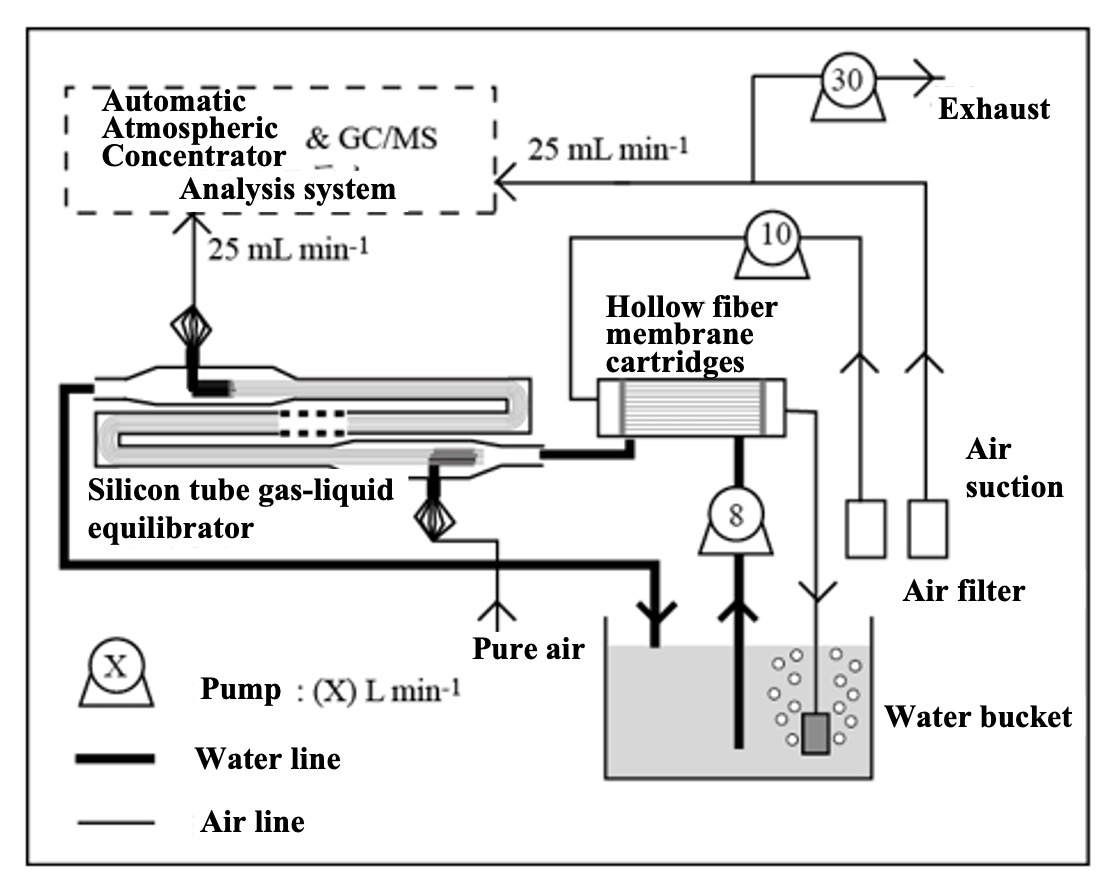
The most important aspect of using a vapor-liquid equilibrator is to compensate for whether the air has truly reached vapor-liquid equilibrium. Cartridge-type vapor-liquid equilibrators consisting of thousands of membrane tubes are commercially available. This is an easy way to reach equilibrium and is effective for use in verification experiments. However, due to its delicate structure, it is not suitable for continuous treatment of seawater. If the same water is measured alternately in the two equilibrators and the measurement results are consistent, it can be confirmed that equilibrium has been reached even with silicon membrane tubes (6 x 10 m). As a result, equilibrium was reached for our target component.
-
Internal cleaning of silicone membrane tube vapor-liquid equilibrator
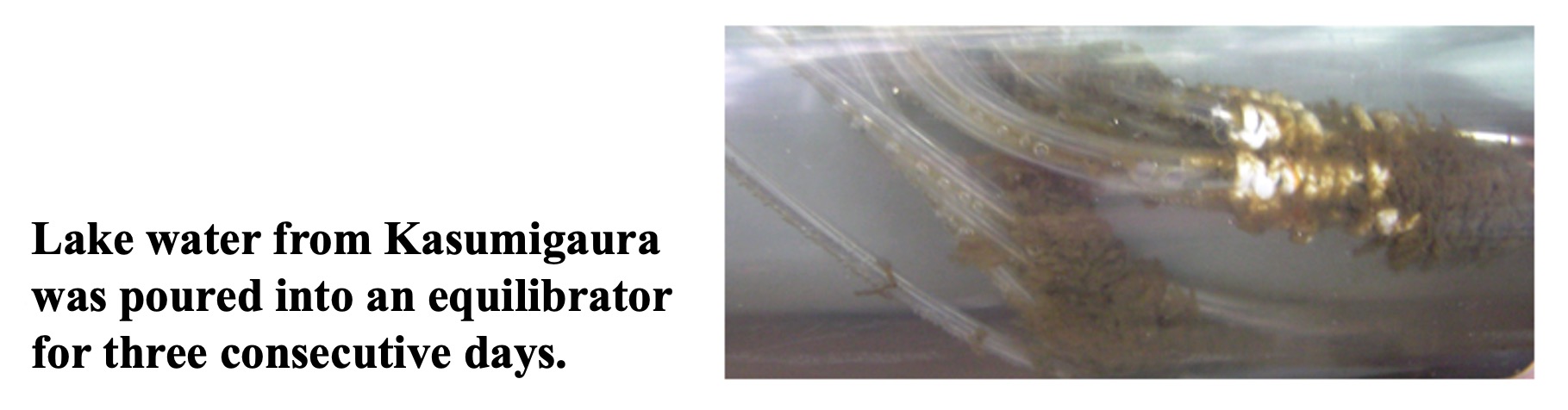
When measuring natural water, organic particles in the water accumulate inside the equilibrator. Periodic cleaning is necessary. The photo below shows the dirt adhering to the inside of the equilibrator when measuring lake water in Kasumigaura for three consecutive days.
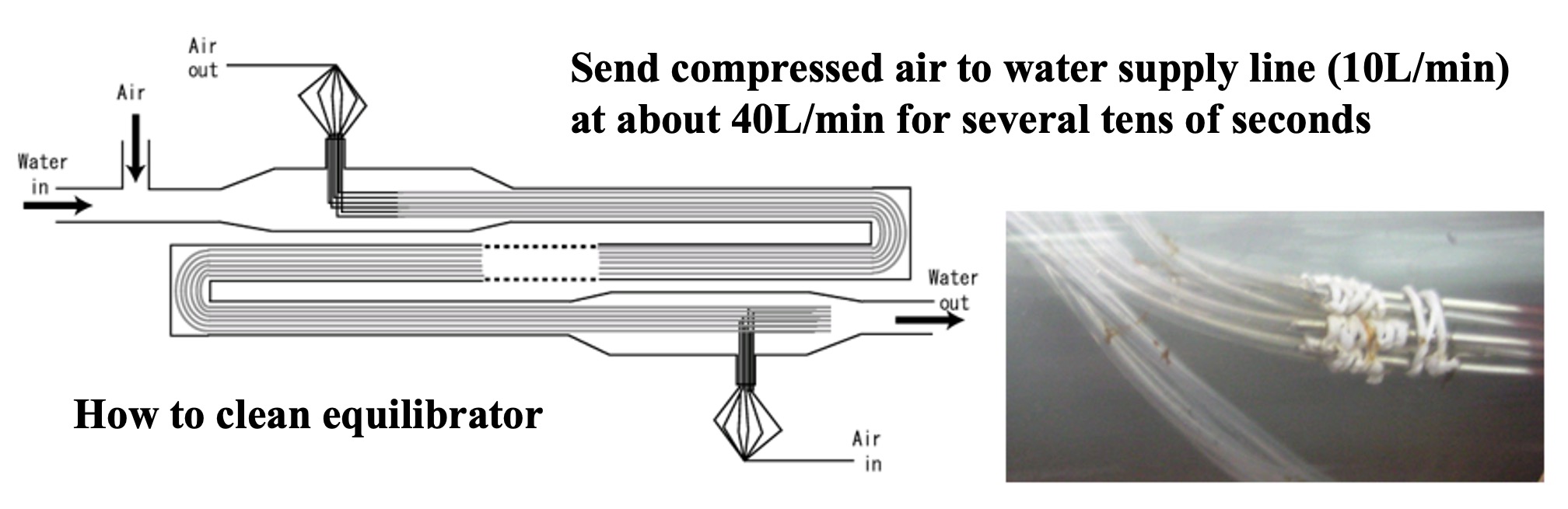
When compressed air is sent from the water flow line (upstream from the equilibrator) while the water is flowing, dirt is washed away along with powerful air bubbles. When continuously measuring natural water with high organic particles, it is advisable to wash the system once a week or so.
-
Reference: Ooki and Yokouchi, Development of a silicone membrane tube equilibrator for measuring partial pressures of volatile organic compounds in natural water, ENVIRONMENTAL SCIENCE & TECHNOLOGY (
42), 5706-5711 (2008), DOI: 10.1021/es800912j -
This is a review paper on the vapor-liquid equilibrator GC-MS system contributed to a Japanese journal. It is sold out, so please browse at the library.
-