

Topic 1
Section outline
-
-
By comparing the standard electrode potentials of each half-reaction equation, we can roughly predict what kind of redox reaction will take place. This is based on the natural law that "negatively charged electrons flow from a lower potential to a higher potential".
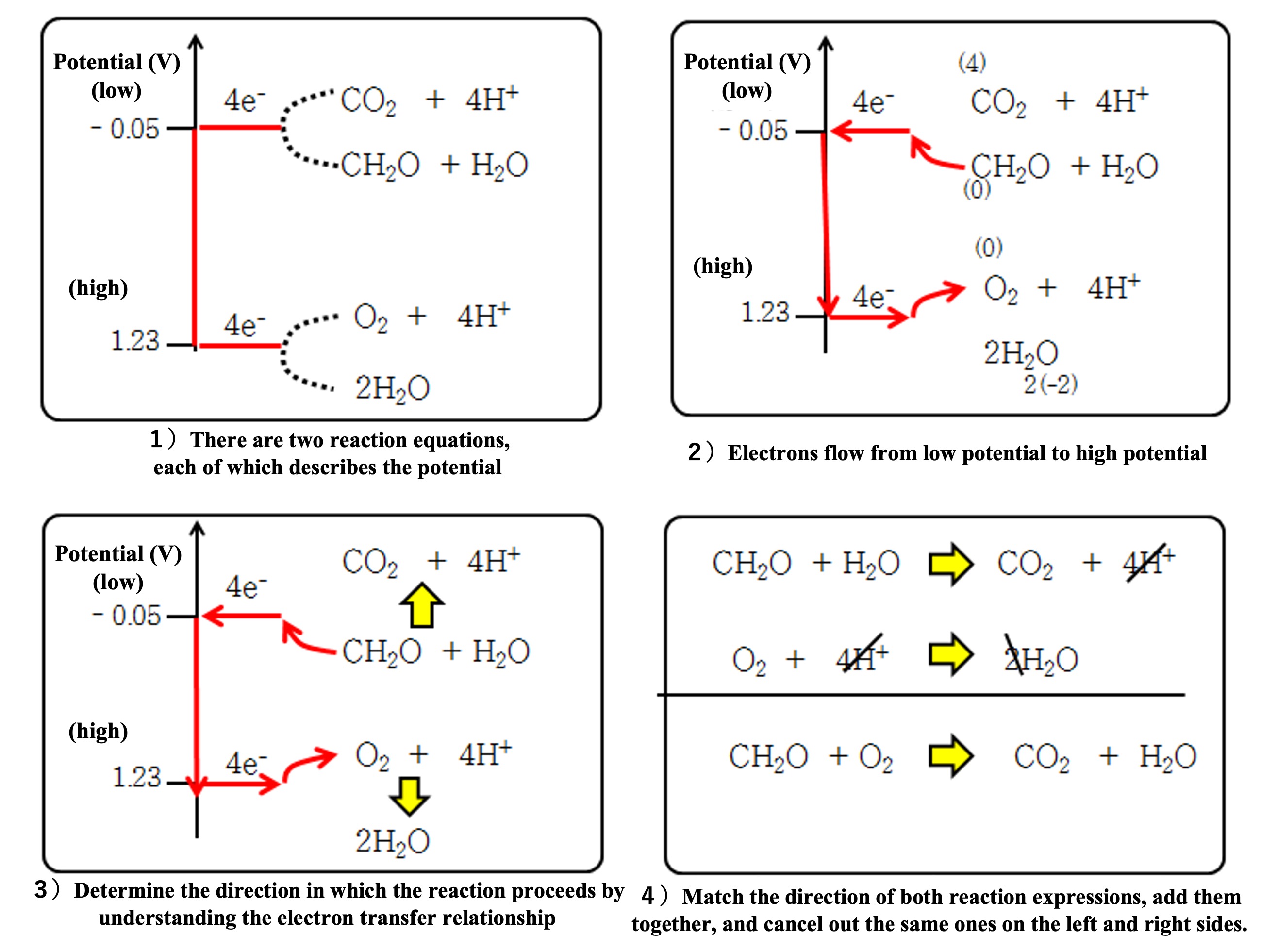
In the following, we consider a situation where there are two half-reactions and we do not know from which one the electrons are passed to which one (the direction in which the reaction proceeds). The direction of the reaction and how to describe the total reaction equation are explained in the order of 1) to 4).
1)The two half-reactions are noted above and below, and their respective standard electrode potentials are noted on the vertical axis.
2)Determines the direction of electron flow based on the law that electrons flow from low to high potential.
Note the oxidation number of each element and the amount of electrons flowing through it. Determine the substance that gives and receives electrons.
3)The direction in which each half-reaction proceeds is marked with an arrow.
4)Add up both half-reactions, placing the original form on the left side and the product form on the right side. When the same substance is present on the left and right sides, cancel out.
-
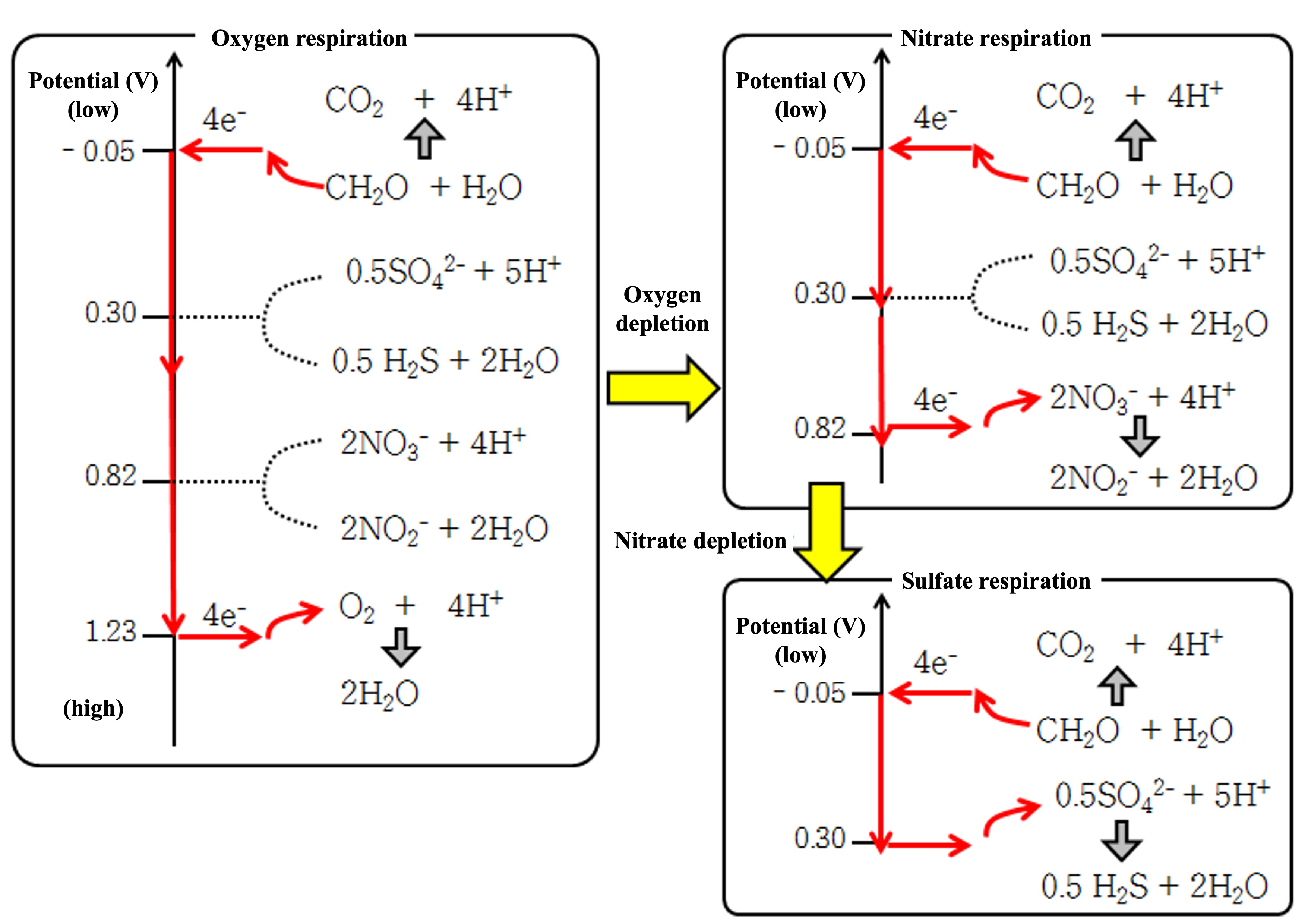
The standard electrode potential of the half-reaction in respiration determines the order of respiratory forms
When sulfuric acid, nitric acid, and oxygen are mixed in water (left side of the figure below), only the reduction reaction of the highest potential oxygen (oxygen respiration) occurs in the respiration reaction that oxidizes organic matter. This is because, based on the natural law of electrons flowing from low to high potential, electrons released from organic matter pass to oxygen without through sulfuric acid and nitric acid.
-
Sulfate respiration (sulfate reduction) and blue tide
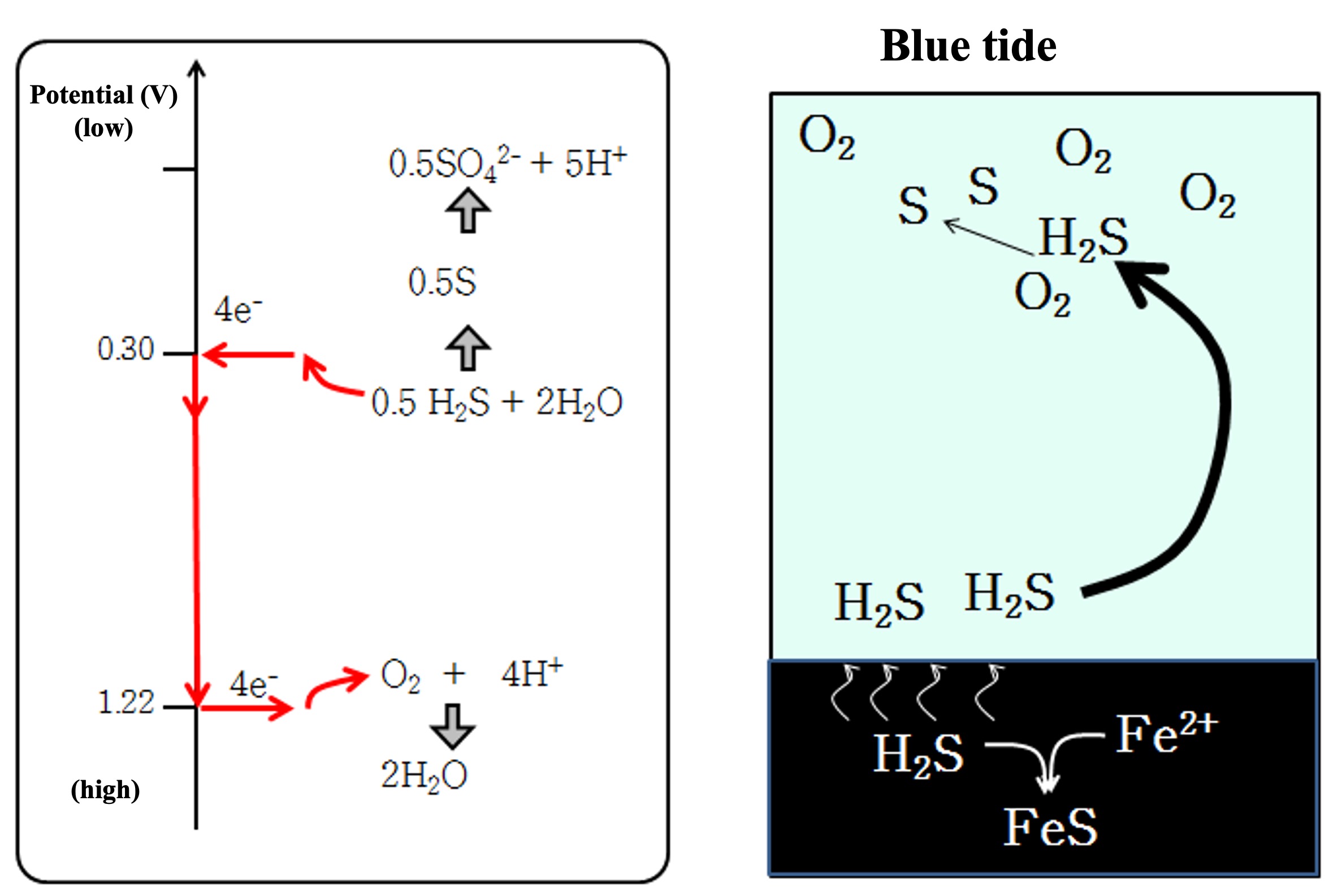
Now, when oxygen is depleted in the water, microorganisms (nitrate-reducing bacteria) appear that use nitric acid as an oxidant. When nitric acid also runs out, the absolutely anaerobic bacteria sulfate-reducing bacteria appear. As explained earlier, sulfate reduction occurs in an environment rich in organic matter and sulfate ions, where oxygen supply from the outside world is severely limited. Because seawater is rich in sulfate ions, sulfate reduction occurs in marine sediments at depths ranging from a few centimeters to several tens of centimeters below the surface. When marine sediments are sampled, such depths may reveal a hydrogen sulfide odor and a layer of black iron sulfide (FeS) formed by the reaction of hydrogen sulfide and iron ions.
Where there is a large amount of organic sediment and stagnant bottom water, the bottom water can become anoxic. Sulfate reduction occurs near the surface of marine sediments, producing hydrogen sulfide. When this highly poisonous hydrogen sulfide accumulates in anoxic bottom waters, the marine environment deteriorates significantly. Furthermore, when bottom waters rise due to weather disturbances and meet oxygen in the surface layer, hydrogen sulfide is reduced to form single sulfur particles. These sulfur particle colloids scatter light, making them appear blue when viewed from the sea. This is the blue tide. The surface water in which a blue tide occurs is also hypoxic, which can cause fish kills and other damage. The single sulfur particles are eventually oxidized back to sulfate ions.
Up to this point, we have been calculating the total difference in the standard Gibbs energy of formation (⊿∑Gf0) before and after a chemical reaction, using the respiration reaction of living organisms as an example. I hope you are now a little more familiar with it.
In the next course, we will use ⊿∑Gf0 to calculate the concentration of each substance when the chemical reaction is complete (in equilibrium). This is where calculating chemical equilibrium comes into play in analytical chemistry.
In the Department of Marine Biology of the Faculty of Fisheries Sciences, when dealing with analytical chemistry, it is sufficient to remember and use the basic equations of chemical equilibrium in the following courses.
-