

How to make a half-reaction equation for a redox reaction (example of oxygen respiration)
Perfilado de sección
-
-
In the previous course, we determined the energy difference before and after the respiration reaction to determine the energy available to the organism. What we noted in the reaction equation for the respiration reaction is the total redox reaction. A redox reaction like the respiration reaction consists of a half reaction of a substance receiving an electron, a half reaction of a substance giving an electron, and a combination of the two half reactions.
Learn how to divide a total redox reaction into half reactions. This is explained in detail in general chemistry textbooks, so we recommend that you study them carefully. There are many different ways to do this, but I will describe one way below.
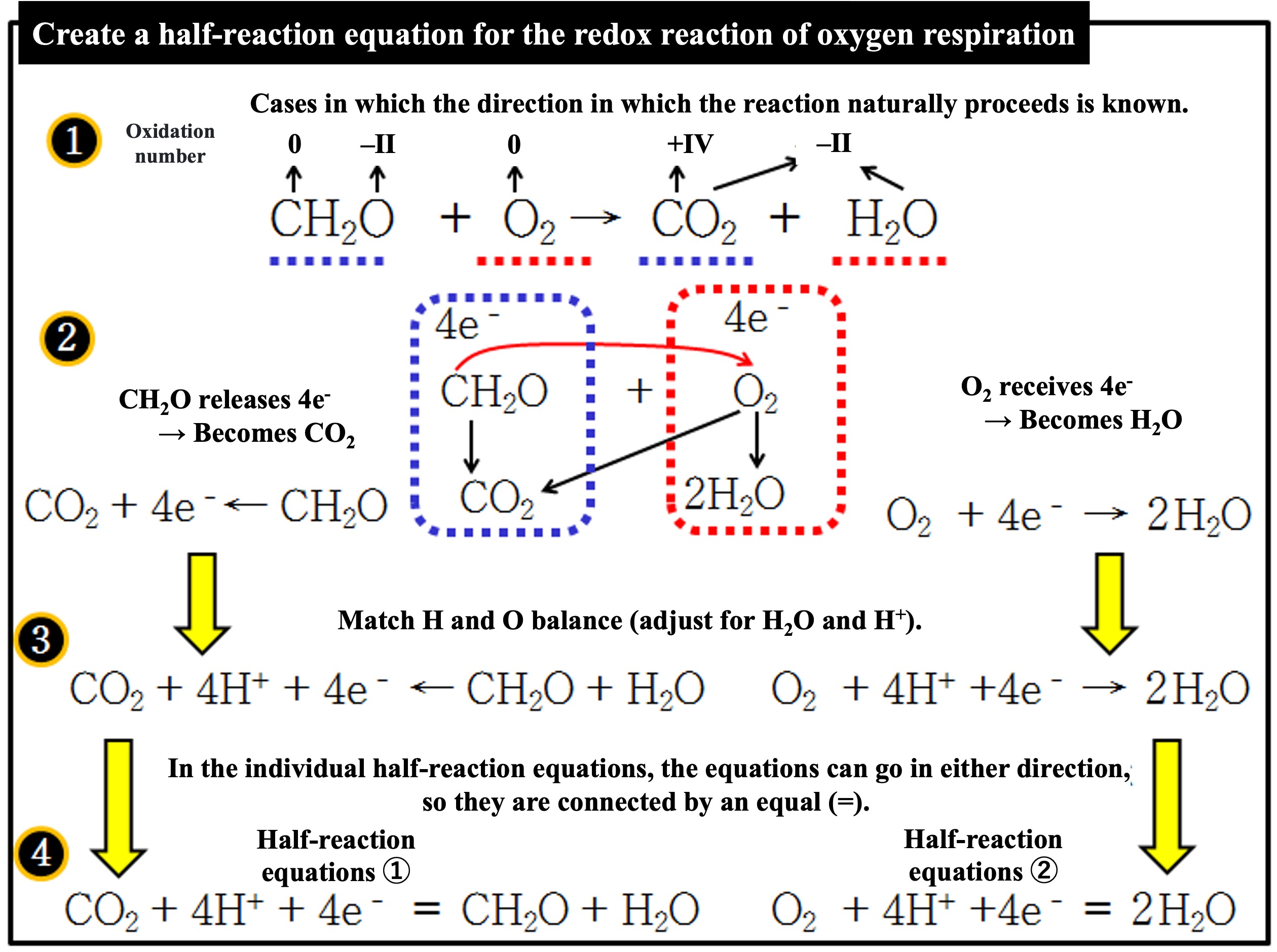
The total reaction (redox reaction) in which formaldehyde (CH2O) is oxidized with oxygen (O2) to form carbon dioxide (CO2) and water (H2O) is divided into two half reactions. Please refer to the figure below to understand the procedure.
① Write down the oxidation number of each element in all reactions: H is +1, O in the compound is -2, and O in the O2 molecule is 0. Since the elements whose oxidation numbers change are C and O, make half-reaction equations for C and O, respectively.
②Note the mass change involving C and the amount of electrons transferred, and the mass change involving O and the amount of electrons transferred.
③Match the O balance; match the H balance. Add H2O, H+, and OH-, assuming there are enough water molecules.
④In the individual half-reaction equation, both sides are connected by equals, since they can go in either direction. Place the electrons on the left side.
-
How to make a half-reaction equation (example of nitric acid respiration)
Make the half-reaction equation of nitric acid respiration (nitric acid reduction). Since the half-reaction equation for the oxidation of organic matter (formaldehyde) in the half-reaction of oxygen respiration is common, only the half-reaction equation for nitric acid reduction is given below.
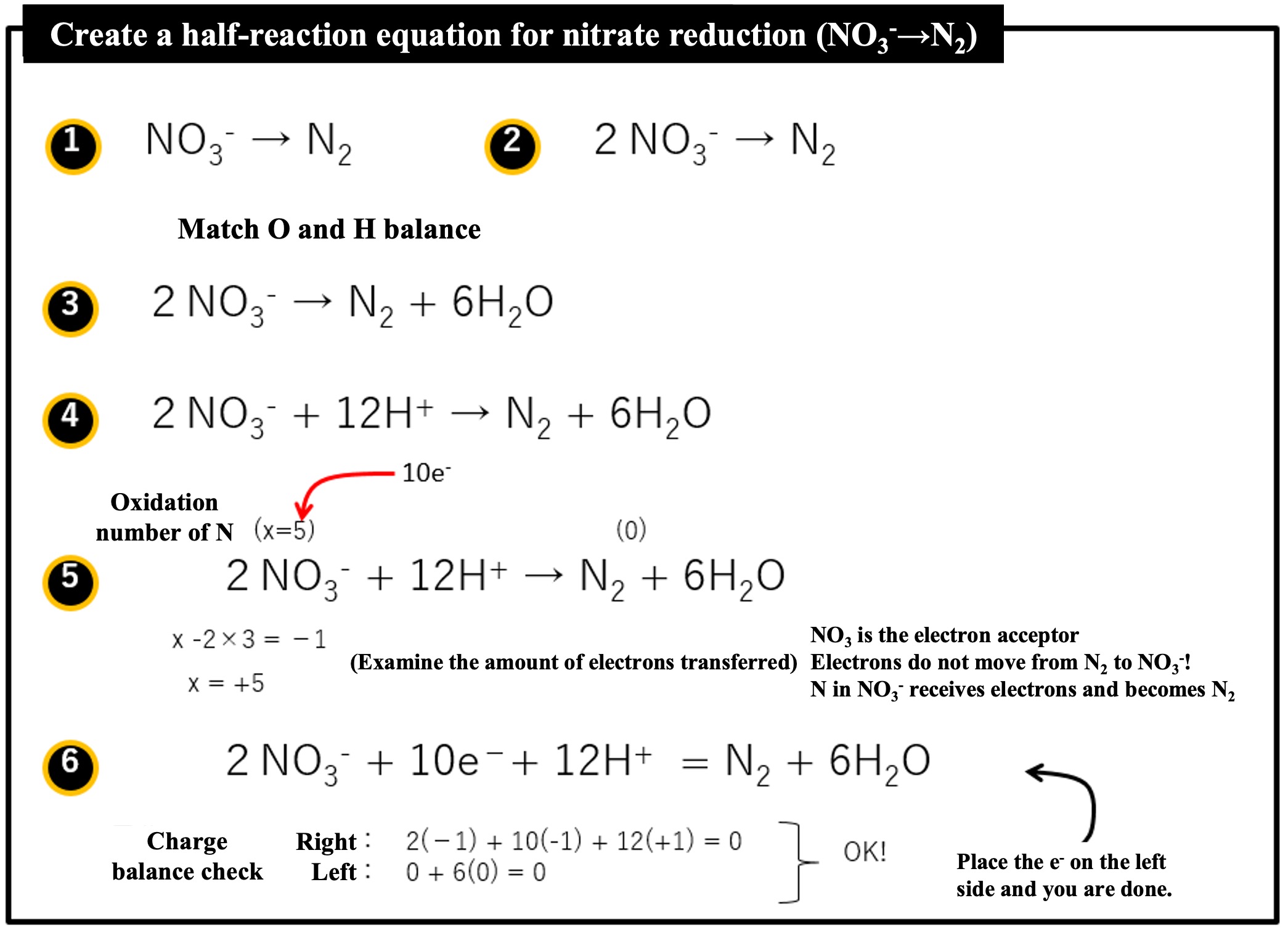
This is a half-reaction in which nitric acid is reduced to nitrogen molecules (N2).
① We want to find the half-reaction equation where NO3- is reduced to N2. Connect it with →.
② Match the N on both sides
③ Match the balance of O and H. First, to match O, we put 6H2O on the right side.
④ Then, to match H, place 12H+ on the left side.
⑤ To examine the amount of electron transfer, we note the oxidation number of N. Let the oxidation number of N in NO3- be x. The amount of electron transfer is 2(5e-) since the N oxidation number of N2 changes from zero to 2NO3- N oxidation number +5.
⑥ Add the amount of electrons (10e-) to be transferred. Check the charge balance between the left and right sides. Both sides are 0, so it is OK. (If 10e- is placed on the right side, the charge on the left side will be +10 and that on the right side will be -10.) To make e- on the left side, both sides are swapped and connected by an equal sign. (In the above case, e- is originally placed on the left side, so no swapping is necessary.)
-
How to make a half-reaction equation (example of organic oxidation (CH2O → HCO3-)
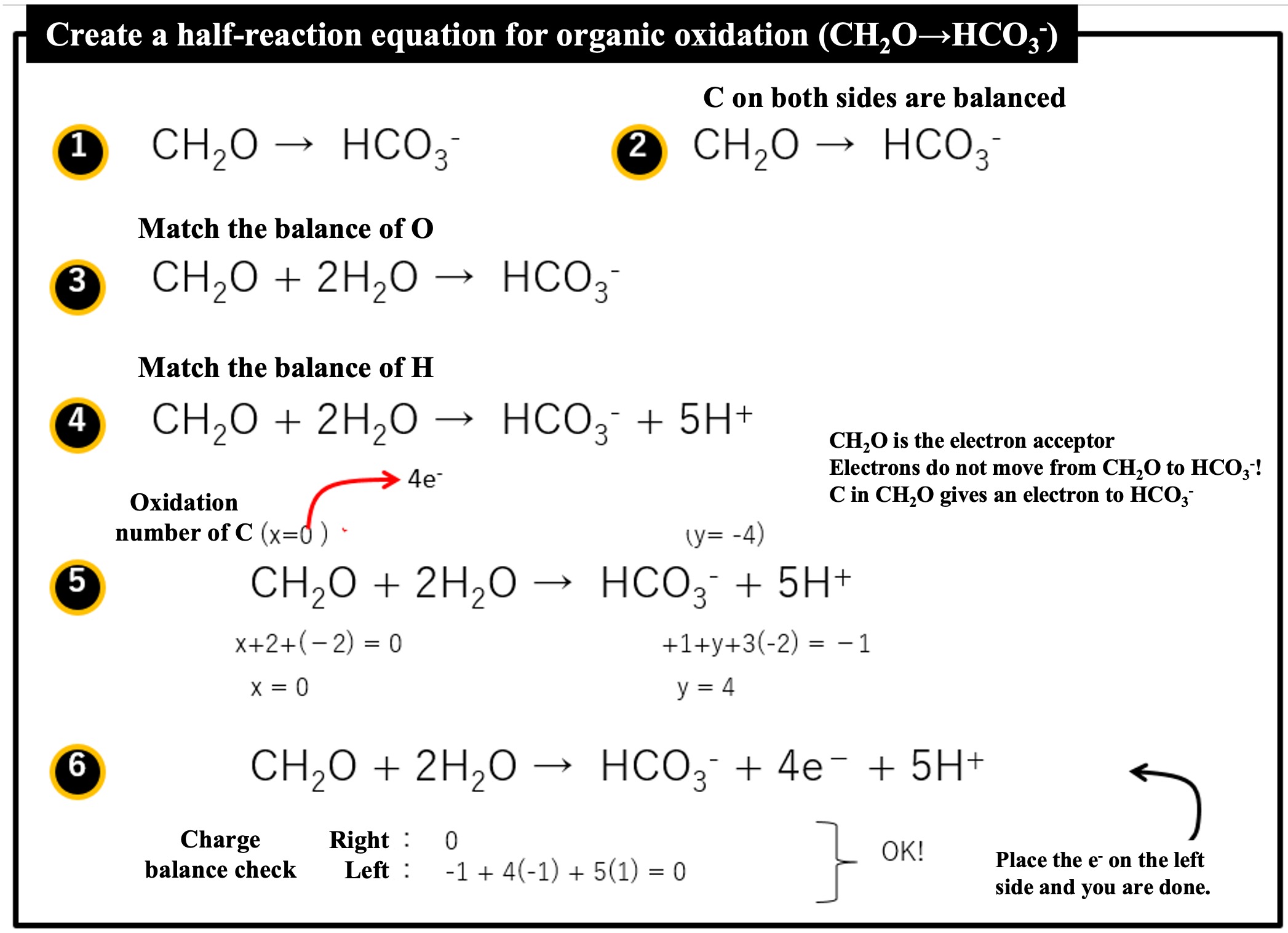
We make a half-reaction equation in which formaldehyde (CH2O) in water is oxidized to produce bicarbonate ions (HCO3-). In the previous example, we made an equation that produces carbon dioxide (CO2), but carbon dioxide is immediately converted to hydrogen carbonate ions in water, so this half-reaction may be occurring in vivo.① We want to find the half-reaction equation where CH2O is oxidized to HCO3-. Connect it with →.
② Match the C of both sides (originally, the C amounts are the same).
③ Match the balance of O and H. First, to match O, we put 2H2O on the left side.
④ Next, to match H, place 5H+ on the right side.
⑤ To examine the electron transfer, we note the oxidation number of C. Let the oxidation number of C in CH2O be x (0 = x +2 -2) and the oxidation number of C in HCO3- be y (-1 = 1+y-6). The electron transfer is 4e- since the oxidation number of C in CH2O changes from 0 to +4 in HCO3-.
⑥ Add the amount of electrons (4e-) to be transferred. Check the charge balance between the left and right sides. Both sides are 0, so it is OK. (If 4e- is placed on the left side, the charge on the left side will be -4 and that on the right side will be +4.) To make e- on the left side, both sides are swapped and connected by an equal sign. (In the above case, e- is placed on the right side, so swap the left and right sides.)
-