Introduction
섹션 개요
-
-
Analytical chemistry is the study of the quantity and properties of substances. In this course in "Analytical Chemistry", you will learn mainly the methods and principles of analytical chemistry.
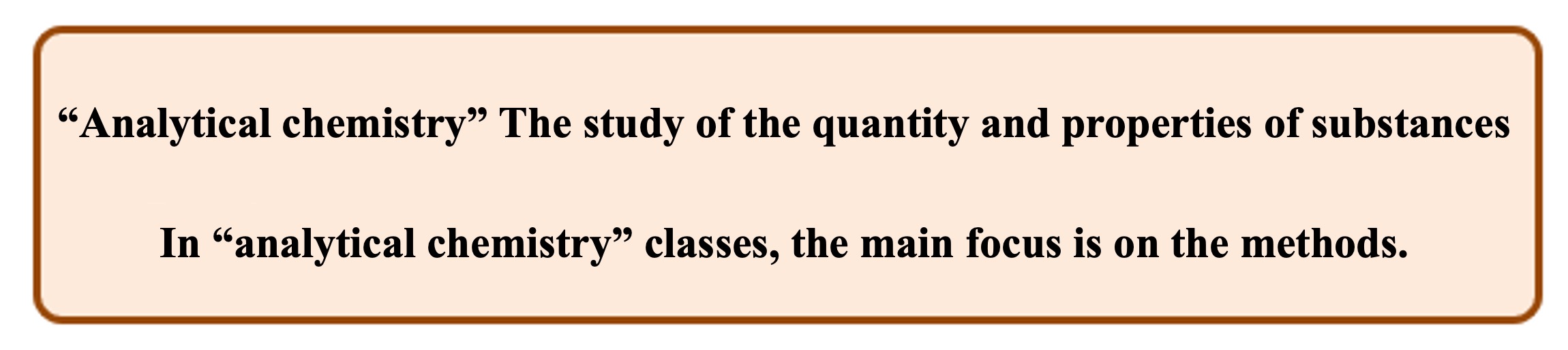
Analytical chemistry is used to investigate the quantity, state, and properties of all kinds of things in the world. If you want to investigate the chemical quality and quantity of industrial products, you can use analytical chemistry in industrial chemistry; if you want to investigate pharmaceuticals, you can use analytical chemistry in pharmacology; if you want to investigate foods, you can use analytical chemistry in agriculture and fisheries, and so on. The analytical chemistry handled by the Department of Marine Biology in the School of Fisheries Sciences is mainly environmental analytical chemistry.
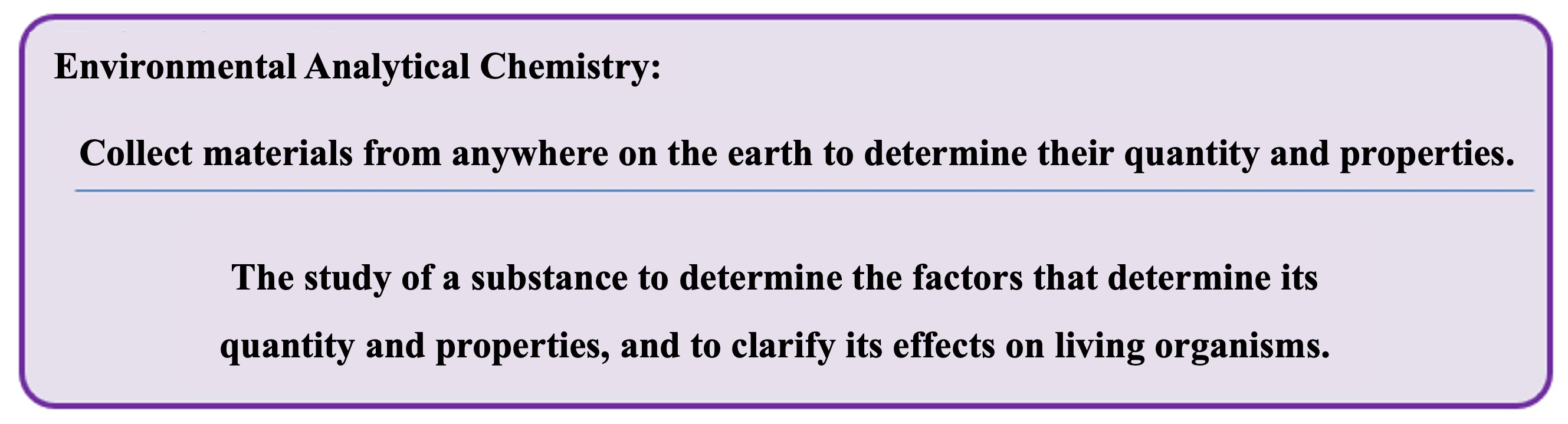
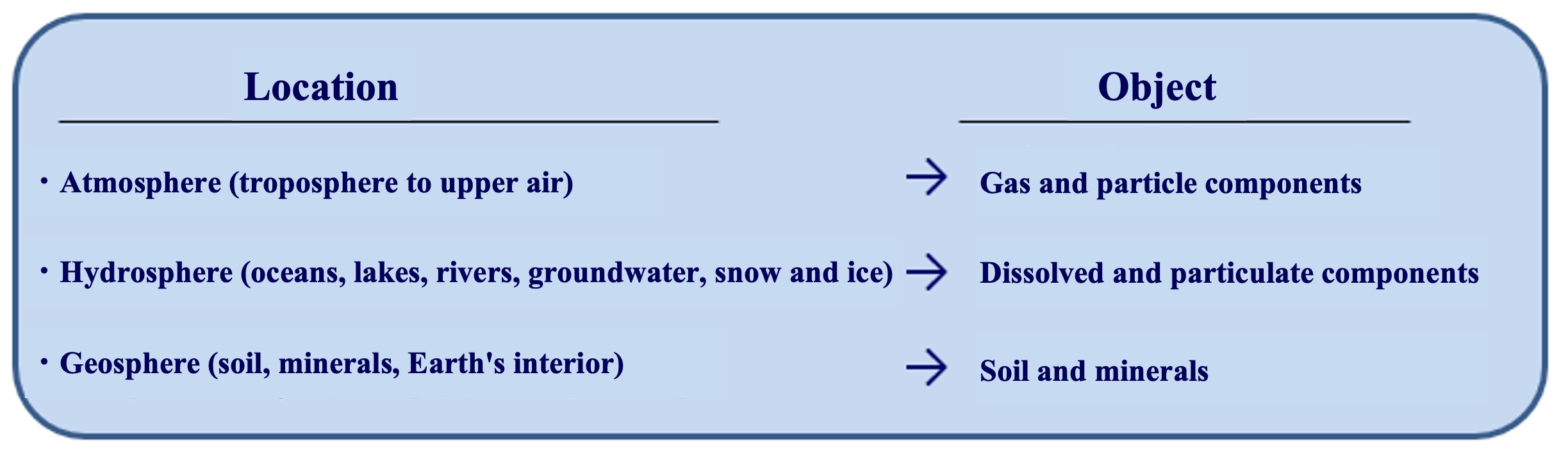
In environmental analytical chemistry, substances are collected from all parts of the earth to determine their quantity and properties. The study is designed to identify the factors that determine the quantity and properties of the substance and its effects on living organisms. It can be viewed as part of environmental science. The scope of the study is the impact on humans and the places where humans have an impact on the environment. The entire surface environment of the earth would be covered. On the other hand, geochemistry also deals with analytical chemistry, but it also covers the interior of the earth and outer space, which are not subject to human influence.
The objects of environmental analytical chemistry are air, water, soil, living organisms and organic matter of biological origin. In the Department of Marine Biology of the Faculty of Fisheries Sciences, third-year students participate in practical training aboard the Oshoro-Maru, sampling water from the surface of the Pacific Ocean to depths of 5,000 m. The students then analyze the chemical components of the water, such as oxygen, phosphoric acid, silicic acid, and photosynthetic pigments, that are relevant to the marine ecosystem. The results of these analyses are used to elucidate the mechanisms of the marine environment.
By the way, it is sometimes the minuscule amounts of constituents in the air, water, and soil that affect the global environment. In a kilogram of seawater, we may detect picograms or femtograms of a target component, and so on. Also, environmental samples are rarely subjected to analytical instruments immediately after they are collected. Samples are collected from all over the earth, somehow brought back to the laboratory, and finally measured. Or sometimes, we manage to bring analyzers to the observation site and measure the samples on site. It is better if the observation equipment is carried on a huge research vessel, but sometimes we use fishing boats, rubber boats, submersibles, or airplanes to collect samples. We may even have to walk on glaciers with heavy equipment on our backs. Each of these environmental analytical chemistry may present many difficulties.
In environmental analytical chemistry, assume a variety of problems from sample collection to analysis, and many tasks will be set and completed, such as① Selection of instruments and equipment to be used for observation
② Cleaning of instruments
③ Sampling methods
④ Methods of storing and transporting samples
⑤ Sample pretreatment methods
And finally, we go to the observation site,
The last thing that needs to be done is to make it snappy,⑥ We arrive at the analysis from the sample collection.
⑦ Organizing and validating the results of the analysis.Environmental analytical chemistry" completes the series of tasks ① through ⑦. -
In this course on "Analytical Chemistry," the focus is on understanding the principles of analytical methods (=⑥).
I hope that everyone will gain knowledge in this course and then learn analytical chemistry in the field through student experiments in the third year of college and practical training aboard the Oshoro-Maru. Of course, not everyone who takes this course will become an expert in environmental analysis. If you are going to live your life as a person of science, you should at least acquire the basic knowledge of environmental analysis.
This is because we often see "spreading rumors" in the press about environmental issues. "Radioactive materials have been detected! or "Dioxin has been detected!” it is hard to believe that the reporters understand the definition and meaning of the detection limit. Any element can be detected by extremely sensitive measurement, because any element is diffused in the environment. I wish they would at least indicate the detection limit on the edge of the TV screen. It is not good to inflame the danger without any evidence. On the other hand, if we use dishonest tricks in our environmental analysis methods, we can even hide the spread of truly dangerous substances. Shouldn't all intellectuals have the ability to detect these things?
Environmental analytical chemistry is a fundamental field of environmental science. The most important issue in environmental science is climate change associated with global warming (and let me venture to assert that it is a fact). It is a solid fact that the earth is warming, and it is also a solid scientific finding that increasing the concentration of carbon dioxide and methane in the atmosphere will cause warming. It is also a fact that mankind is emitting large amounts of carbon dioxide. It is difficult to explain the causal relationship between these facts quantitatively, and it is impossible to predict the future with certainty. Therefore, efforts are being made to increase certainty by accumulating observational facts through environmental analysis. Therefore, we must continue our efforts to reduce uncertainties in environmental analysis as much as possible.
Climate change focuses on the dynamics of carbon dioxide and methane, but the scientific community is also working to understand the climate system as a whole by consolidating knowledge in the surrounding areas. Individual scientists may focus on the immediate phenomenon at hand, but this can also be seen as part of understanding the system as a whole.
Depending on where you are assigned for your graduate research, you may find yourself dutifully repeating environmental analytical chemistry. Some items are routine, following recipes created by our predecessors. In fact, oxygen, phosphoric acid, silicic acid, and photosynthetic pigments in seawater are the most important parameters in oceanography, so they are quite routine. That is why we can offer them as a menu for student experiments and onboard training.
When taking on a new survey item, it is usual for a problem to arise somewhere between (1) and (6) mentioned above, which must be cleared somehow. If a problem arises, a solution is formulated and another attempt is made. If the problem recurs, another solution is devised, and so on, repeating the process of trial and error until the result is finally reached. It is not unusual for the process to take years. You must not give up. The world firsts! will be born during the long process of trial and error. Researchers involved in environmental analytical chemistry are patiently pursuing "world firsts," even if they are small, and they are patient, persistent, and patiently repeat the process. If you are involved in environmental analytical chemistry, you will have the privilege of cultivating perseverance! It is a great study for young people.
In this course, you will learn units and significant figures, as well as the basics and practice of calibration curves, limits of detection, and blank measurements. In particular, there is no fixed method for calibration curves and detection limits. They must be determined by the researcher according to the situation and purpose. Therefore, they are not usually described in analytical chemistry textbooks. However, it is the most important part of environmental analytical chemistry.
In this course, we will derive the conditional equations of chemical equilibrium. This is in the scope of physical chemistry and thermodynamics, but since it should normally be studied as a set with analytical chemistry, we will learn the concept in this course as well. Since I myself have a background in physics, we talk a lot about physics-like topics. However, I have also created this course by relearning thermodynamics from the very beginning. I intend to make it more detailed and maniacal than an ordinary textbook.
※ We will not explain "unit notation" or "physical quantities" which are written in any textbook.
-