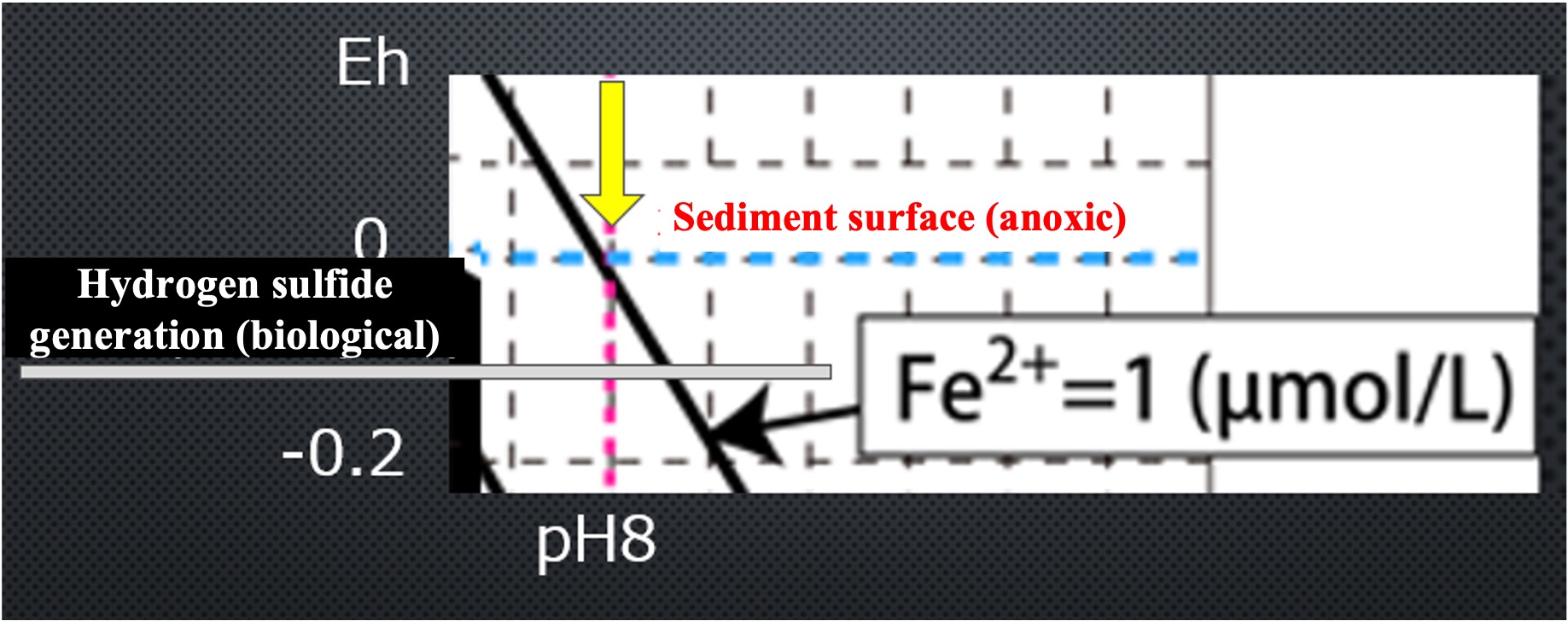
Where hydrogen sulfide ions occur, the presence of previously leached Fe2+ causes a reaction between the two, resulting in the black precipitation of iron sulfide FeS. FeS (which eventually becomes FeS2) does not dissolve easily, so it will be buried deep beneath the seafloor, creating iron deposits of pyrite (FeS2) in a few tens of millions of years . Thus, in sedimentary layers that have progressed to sulfate reduction, the concentration of dissolved Fe2+ ions in the pore water will be significantly lower. HS- ions that occur relatively deep in the sediment and escape reaction with Fe2+ are transported by molecular diffusion to the upper part of the sediment. HS- ions are oxidized when they encounter oxygen, so HS- ions are affected only up to a redox potential near zero (anoxic layer). If the water directly above the marine sediments is anoxic for some reason, HS- ions may be affected up to near the surface of the sediments. Of course, if the bottom waters of the ocean are anoxic and the redox potential of seawater falls below -0.1 (V), sulfate reduction occurs in the seawater and HS- ions are generated. This can happen when bottom water stagnates in a closed system inner bay.