

Total difference in standard Gibbs energy of formation for respiratory response (energy gained)
Section outline
-
-
Oxygen respiration
Eukaryotes use oxygen to oxidize organic matter to obtain energy (oxygen respiration). In the column below, we have assumed the simplest organic substance, formaldehyde, and described the reaction of oxidation of organic matter by respiration. Under each substance, we note the standard Gibbs energy of formation for each substance. The total energy of the chemical reaction in its product form (right side) minus the total energy in its original form (left side) (⊿∑Gf0) is the energy that the organism can obtain. The reason for the negative energy difference is that, from the reaction system's point of view, the energy is lost and the organism can obtain it.
*Before the reaction is called the original form, and after the reaction is called the product form.
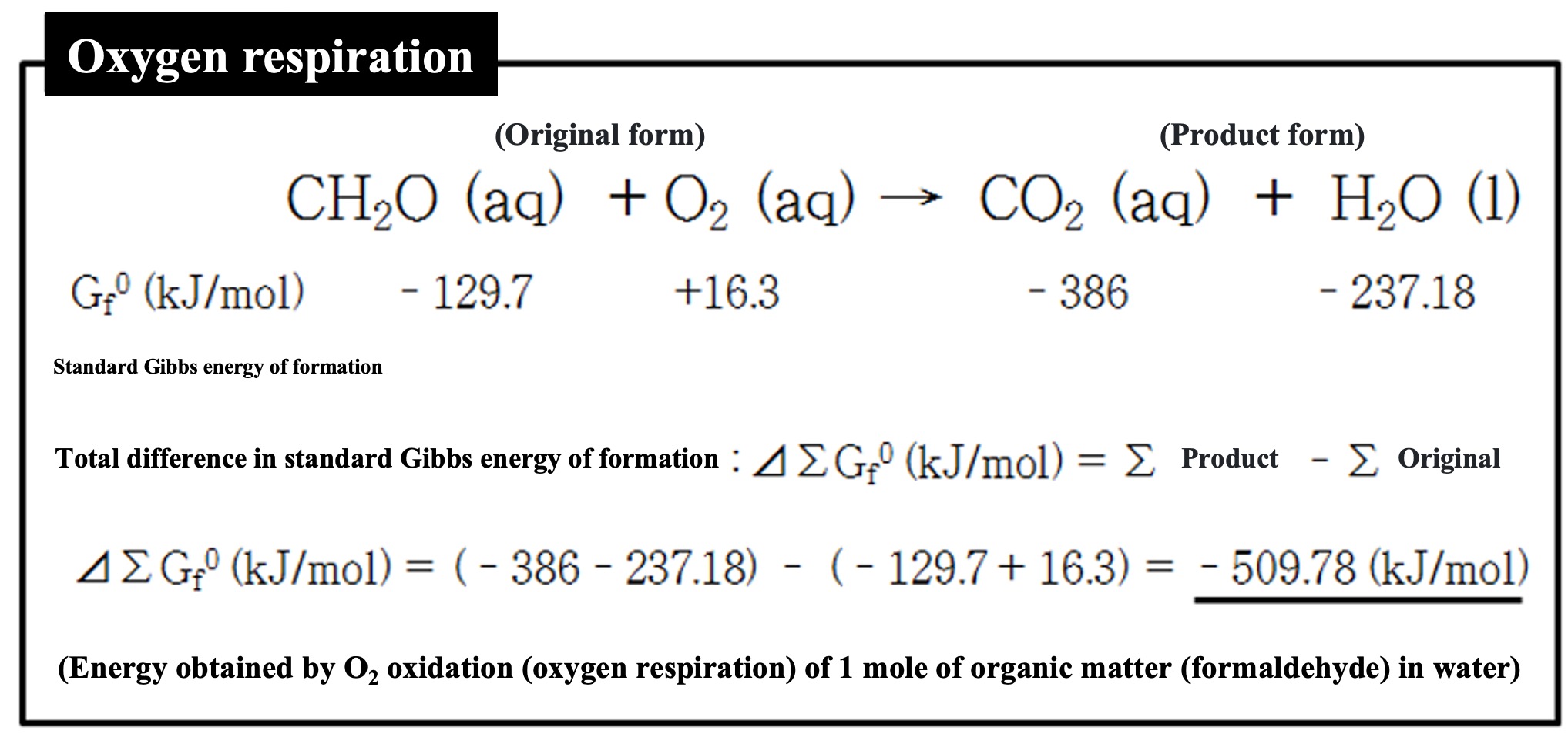
As in this example, the standard Gibbs energy of formation for each substance is written below the reaction equation, and the total difference (⊿∑Gf0) is calculated before and after the reaction (left side: original form, right side: product form). The standard Gibbs energy of formation (Gf0) for each substance is an important thermodynamic constant. It can be downloaded in one previous course.
*The standard Gibbs energy of formation for O2 in its standard state is 0 (kJ/mol), but dissolving it in water produces energy (16.3 kJ/mol). Assuming respiration in water, we used the standard Gibbs energy of formation for O2(aq) as shown above. Also, if the organism exhales CO2 in water, CO2(aq) should be used, but if it exhales into the gas phase, the CO2(gas) value should be used. Even when plants in water use CO2 in photosynthesis, or whether it is H2CO3 or HCO3-, the energy used in the calculation will change. In this course, I have dealt with that in an appropriate manner.
-
Nitrate respiration
Next, in the absence of oxygen, organisms appear that use nitric acid as an oxidant to breathe. They are known as nitrate-reducing bacteria.
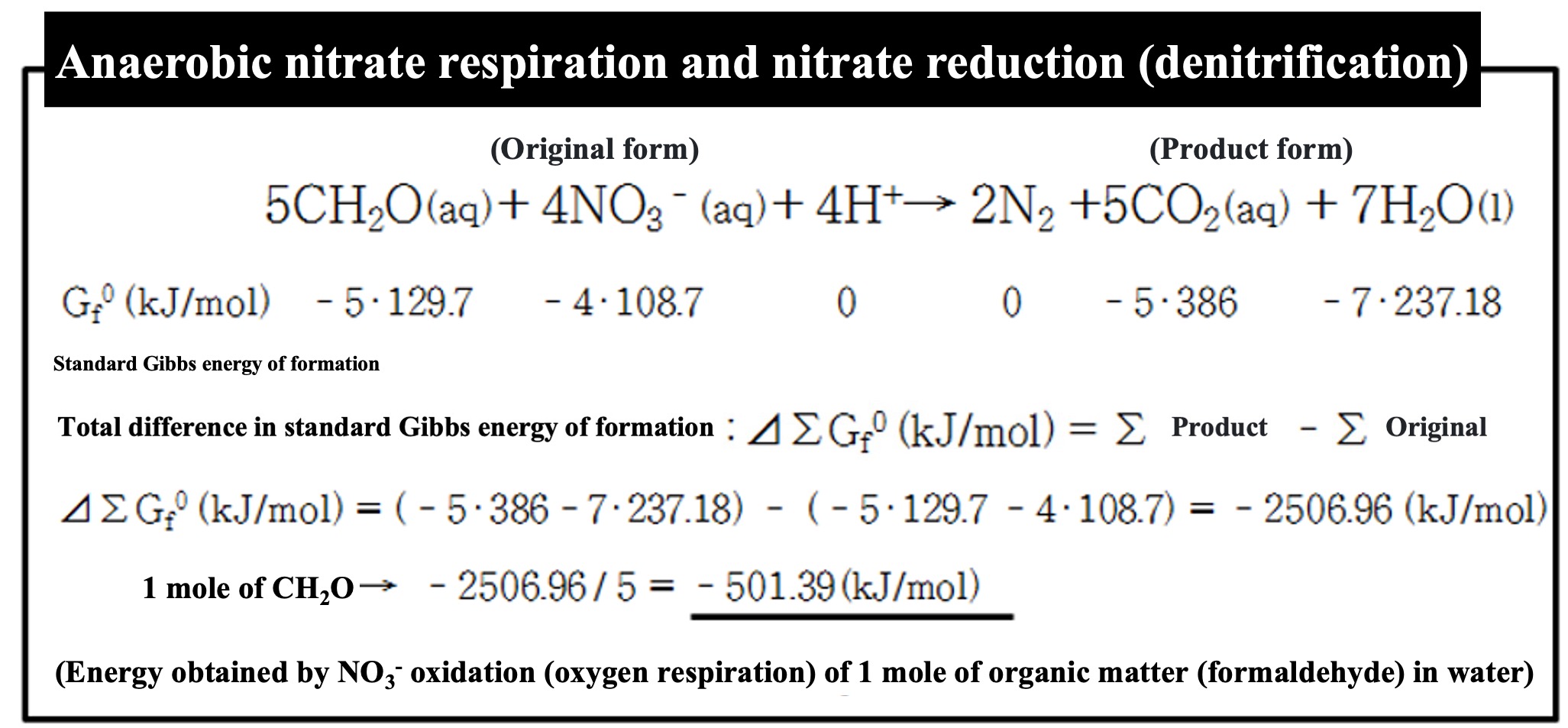
Although it appears that slightly less energy is gained from nitrate respiration than from oxygen respiration, nitrate reduction actually occurs in two stages. Nitrate-reducing bacteria exhale NO2- through NO3- respiration and then nitrite-reducing bacteria exhale N2 through NO2- respiration; splitting it into two stages (since the energy gained is split in half) makes it much less efficient than oxygen respiration.
Manganese respiration and iron respiration
Assume an environment where there is little oxygen and nitric acid, but lots of manganese oxide (MnO2) and organic matter. The environment would be like a pool of water where manganese oxide minerals are exposed and organic matter has accumulated.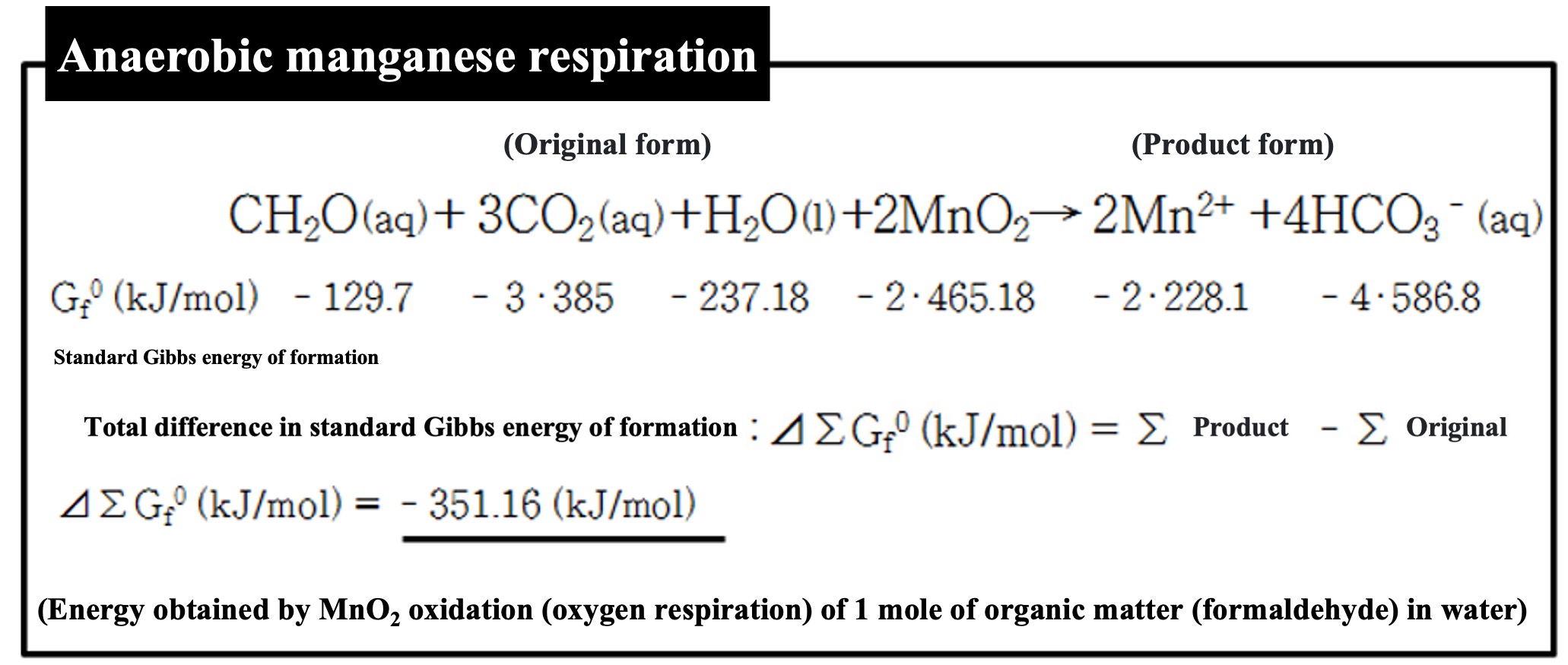
Some organisms (prokaryotes) have this specific form of respiration. There are also iron-breathing bacteria that use iron hydroxide as an oxidant, since iron is more common.
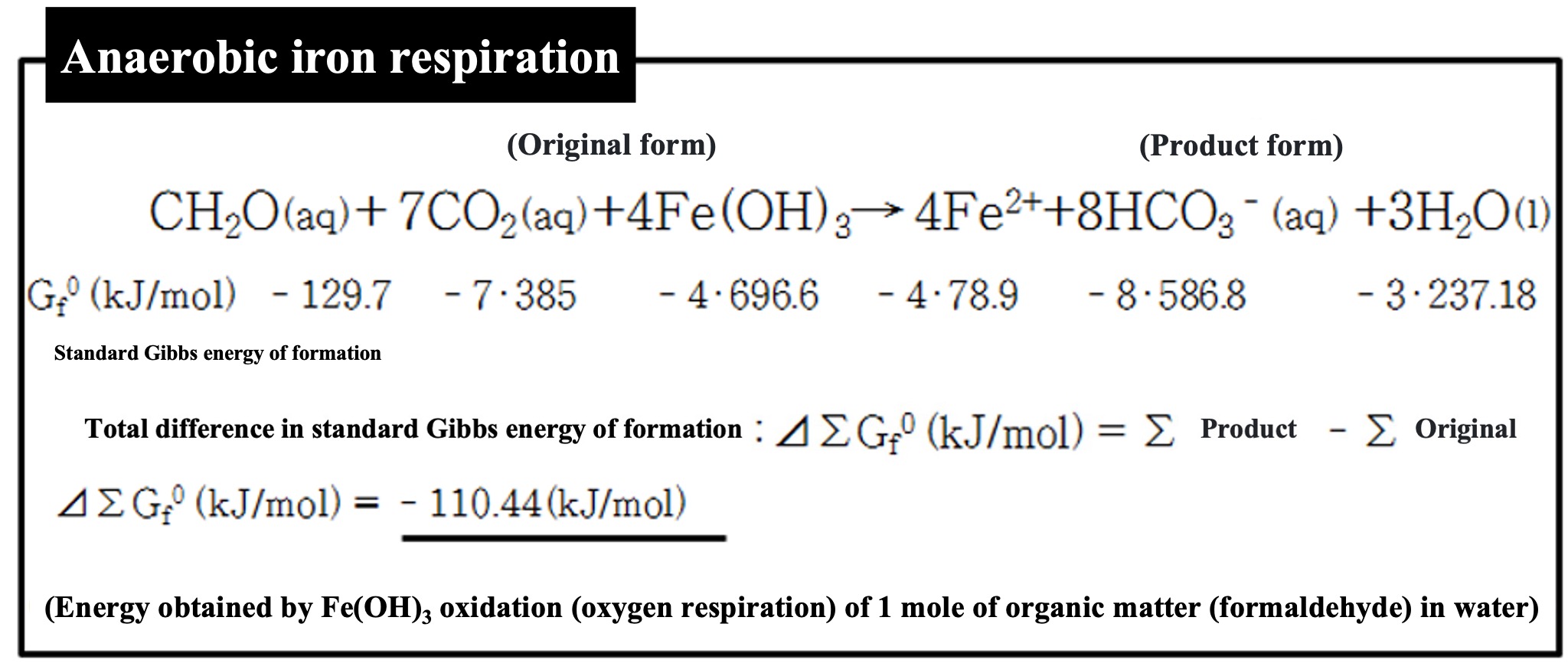
The energy gained is also much less, 110 kJ. -
Sulphate respiration
Oxygen and even nitric acid are gone, and without oxidized minerals such as manganese oxide and iron hydroxide, organisms that use sulfuric acid as an oxidizing agent will show their faces.
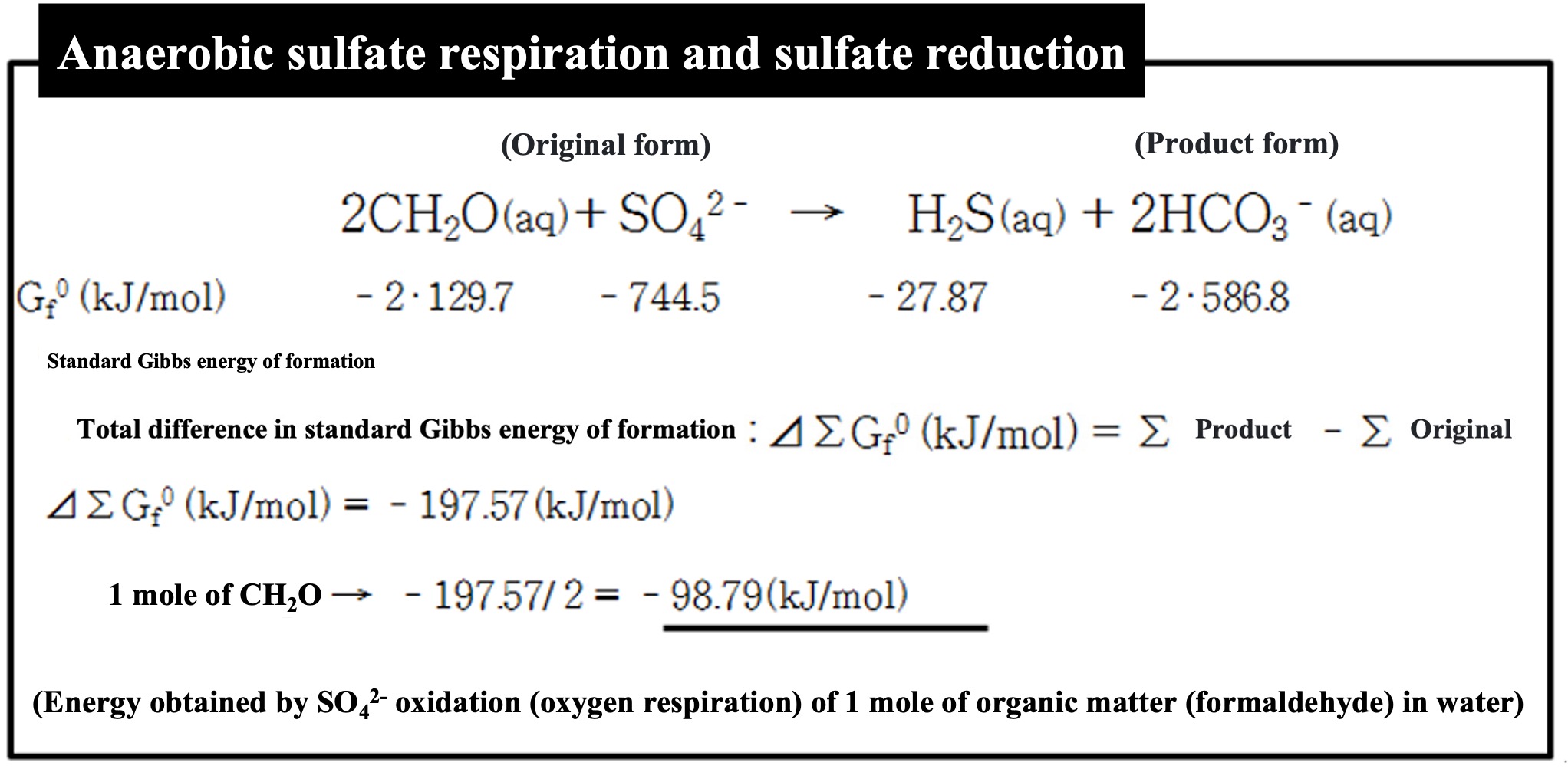
Of the dissolved sulfur compounds in the aqueous environment, sulfuric acid is the most energy-intensive to synthesize from its constituent elements (S and O). Stripping oxygen from such a stable compound requires a great deal of energy, and the energy available from organic matter is used to do so. This reduces the energy available to the organism, which is quite inefficient. It is precisely because of this harsh situation that bacteria with the special ability to reduce sulfuric acid dominate here and there.