
章节大纲

    •  What is important in the decomposition of particulate organic matter in the ocean is that there is a significant difference in the oxygen supply to the organic particles when they decompose in the water during sedimentation and when they decompose in the sediment after reaching the seafloor surface. In the open ocean, even in the pycnocline at depths of 700 - 1000 m, where decomposition of particulate organic matter is predominant, there are few areas where the oxygen concentration is zero (anoxic conditions occur in the Pacific Ocean off Peru and the Arabian Sea). However, in sedimentary layers located a few centimeters below the sediment surface, the oxygen supply from the seawater immediately above is severely limited. The supply of oxygen is so limited that it is not enough to decompose the organic matter that has accumulated in large quantities. When this happens, the marine sediments quickly enter a state of anoxia. As the decomposition of organic matter proceeds under anoxic conditions, various chemical changes occur that could not occur in seawater. The picture below shows how oxygen, nitrate ion, and sulfate ions seep in from seawater and oxidize and decompose organic matter (oxidants are reduced). Sulfuric acid is not reduced in seawater, but sulfate reduction occurs deep in the sediments.
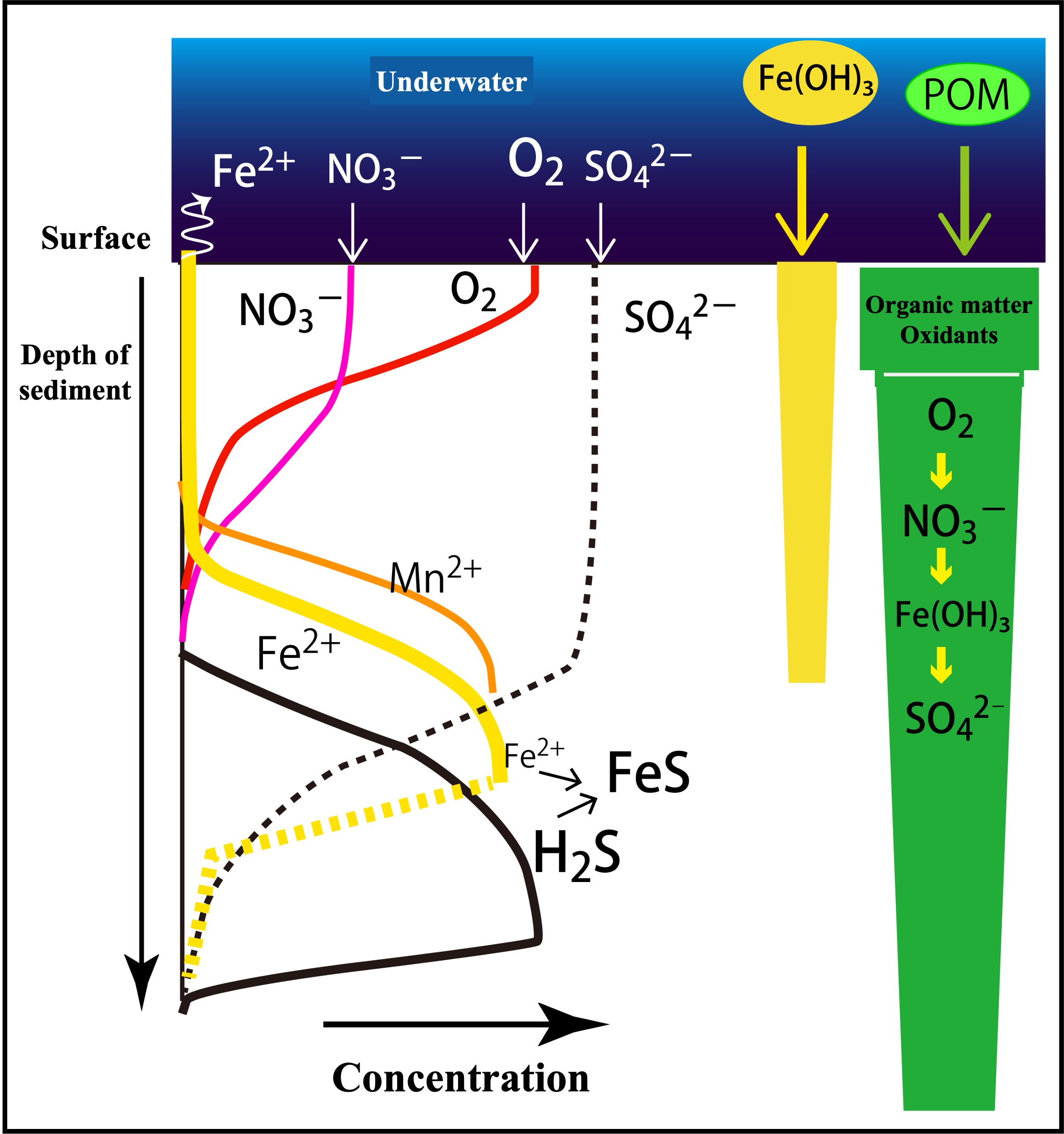
      No.271


    • Importance of redox potential in sediment chemistry


       The form of respiration (redox reaction) described above is determined by the high and low redox potential of the place. That redox potential is determined by the amount of oxidizing and reducing agents present in the field. Oxygen is a representative oxidant. Seawater is rich in oxygen supplied from the atmosphere. As a result, the redox potential is maintained at about +0.4 (V). If the amount of oxygen decreases, the potential also decreases, but normally the oxygen concentration in seawater never reaches zero. On the other hand, marine sediments are densely populated with microorganisms that decompose organic particles that fall from the surface, and their respiration rapidly consumes oxygen. The oxygen concentration in the sediment decreases from the surface (seafloor surface) to the deeper layers, and at some depth the oxygen concentration reaches zero. At some depth, the oxygen concentration becomes zero, and the redox potential also becomes zero. Even after the oxygen concentration becomes zero, anaerobic bacteria that use the organic matter as a source of nutrients will emerge if there is still some organic matter in the sediment. Anaerobic bacteria use nitric acid and sulfuric acid instead of oxygen as oxidants for respiration. In such cases, the redox potential is negative. The redox potential of the water determines which substances can be oxidants (which type of respiration is dominant).


       人Eukaryotes, including humans, breathe oxygen, and many prokaryotes (bacteria) also breathe oxygen. Some prokaryotic species are nitrate respirators, sulfate respirators, and methane fermenters. Because the redox potential decreases with depth in sediments, the dominant species vary with the depth of the sediment.

       ※More details on redox reactions and redox potentials will be explained in the "Analytical Chemistry" course that OOKI will be offering in LASBOS Moodle (please wait for a while).


       So far, I have talked qualitatively about marine sediments. What makes sediment chemistry interesting is that calculations based on theory match observations. Starting with the next course, this will be a difficult explanation, but somehow, please follow along.