

Chemistry of marine sediments (Introduction)
セクションアウトライン
-
-
Particles sedimenting on the seafloor
Organic matter produced in the ocean surface layer, mineral particles falling from the sky, and organic and mineral particles entering from rivers, settle in seawater, and only those that escape decomposition along the way are sedimented on the seafloor.
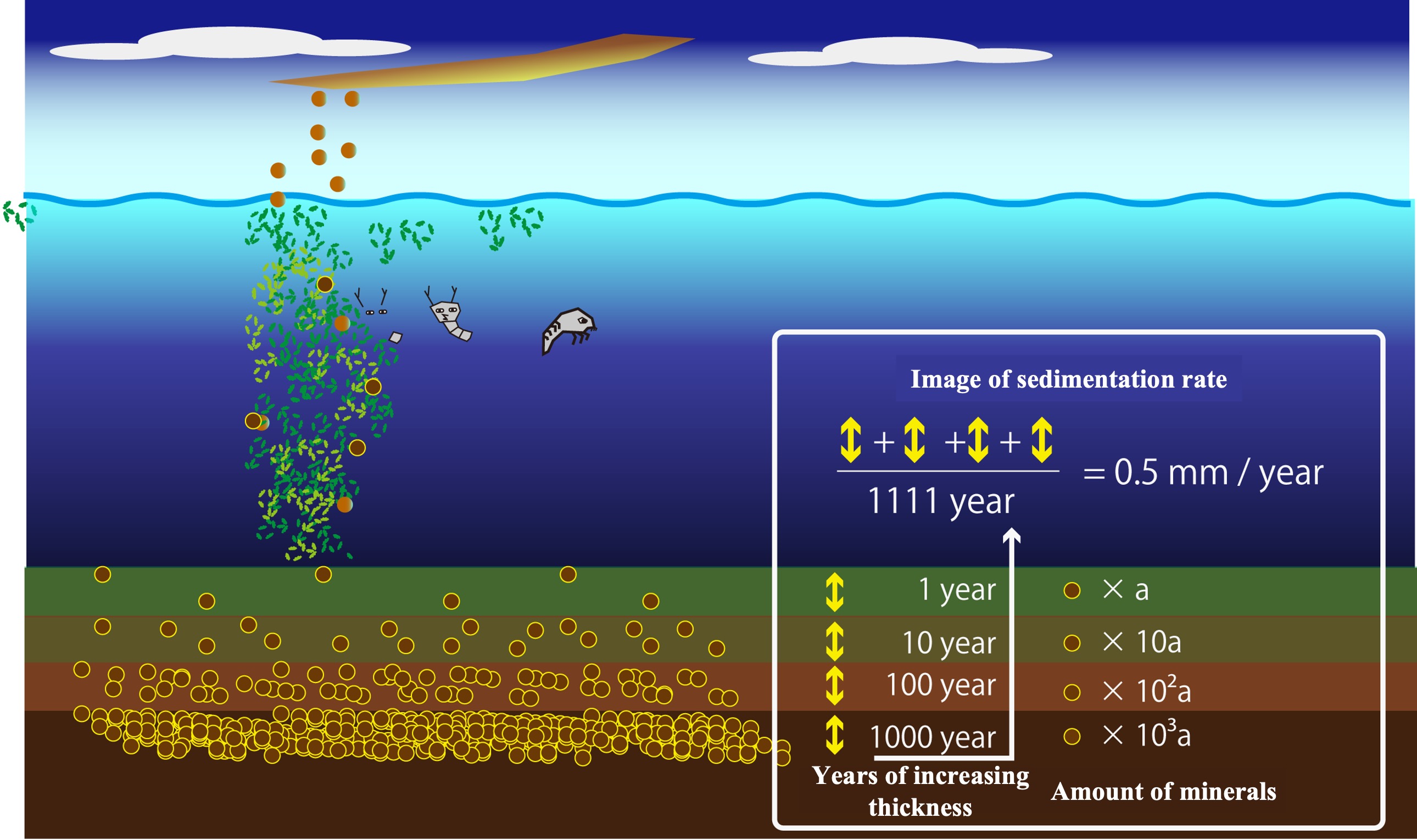
Most of the particles accumulated on the seafloor at a depth of 5,000 m in the middle of the Pacific Ocean are mineral particles that fell from the sky, and although there are probably a few, there are also organic particles and biogenic opal particles that have not been fully decomposed. According to a textbook of marine science (Sugimura, 1970[1]), the annual sedimentation rate in the open ocean region of the Pacific Ocean is less than 1 mm per thousand years. In the Bering Basin region, where biological productivity is very active, the sedimentation rate can reach 300 mm per thousand years. Even in areas with large sedimentation rates, it is only 0.3 mm per year. Is it true?
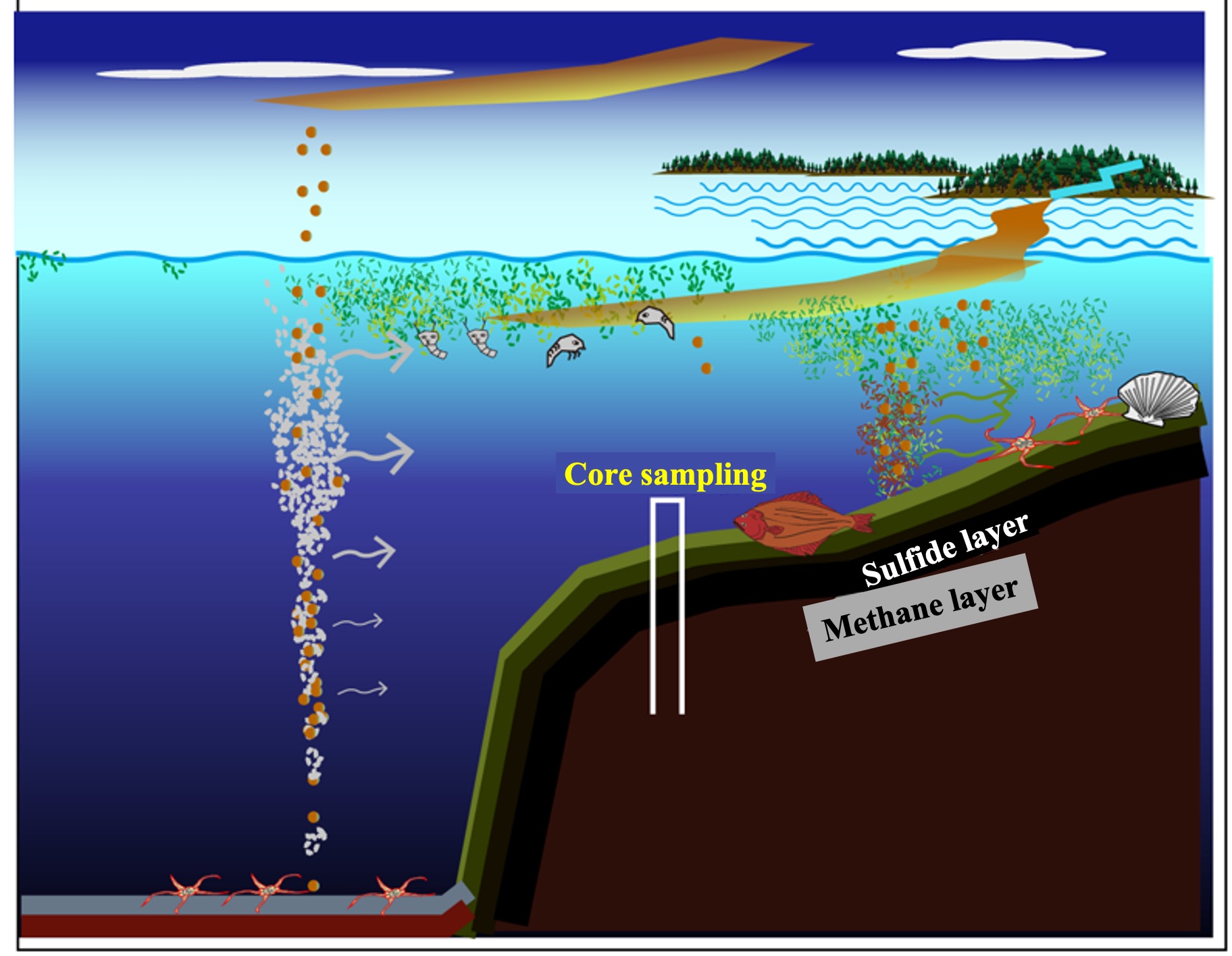
It is important to note that these sedimentation rate estimates were obtained by taking several meter long marine sediment cores (cylindrical samples) to determine how many millions of years ago the sediment layers at each depth were deposited and how many years it took for a given thickness of sediment to be buried under the seafloor. Even if there were lots of organic particles that reached the seafloor surface, if most of them decomposed in the sediment surface layer within a few months to a few years, they would not add up to the sedimentation rate above. If you set up a sediment trap on the seafloor surface and collect it after a year, you will capture a few millimeters of fluffy organic material being deposited. Over time, most of the organic matter in the sediment surface layer will decompose, resulting in a very slow sedimentation rate of <1-300 mm in a thousand years.
-
Marine Sediment Dating Methods
In the organic course, we discussed how to use the radiocarbon isotope 14C in seawater carbon (carbonic acid component or organic carbon) to estimate ages. 14C dating can only go back tens of thousands of years at best. To go back tens of thousands to millions of years, other radionuclides must be used.
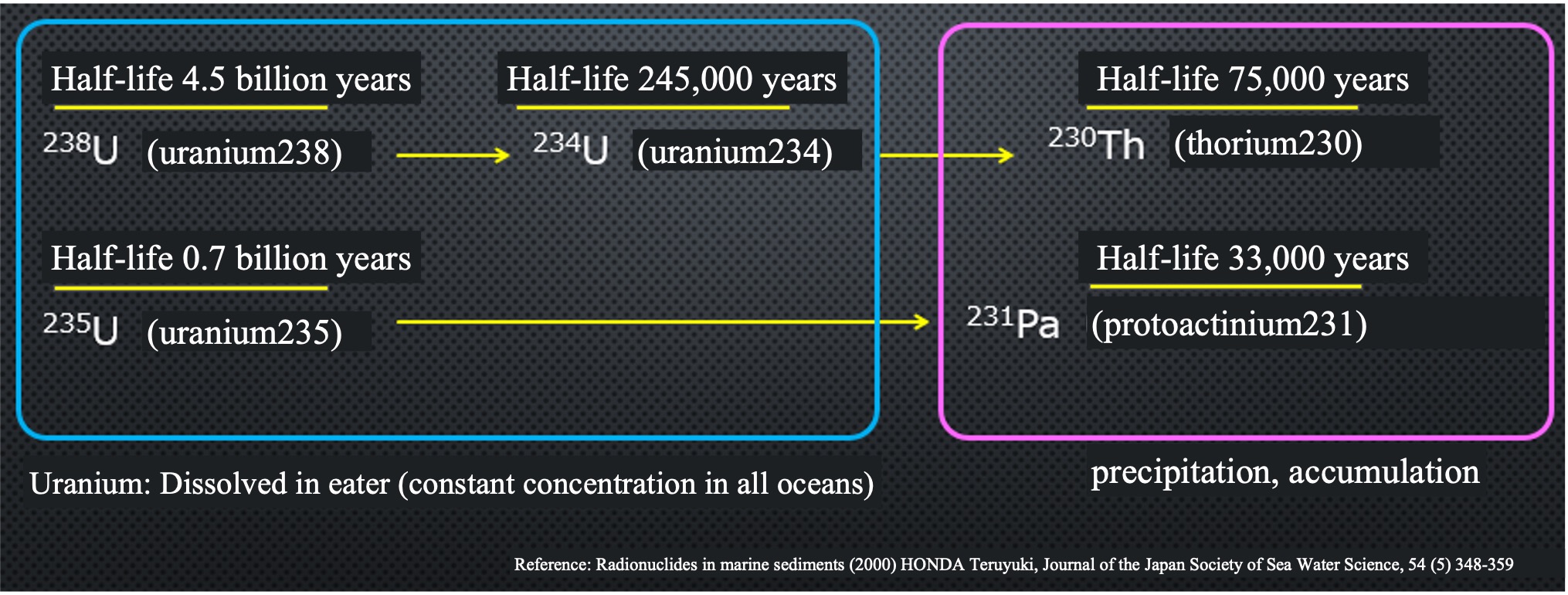
In seawater, 238U (uranium 238), which has a half-life of 4.5 billion years, is dissolved in a certain concentration, and when it undergoes radioactive decay (in the uranium series) starting from 238U, it becomes 234U. 234U undergoes radioactive decay with a half-life of 245,000 years to become 230Th (thorium 230) with a half-life of 75,000 years. Uranium is dissolved in seawater, but thorium instantly becomes particulate, so it tends to precipitate and concentrate on the seafloor by attaching to other settling particles.
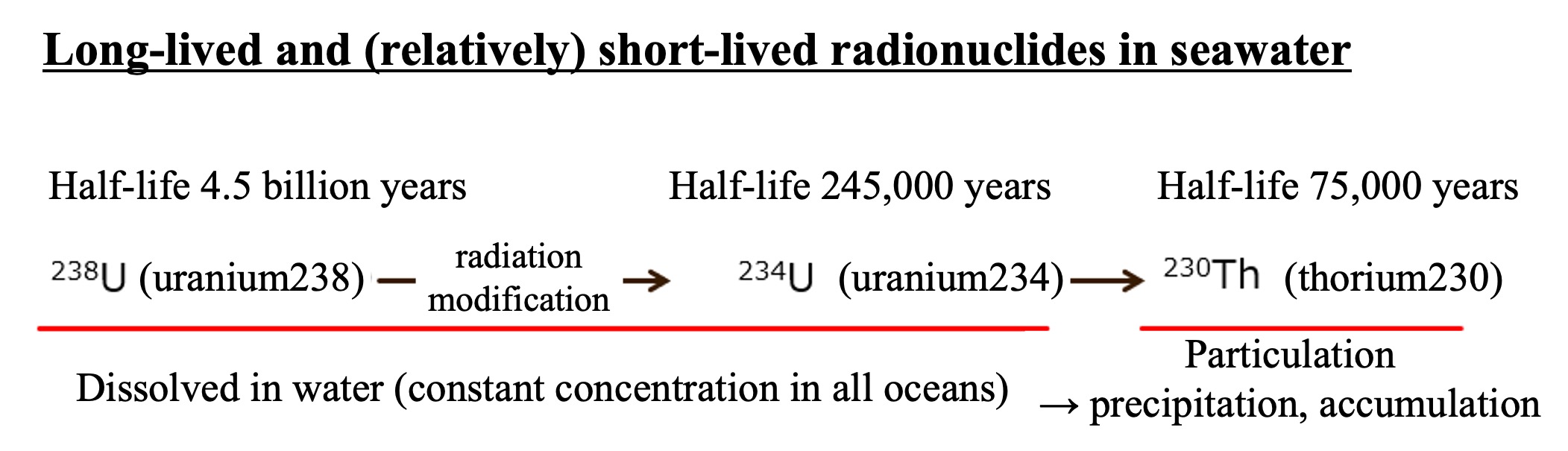
Uranium has been present in seawater at a constant concentration in the past. Therefore, thorium-230 is generated at a constant rate. The thorium-230 generated at a constant rate immediately attaches to the particles in the seawater and is deposited on the seafloor surface along with the settling particles. The particles with attached thorium-230 accumulate on the seafloor surface. The amount of thorium-230 buried in the sediment is reduced to half of its original amount after 75,000 years of radioactive decay. Deeper in the sediments, the proportion of thorium-230 present decreases with time. The ratio of thorium-230 to other radionuclides in the water in the crevices of the sediment (pore water) allows us to calculate the number of years since it was deposited on the seafloor surface.
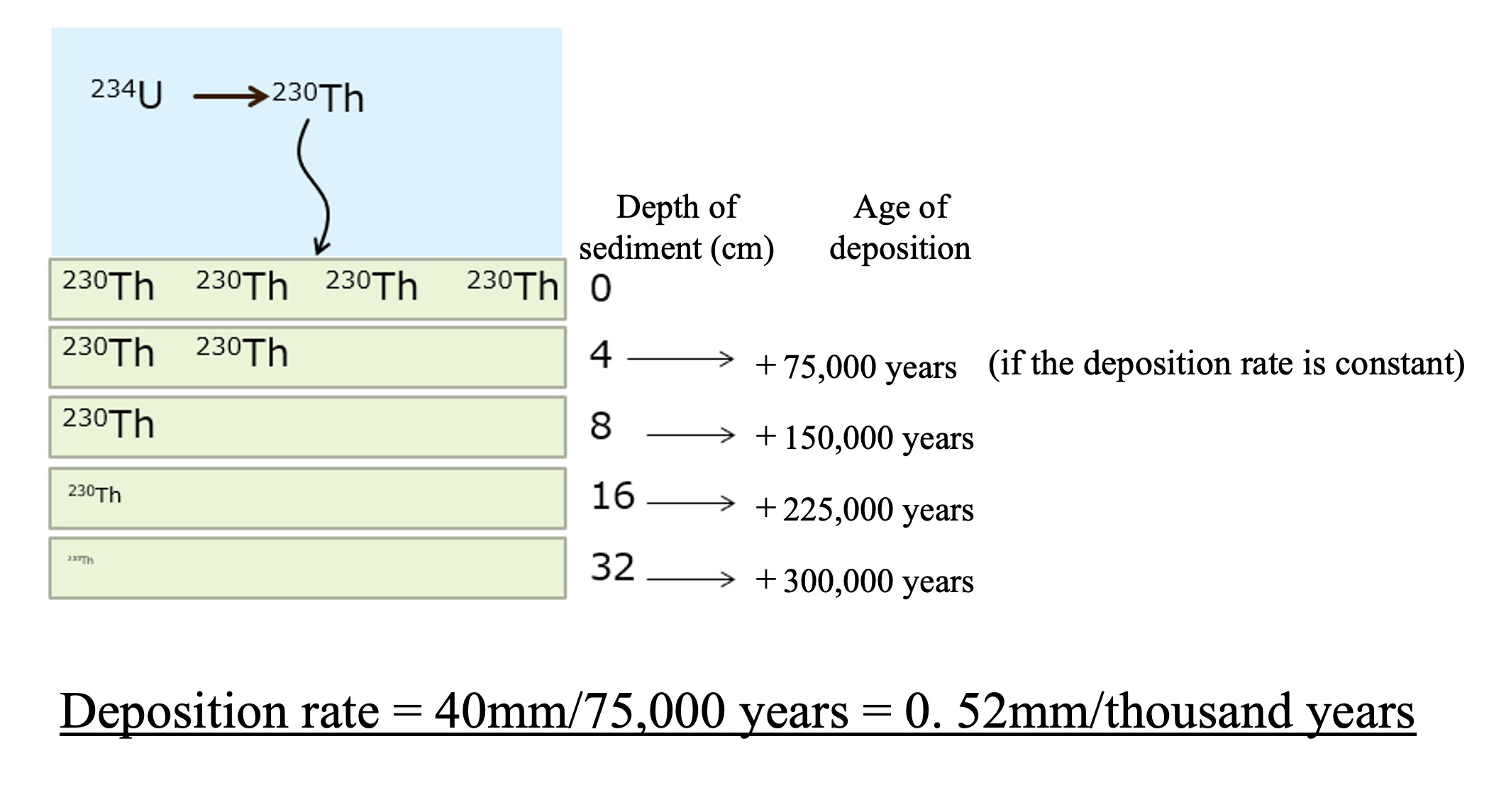
In the example above, we have shown how the abundance ratio of thorium-230 decreases by half as the sediment deepens by 4 cm. Since the half-life of thorium-230 is 75,000 years, this sedimentation rate is calculated to be 40 mm / 75,000 years = 0.52 mm / thousand years.
It is likely that it is the organic particles that remove thorium-230 from seawater. Most of those organic particles will decompose in the sediment and be gone in a few years. Clay minerals, biogenic opal, and calcium carbonate will remain in the sediment, although they are a small proportion of the settled particles. Thorium-230 does not decompose and will remain as particles in the sediment.
Again, it is important to understand that the sedimentation rate required by this method is the sedimentation rate of particles that remain undecomposed for tens of thousands of years.
-
There are a variety of radionuclides in nature. For example, protoactinium 231 (231Pa), which is formed by the alpha-decay of uranium 235, is produced in seawater and, like thorium, forms particles and is deposited on the sea floor. 231Pa has a half-life of 33,000 years. The ratio of 230Th to 231Pa in the sediment can be used to more accurately estimate the age of deposition.
For more information, please refer to the following paper.
-