
(3)Summary of collection operations
Section outline
-
-
(3) Towing net
The armored cable is unrolled and the underwater station is sunk directly down (vertically) to the target depth. The VMPS observation screen is shown in Figure 9. In this example, the red line shows the vertical distribution of water temperature, the blue line shows the rotation speed of the water filter (which is reset to 0 at the deepest point), and the green mark on the blue line shows the net open/close status.
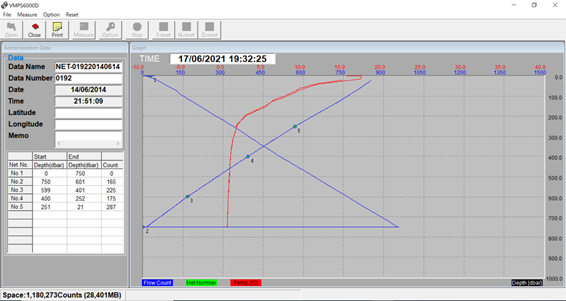
図9 VMPS Observation screen
Image courtesy of Dr. YAMAGUCHI Atushi (Faculty of Fisheries Science, Hokkaido University)
-
Figure 10 VMPS towing example
While the underwater station is being lowered, the depth sensor readings are continuously monitored on the onboard station monitor. As soon as the underwater station reaches the desired depth, the cable is hoisted and the towing begins. Since the plankton collection efficiency depends on the speed at which the net is moved, the cable is wound up at a constant speed to ensure that the collection efficiency does not vary during the tow. The net is opened and closed by sending an open/close signal from the on-board station at an arbitrary timing during the tow. Usually, a collection range (depth) is determined in advance, and the net is opened and closed when the underwater station passes through that depth. The net is sometimes monitored for water temperature, salinity, and other parameters, and the collecting area is determined based on these parameters. Also, when the underwater station is in the water, the ship must be maneuvered to avoid being separated from the station by currents and winds.
*Example of a Towing Net
An example of a VMPS tow net is shown in Figure 10. In this example, the net is opened and closed at three depths of 750, 500, and 250 meters during the ascent (tow) after the underwater station has been lowered to 1,000 meters. By doing so, the plankton community in four different ranges (0~250, 250~500, 500~750, and 750~1,000 meters) can be sampled separately in a single tow.
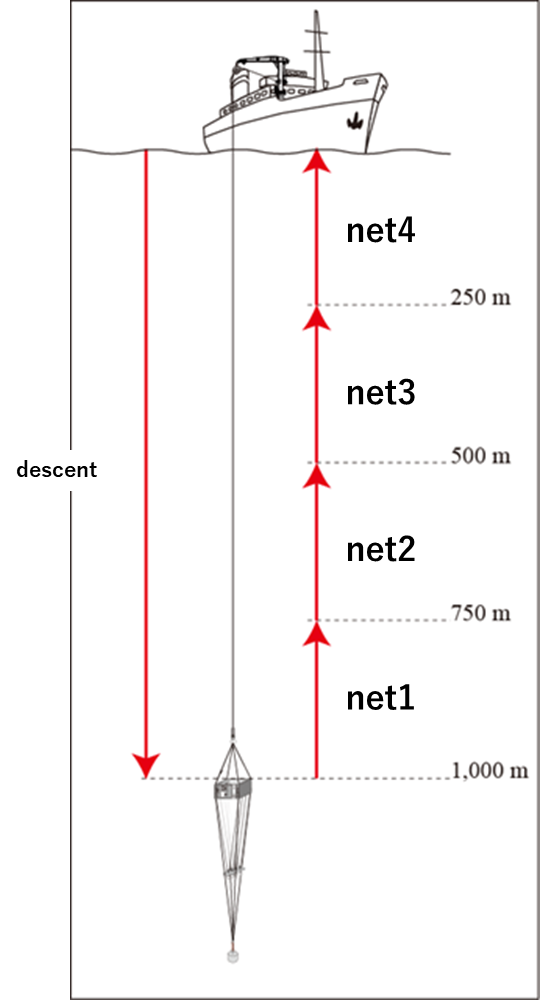
Figure 10: Example of VMPS towing
-
(5) Sample collectionThe collected sample is taken out from the codend. A vinyl chloride tube is attached to the cod-end, and the sample is collected in a bag made of nylon mesh or a bucket made of vinyl chloride fixed to the lower end of the tube. The bag-type codend is tied to the PVC pipe with a thin rope, and the bag can be removed by untying the rope (Figure 11-a). The bucket-type codend is fastened to the PVC pipe with a screw and can be removed by turning it counterclockwise (Figure 11-b). Transfer the contents of the cod-end into a sample bottle, being careful not to spill the contents on the deck.
dictionary
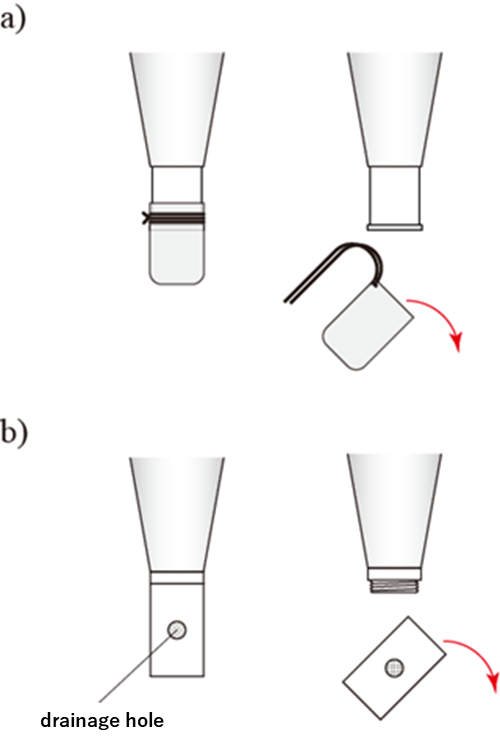
Fig. 11 Cod ends of VMPS
a) Bag type b) Bucket type