

Course Content
섹션 개요
-
-
Sediment trap observation to capture settling particles
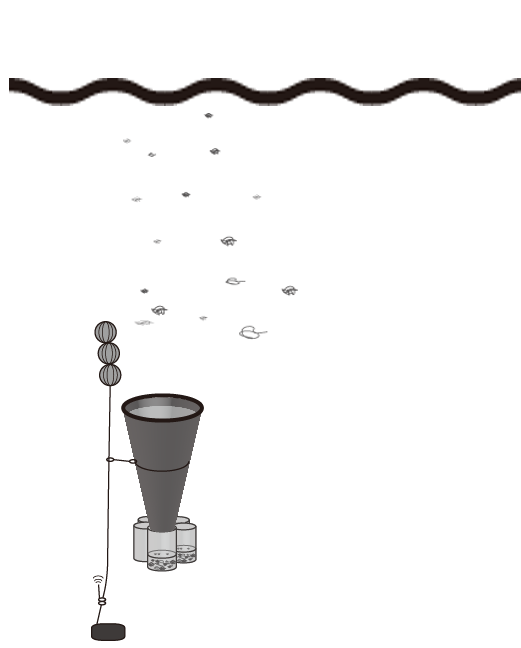
The only way to capture particles settling in the ocean is to submerge a large roto in seawater and collect particles falling from above. A cup is placed under the large rote to collect the particles and is rotated by a timer device. The particles that settle in each season can be collected in the cup. This is called a sedimentation trap. Every year, we have to go out to the distant ocean by observation ship to set up and collect the sedimentation traps. Currently, JAMSTEC is actively conducting sediment trap observations in Japan. Although it requires considerable effort and expense, it has provided valuable data for understanding the global environment, such as seasonal changes in sedimentation particles, factor analysis through component measurements, and long-term trends that can be captured by continuing the program for many years.
Sediment traps moored in the ocean can become unrecoverable due to some malfunction. Not only is the observation data lost, but the loss of expensive equipment is also a major economic blow. When we throw in a trap, we pour sake over it to purify it before throwing it in. (I'm not kidding.) After the trap has been deployed, it is up to God to take care of it.
① We transport the sediment traps by observation vessel to the area where we observe the settling particles
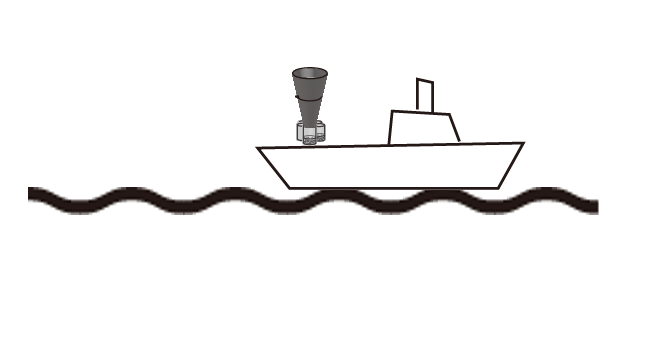
② Sediment traps are moored in the ocean and sedimentation particles are collected in sample cups for one year. The 24 sample cups are strung together so that they can be collected twice a month for one year.
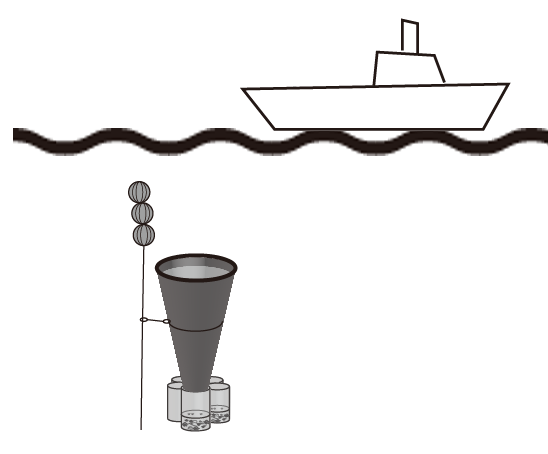
③ A year later, an observation ship will be in the same area, the sediment traps and weights will be detached, and the sediment traps will be floated.
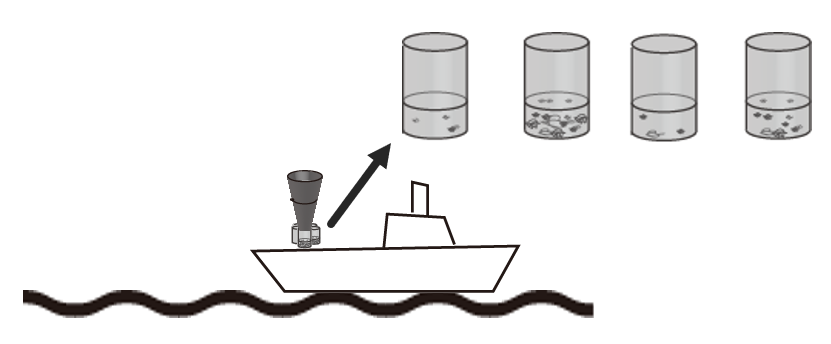
④ On board, the sample cup is removed from the sedimentation trap and the settled particles are processed.
In the past, the School of Fisheries Sciences at Hokkaido University also continued to conduct sediment trap observations, but no longer does so. We sometimes send out the Training Ship Oshoro-Maru to conduct sediment trap observations for large-scale research projects, such as the Arctic Research Project.
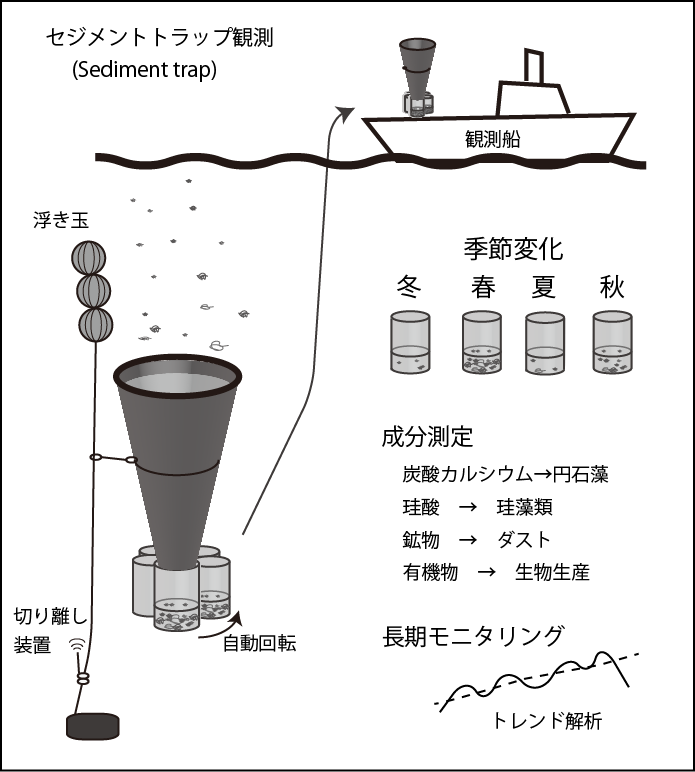
セジメントトラップ観測 Sediment Trap Observation
浮き玉 floating ball
切り離し装置 Detachment device
自動回転 Automatic rotation
観測船 Observation Vessel
季節変化 Seasonal change
冬 Winter
春 Spring
夏 Summer
秋 Autumn
成分測定 Compositional Measurements
炭酸カルシウム→円石藻 Calcium carbonate → circular calcareous algae
珪酸→珪藻類 Silicic acid → diatoms
鉱物→ダスト Minerals → dust
有機物→生物生産 Organic matter → biological production
長期モニタリング Long-term monitoring
トレンド解析 Trend analysis