

章节大纲
-
-
Transparent Exopolymer Particle (TEP): Transparent extracellular polymeric particles are made of acidic polysaccharides. As explained below, algae are thought to produce, clothe, and shed TEP.
-
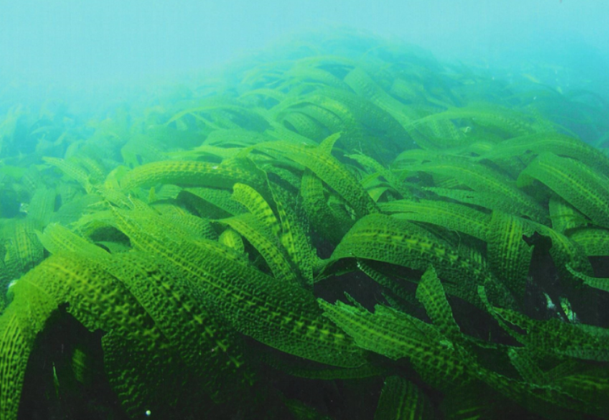
Eel larvae feeding on picoplankton attached to TEP
The photosynthetic bacteria cyanobacteria, Prochlorococcus and Synechococcus, are dominant inhabitants of the oligotrophic subtropical ocean surface layer. They are the smallest primary producers, ranging in size from 0.2 to 2 μm. Plankton of this size are also called picoplankton. For Synechococcus, it has been found that it alone releases TEP and makes aggregate (Cruz and Neuer, Frontier in Microbiology, 2019).
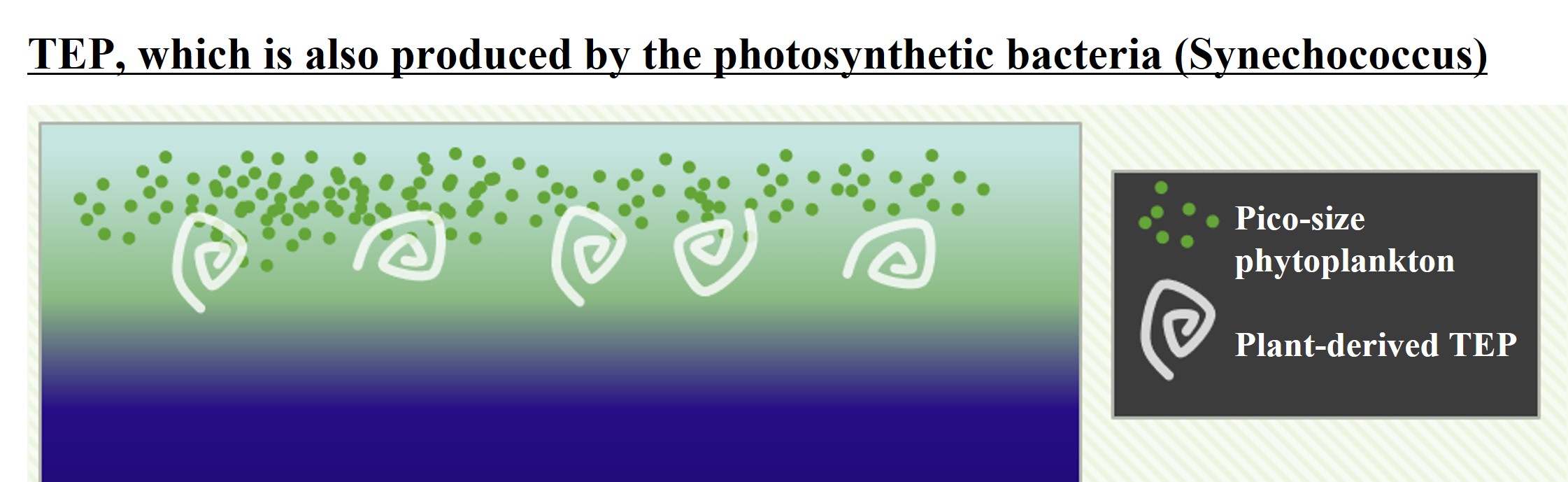
Eels are thought to spawn in the subtropical Pacific Ocean and their larvae migrate just below the chlorophyll maximal layer in the oligotrophic subtropical waters. In that layer, there is a large amount of phytoplankton-derived TEP produced in the surface layer suspended in the water.
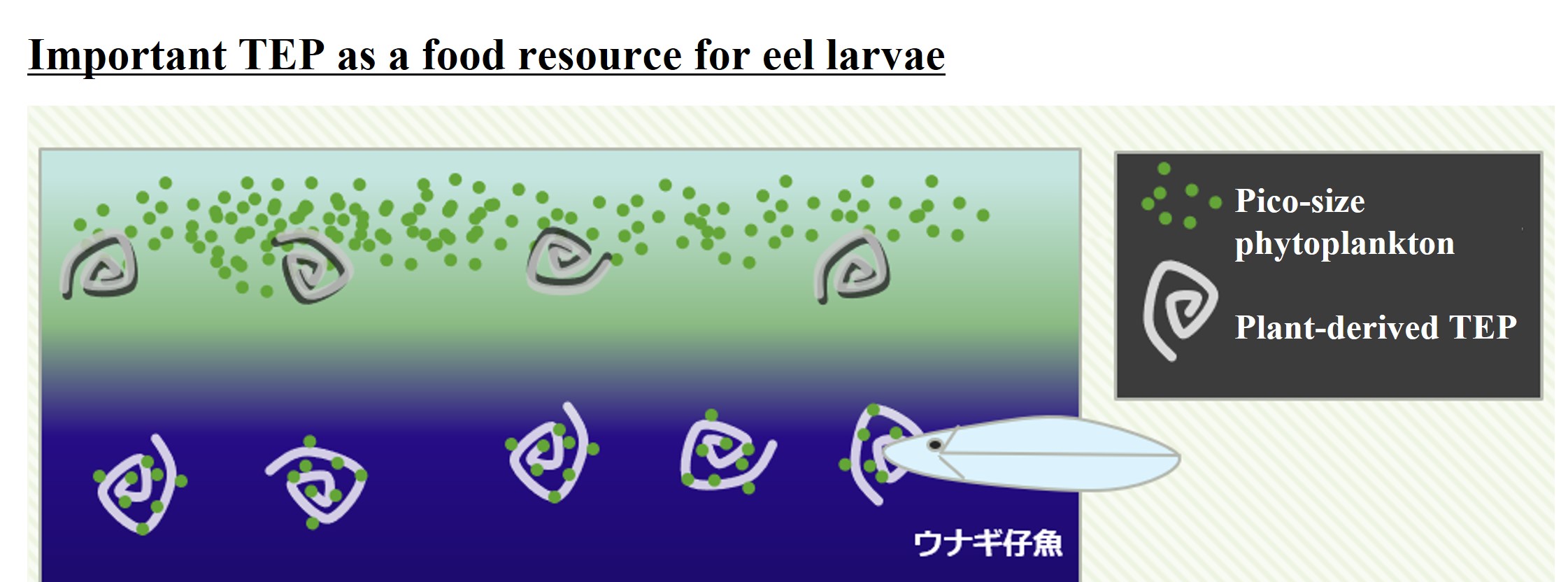 ウナギ仔魚:Eel Larvae
When we examined the digestive tract of eel larvae, we found many pico phytoplankton-like fluorescent particles in addition to TEP-like gel material. (Pico phytoplankton, a photosynthetic bacteria, has photosynthetic pigments that emit a different wavelength of light, fluorescence, when exposed to light of a certain wavelength.)
Pico phytoplankton is a major primary producer in subtropical waters. Their cell membranes are composed of proteins, and although they are small, they are rich in nutrients. However, because their cell size is so small (about 1 to 2 μm), conventional research has thought that only protozoa prey on picophytoplankton.
Picophytoplankton attaches to TEP floating in the ocean surface layer, and it is present in high density even just below the surface. When eel larvae were collected in the subtropical Pacific Ocean and examined in the digestive tract, many gelatinous substances thought to be derived from TEP and fluorescent particles thought to be picophytoplankton were found (Tomoda et al., 2015).
Tomoda et al, (2015) suggest that this is an important food resource for oligotrophic eel larvae. They also state that it provides important hints on how to raise eels during the larval stage, which is a problem in the complete aquaculture of eels.
Tomoda et al., (2015) is a publication in the Journal of the Fisheries Society of Japan, so they are focusing on it from the perspective of fisheries science, but from the perspective of oceanography, which is my specialty, it is very interesting because it provides a new route on the mass transport mechanism in oligotrophic waters. -
TEP floating in the ocean is attached to other organic particles (e.g., zooplankton feces) and is also home to a number of microorganisms. It is considered a valuable food resource for microorganisms. TEP-like gelatinous material is often found in the digestive tract of eel larvae.
-
Eel larvae are found at high densities just below the chlorophyll maximam layer. In that layer, there is a large amount of phytoplankton-derived TEP produced in the surface layer. In addition to TEP-like gel material, many picophytoplankton-like fluorescent particles were found in the digestive tract of eel larvae. Picophytoplankton is a major primary producer in subtropical waters. Their cell membranes are rich in nutrients, for example, they are composed of proteins. However, because the cell size is very small, about 1 to 2 μm, previous studies have thought that only protozoa prey on picophytoplankton. This study suggests that picophytoplankton attach to TEP floating in the ocean surface layer and exist at high density even just below the surface layer, where they become food for eel larvae.
I thought this research is very interesting from the viewpoint of oceanic material cycles.
-
We touched on the topic of picophytoplankton feeding by eel larvae. Speaking of "picophytoplankton" , Dr. SATO Mitsuhide of the University of Tokyo. Here is his paper in Japanese. He wrote about the feeding of picophytoplankton in detail.
-
It was Dr. Inoue of Hokkaido University's School of Fisheries Science who discovered and named marine snow. I would like to introduce a little of the background of this discovery.
Kuroshio, 1941
-
Some of the waters of the Pacific Ocean travel northward through the Bering Sea shelf area into the Chukchi Sea (Arctic Ocean).
Get to know the Arctic Ocean.
-