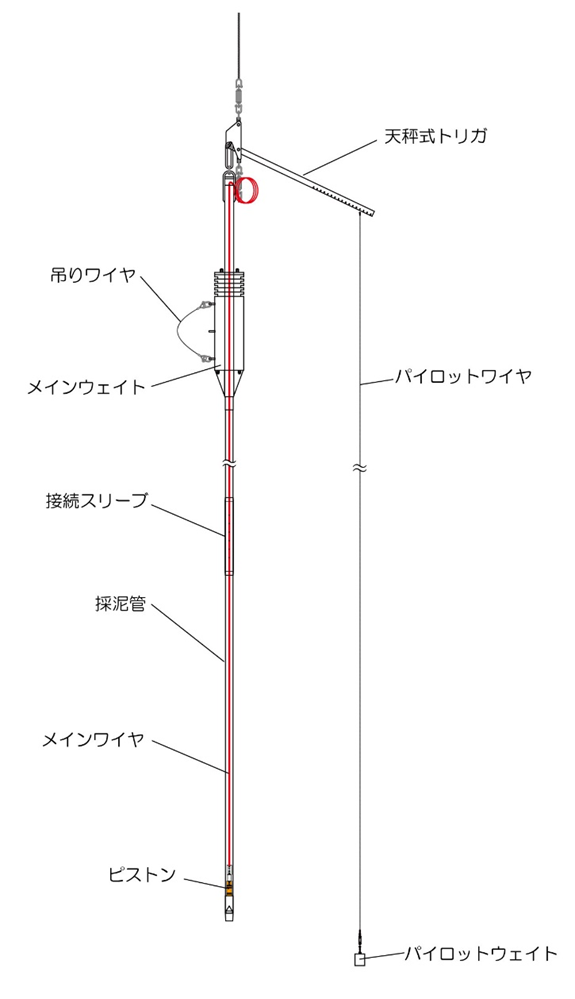
A schematic diagram of the bottom sampler is shown in Figure 2.
The part that collects sediments by free-falling through the water (hereinafter referred to as "bottom sampler") consists of a metal pipe (bottom sampler tube), a weight (main weight) weighing several hundred kilograms, and a piston, from which the name "piston corer" is derived. The trigger part for operating the bottom sampler consists of a balance trigger, pilot wire, and pilot weight. The mechanism of each part of the operation is described in detail in a later chapter.
Fig. 2 Schematic diagram of piston corer
吊りワイヤ Suspension Wire
メインウェイト Main Weight
接続スリーブ Connecting Sleeve
採泥管mud sampler pipe
メインワイヤ Main Wire
ピストン Piston
天秤式トリガ Balance Trigger
パイロットワイヤ Pilot Wire
パイロットウェイト Pilot Weight
The mud sampler pipe can be adjusted to the length of the desired sample by connecting several pipes together with a metal fitting (connecting sleeve). In some cases, a vinyl chloride inner tube of the same length may be attached to the inside of the mud sampler pipe to facilitate extraction and division of the sampled material. A main weight corresponding to the length of the mud sampler pipe is used to push the mud sampler pipe into the ground, because the longer the pipe is, the more force is required to push it into the ground.
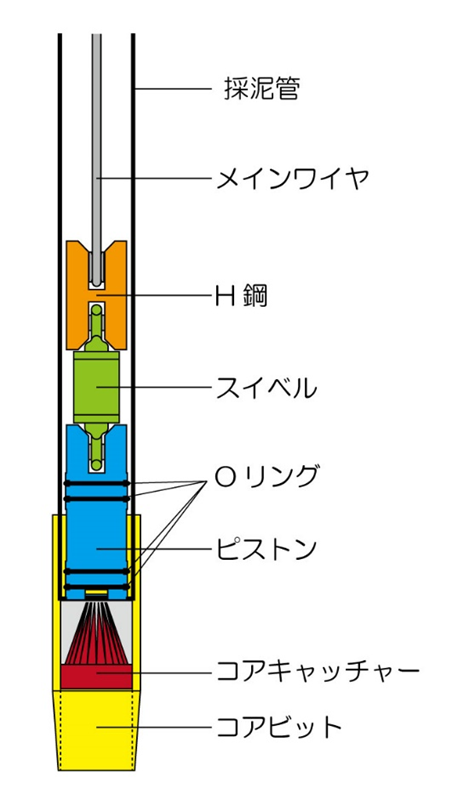
A schematic of the end of a mud sampler pipe is shown in Figure 3. The piston is connected to the balance trigger by a wire rope (main wire) that passes through the mud sampler pipe (Figure 2). The piston incorporates a rubber packing (O-ring), which adheres to the mud tube to maintain a watertight seal. A core bit with a pointed tip is attached to the bottom end of the mud sampler pipe to facilitate penetration of the mud sampler pipe into the sediment. In addition, a check valve (core catcher) is built into the core bit to prevent sediments in the core bit from falling out of the mud sampler pipe.
Figure 3 Schematic drawing of the tip of a mud sampler pipe