KEIRI Imai, KENJI Oguma, and KOUKI Sawada, Oshoro-maru Marine Science Department, School of Fisheries Sciences, Hokkaido University
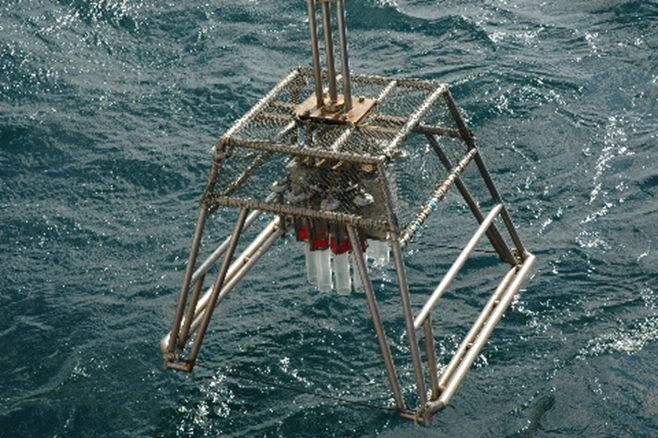
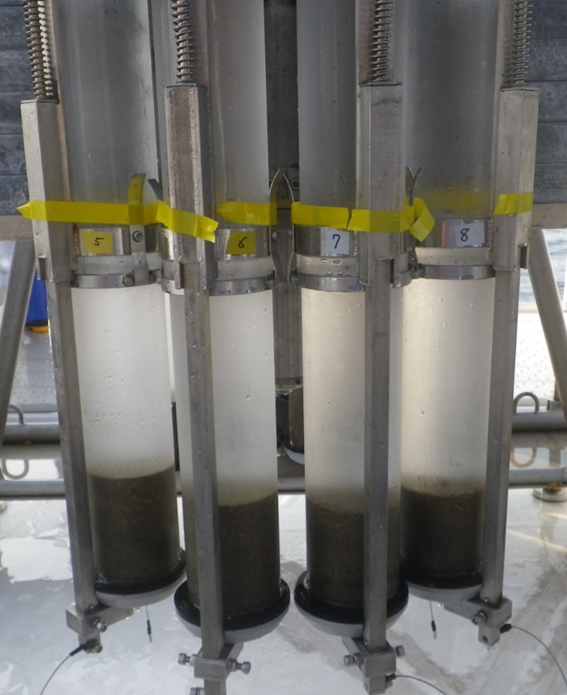
The multiple corer is a type of columnar bottom sampler that allows us to obtain samples that look as if they were cut directly from the seafloor and brought back on board.
In seawater, there are particles floating around, such as remains of organisms, excrement, and agglomerated microorganisms, which gradually settle as they lose buoyancy and eventually accumulate on the ocean floor. The phenomenon of particles being deposited on the seafloor can be thought of as an action that removes substances from seawater, and conversely, some of the deposited substances are released back into the seawater through decomposition actions. Clarification of the interaction between seawater and sediments (seawater-sediment interaction) is essential to elucidate the mechanism of material cycles in the ocean. However, the layers of material deposited on the seafloor surface are extremely soft, and even the slightest force can disrupt their structure. Therefore, the multiple corer, which is equipped with a mechanism that allows the corer tube to slowly penetrate into the sediment, has become an indispensable tool for modern oceanographic research as it can collect sediment and seawater directly above the sediment without disturbing the boundary surface. It is also used for research on the ecology of benthic organisms, as it is possible to collect organisms living in the surface layer of the seafloor along with their habitats.
This course provides a detailed explanation of the equipment configuration and mechanics of multiple corers as well as the actual mud sampling process.