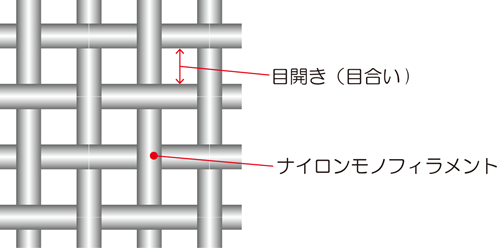
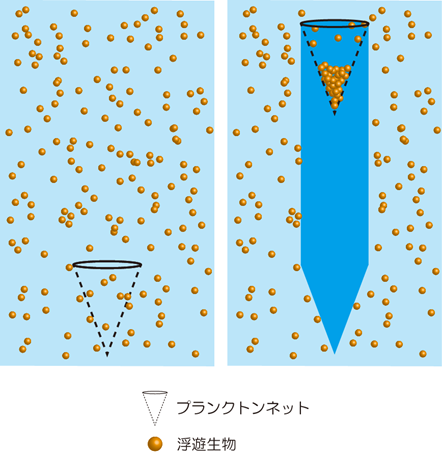
The basic structure of a plankton net is simple, with the netting attached to a frame that serves as the opening (net mouth). The frame is made of metal in most cases, and its shape is either circular or rectangular, depending on the type of net. Nylon mesh (Figure 1) is often used as the mesh material, and the size and shape of the mesh allows for sorting of the plankton community to be collected. Nylon mesh itself is widely used industrially by flour millers and other companies to adjust the particle size of powders, remove foreign matter, and for various types of filters. Nylon mesh is made by weaving nylon threads (nylon monofilaments), and there are various standards depending on the thickness of the threads, the gap (distance between threads), and the weaving method. Among these, the most commonly used are NYTAL XX13 (100 μm mesh) and NYTAL 52GG (335 μm mesh), which are used for phytoplankton and zooplankton, respectively. This mesh is sewn together into conical, cylindrical, or square pyramidal shapes, depending on the shape of the opening and the type of net. A metal or device (cotton end) is also attached to the tail of the net to remove the collected plankton community.