

Salinity of seawater changes due to evaporation at the surface and inflow of fresh water
섹션 개요
-
-
If you ask what is dissolved in seawater, the answer is likely to be "salt. The main components of "cio" dissolved in seawater are cations (Na+, K+, Mg2+, Ca2+, etc.) such as sodium, potassium, magnesium, and calcium, which are strongly electrolytic, and anions (Cl-, Br-, SO42-) such as chlorine, bromine, and sulfuric acid. SO42-). The total amount of ionic components dissolved in seawater is called salinity (see supplement).
The concentrations and ratios of these ionic components are almost uniform, but there are some characteristics that vary by region, as freshwater inflow and evaporation cause slight changes in salinity near the ocean surface. For example, subtropical waters are characterized by high salinity (34-37.5‰) due to evaporation exceeding freshwater inflow, while the opposite is true for subarctic surfaces, which have low salinity (32-34‰). The rough image is that water evaporated in the subtropics is brought to the subarctic by rainfall.
We have noted the salinity in the subtropics as roughly 34-37‰, but when compared to the North Pacific and North Atlantic subtropics, the North Atlantic has a higher salinity of 34-35.5‰ and 36-37.5‰, respectively. This slight difference characterizes the deep ocean circulation.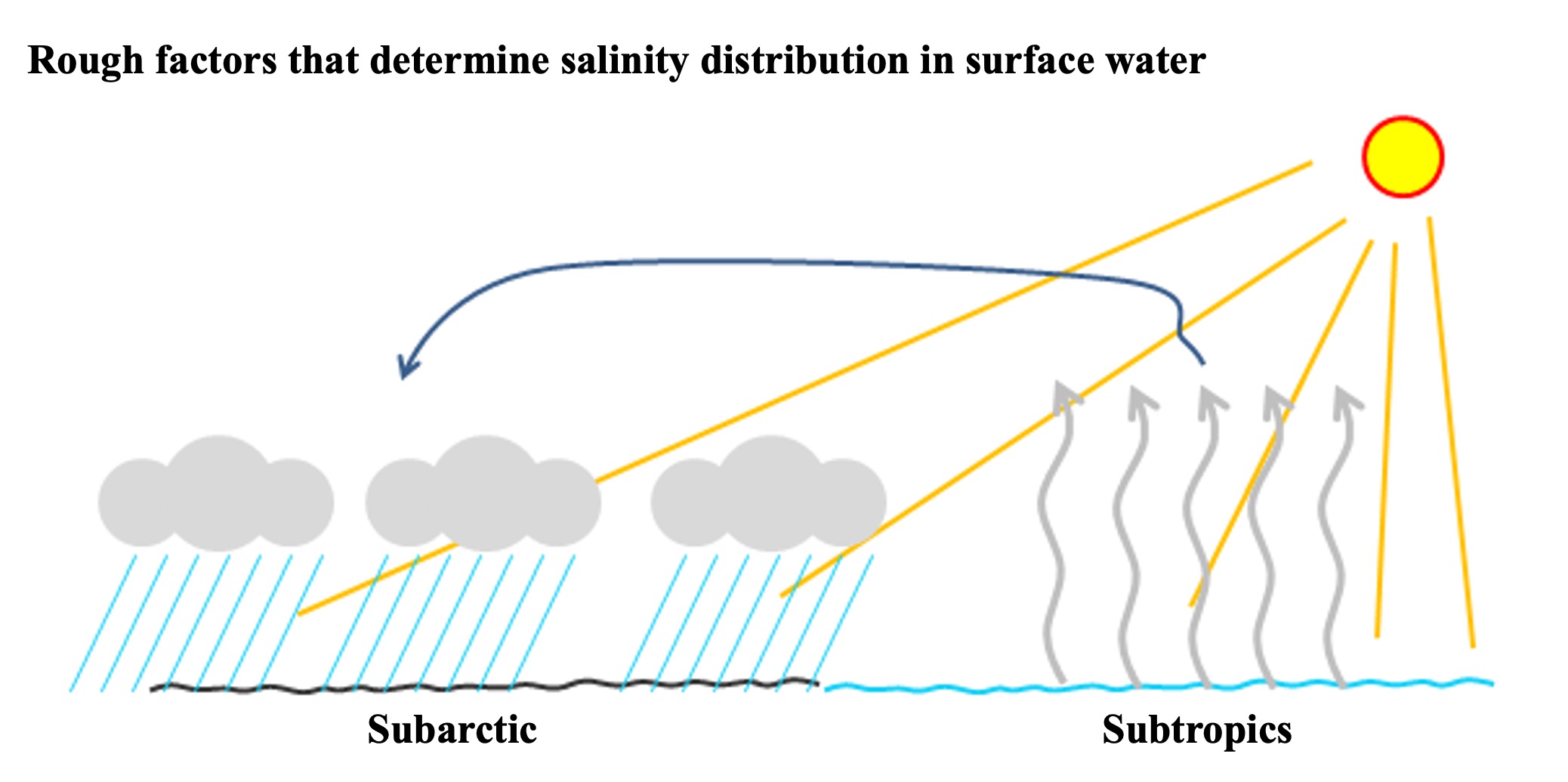
-
"Salt" in chemistry and "salt" in oceanography have different meanings.
-
Higher salinity in the Atlantic than in the Pacific
The subtropics are roughly characterized by high salinity and the subarctic by low salinity, but there are differences in surface salinity when compared to the Pacific and Atlantic. This difference is explained below.
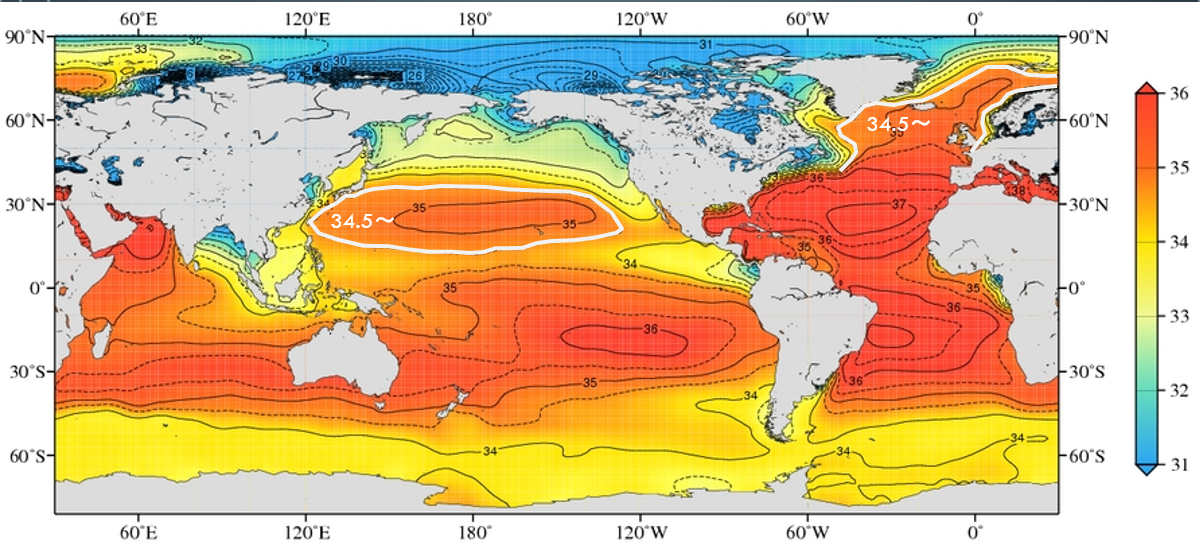
The figure below shows the distribution of salinity on the ocean surface, with darker red representing higher salinity. The white bold line indicates the salinity of 34.5. In the Pacific Ocean, the subtropical region is surrounded by the 34.5 salinity line. The North Pacific subtropics are in the salinity range of 34.5 to 36. The North Pacific Subarctic is below 34 salinity. The North Atlantic, on the other hand, has a salinity of 34.5 and above, extending all the way to the North Pole. The Atlantic Ocean has a higher salt content than the Pacific Ocean. Why does this happen?
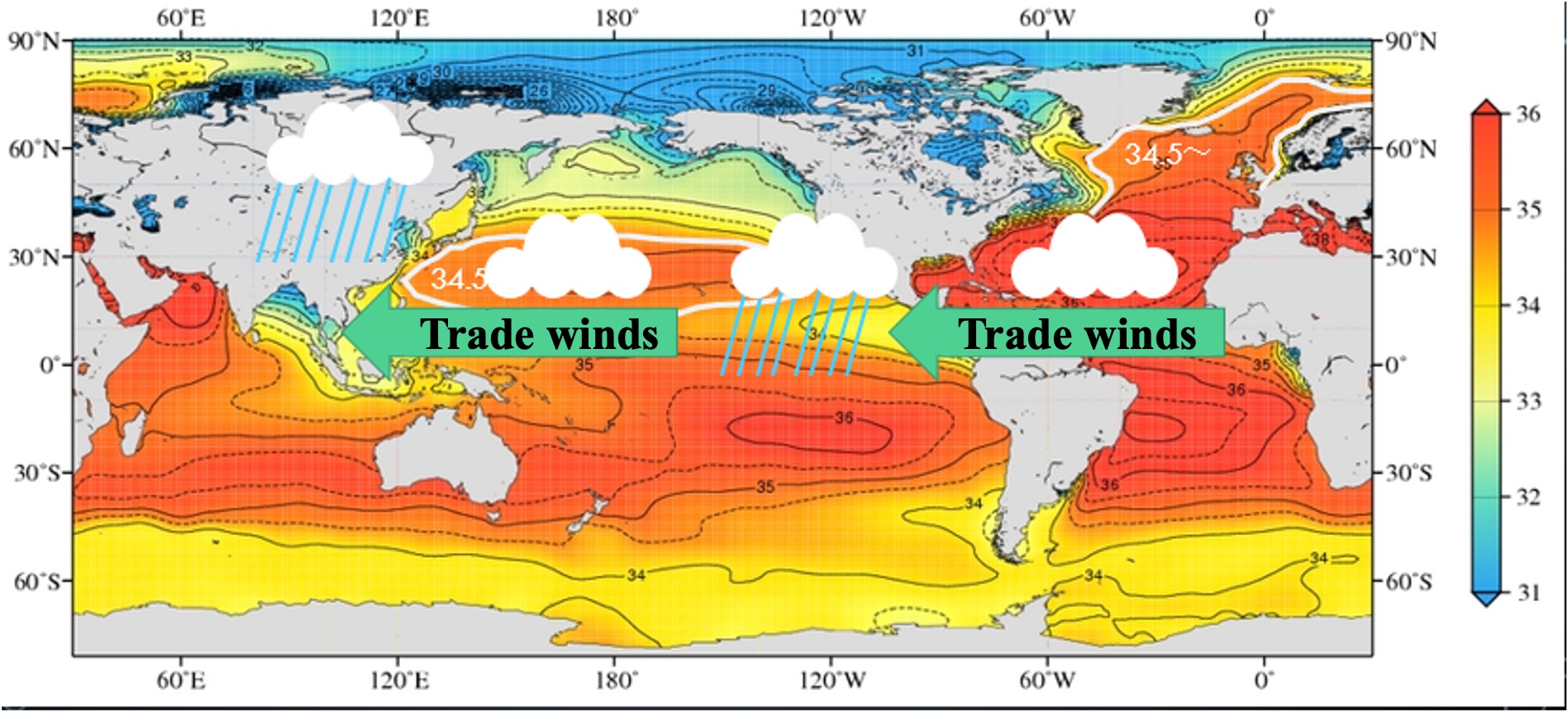
Moisture-rich air that has evaporated in the tropical and subtropical Atlantic is swept westward by the trade winds and brought to the Pacific Ocean over the low mountains of Central America. Evaporation is also active in the subtropical and tropical Pacific, and the moisture-rich air is carried westward. Moisture that is carried westward in the Pacific is returned to the Pacific as river water by the monsoons, which bring rain to the land.The subarctic moist air in the Pacific is swept eastward by the prevailing westerly winds, intercepted by the Rocky Mountains in North America, and returned to the Pacific. The result is high-salt differentiation in the Atlantic Ocean and low-salt differentiation in the Pacific Ocean.
-
View (and download data for) surface to deep water profiles of temperature, salinity, oxygen, nutrients, etc. Select the parameters you wish to view and choose the resolution (1 or 1/4 degree) and water depth.
-
Compare the salinity of the surface layer of the North Pacific Ocean and the North Atlantic Ocean
Salinity in seawater is expressed in per thousandths of a percent. We usually use percentages in hundredths, but salinity in oceanography is expressed in thousandths of a permil. The Atlantic Ocean is two to three per mils saltier than the Pacific Ocean. The Atlantic Ocean is more salty than the North Atlantic and the North Pacific when compared between the subarctic and arctic zones. The Atlantic Ocean is also more salty than the subtropical Atlantic Ocean. Let's visualize the difference in salt content.
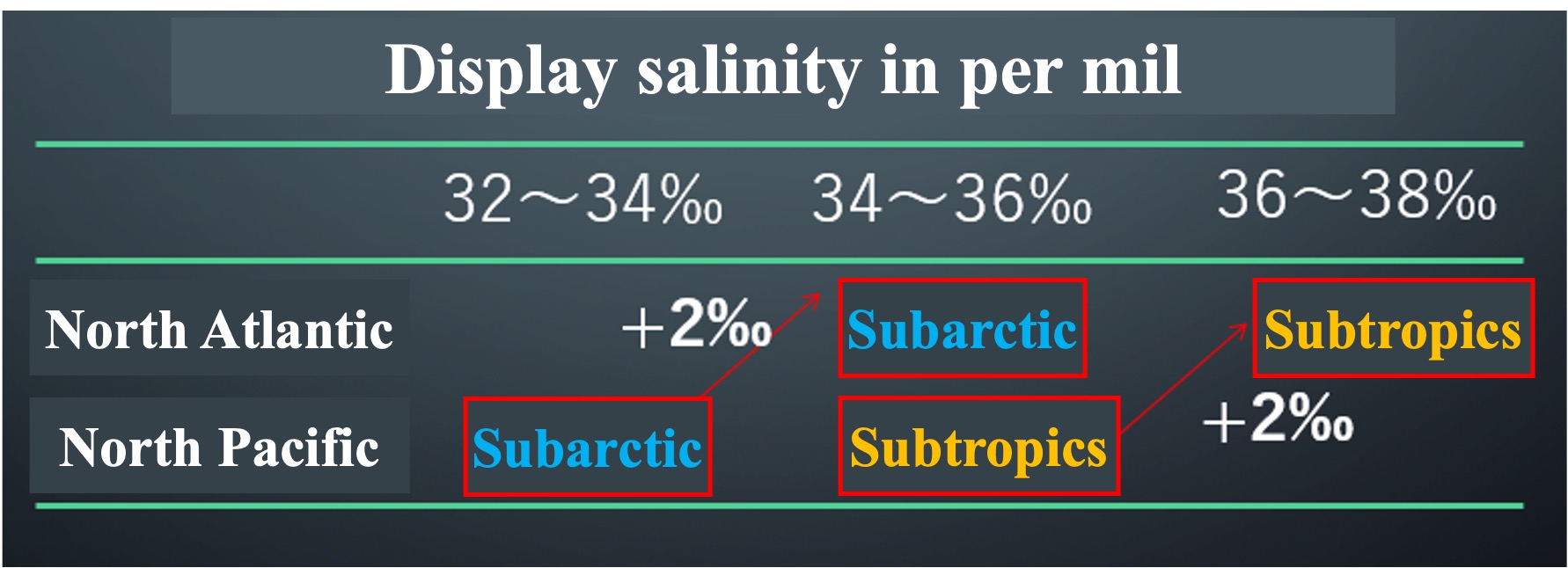
1000 g approx. 1 L of seawater with 34 g of salt is 34‰. The salinity of the Atlantic subarctic surface layer is 34-36‰, so 1 L of water measuring 10 cm x 10 cm x 10 cm contains about 35 g of salt. The salinity of the Pacific subarctic surface layer is 32-34‰, so 1 L of water contains about 33 g of salt. What is the difference in the amount of salt between the Atlantic and Pacific Oceans?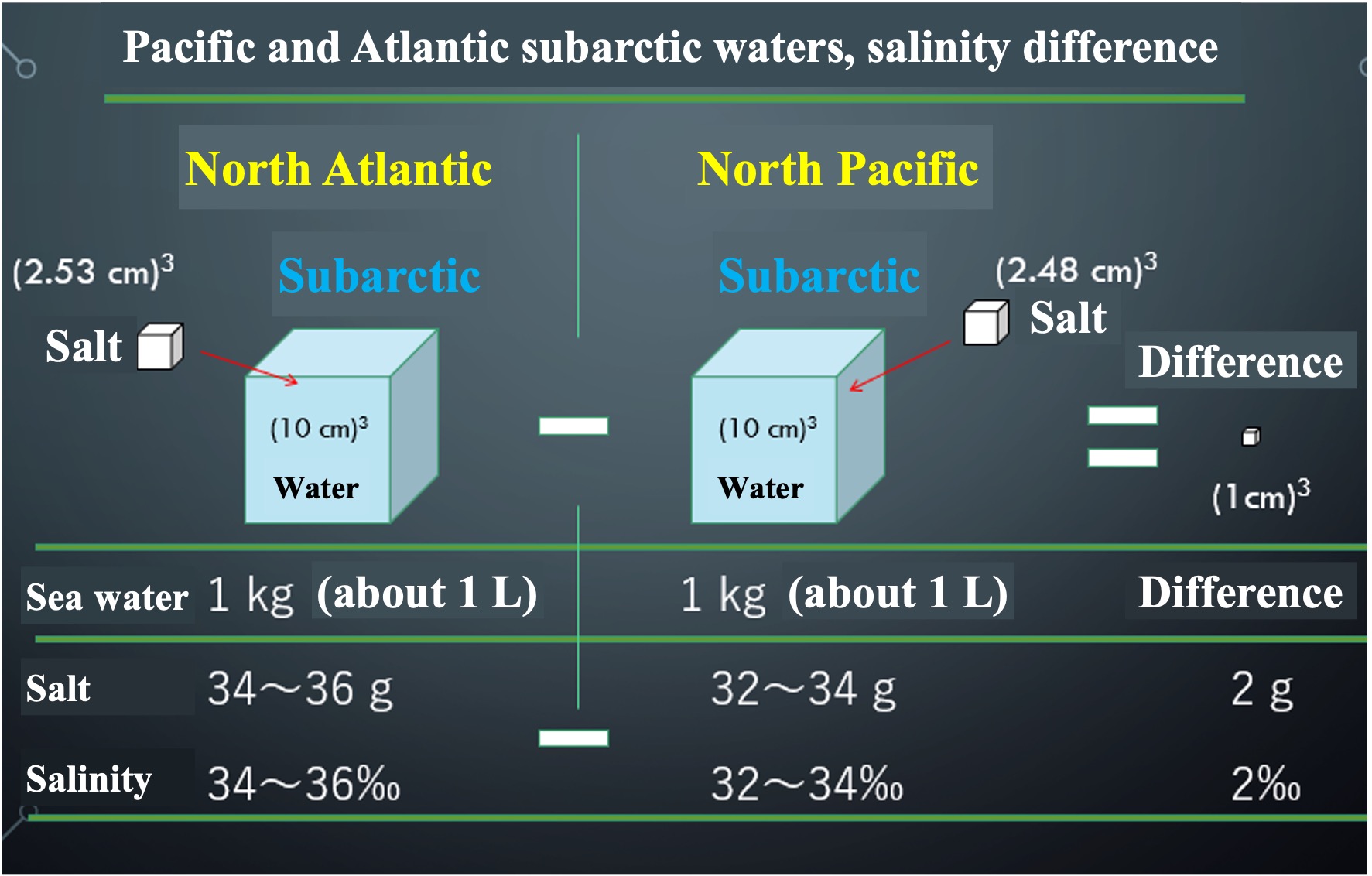
If we take the difference in the amount of salt between the Atlantic and Pacific Oceans, the difference in salinity is 2‰ and the difference in weight is 2 g. The 2 g weight difference is equivalent to 1 cubic centimeter of salt in volume. This difference in the amount of salt contained is what creates the ocean general circulation, which is driven by the density difference of seawater.
Calculate the density. In the subarctic zone of the North Atlantic and North Pacific, sea water is cooled in winter. Suppose the water temperature drops to 2°C. Calculated density at that time is 1.02829 g cm-3 for the Atlantic Ocean. The Pacific is 1.02668 g cm-3. The difference is only 0.0016 g cm-3.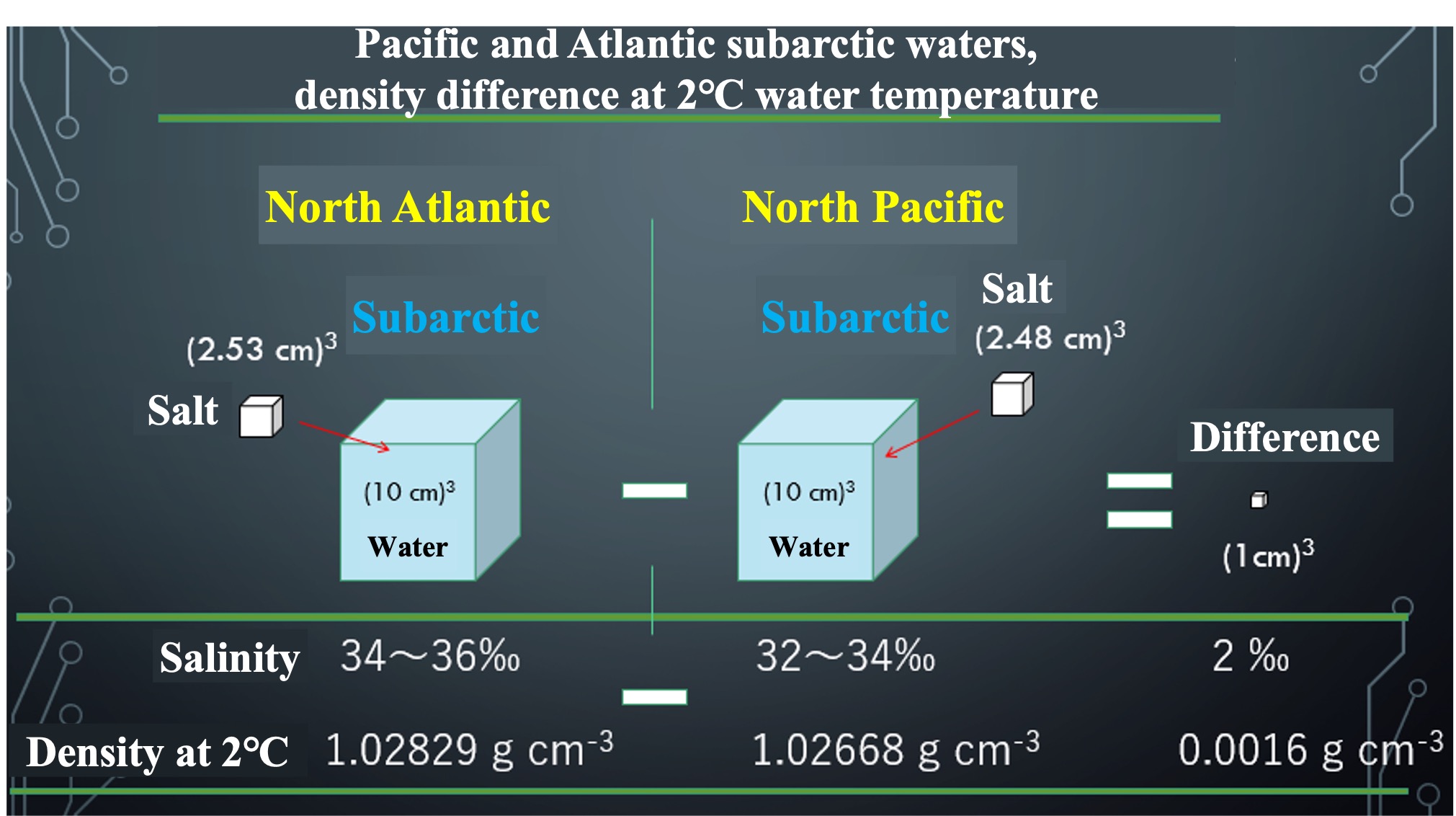
Surface water in the subarctic zone can rise to a water temperature of about 13°C in summer. The density at that time was determined. The density of water at 13°C in the Atlantic subarctic is 1.02671 g cm-3, which is the same as the density of water at 2°C in the Pacific subarctic. Water in the Pacific cannot be heavier than water in the Atlantic, no matter how much it is cooled. When surface water cools rapidly in the subarctic North Atlantic and becomes denser and sinks to the depths, the deeper water is pushed down to the deeper layers of the Pacific Ocean in a roundabout way.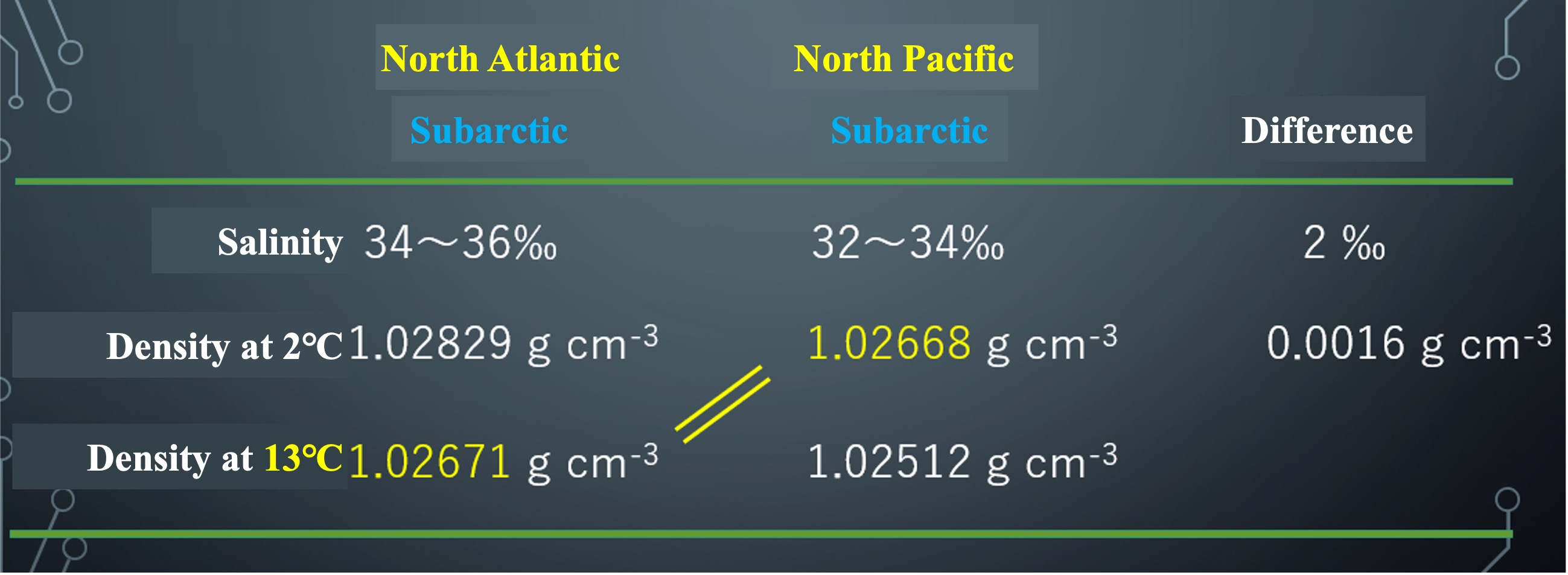
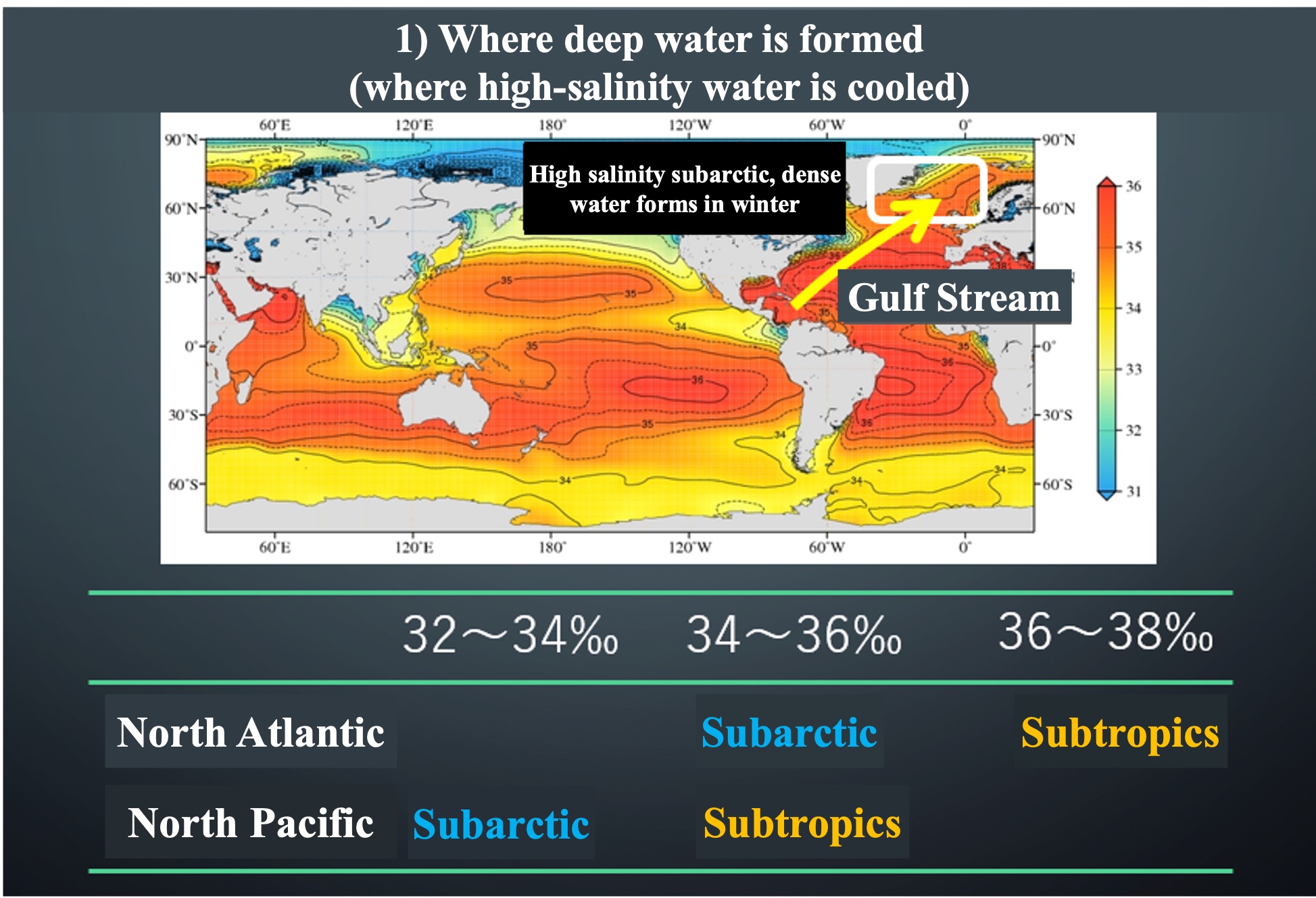
Once again, let's look at the salinity distribution at the ocean surface. The high-salinity subtropical Atlantic waters are carried to higher latitudes by the strong currents of the Gulf Stream. When this high-salinity surface water cools rapidly near the North Pole, it creates high-density water that gravity falls to the deeper ocean layers. As the water is supplied to the deeper layers each winter, it is pushed away. This is the start of the deep circulation. The deep circulation will be explained in the next article.
-
Summary of ocean salinity
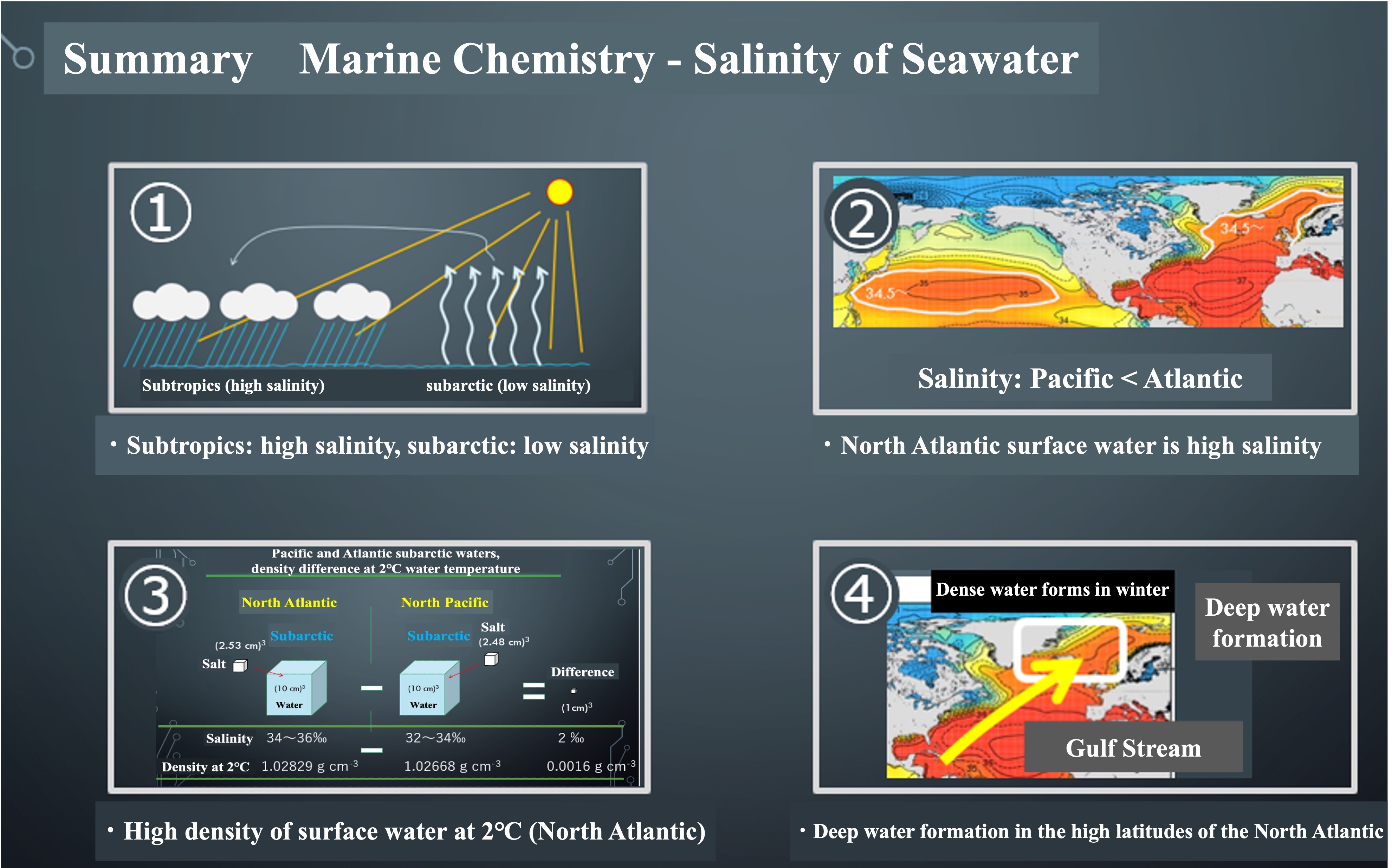
The salinity of seawater is summarized in the figure below.
① Evaporation predominates in surface water in the subtropics, resulting in high salinization, while freshwater inflow predominates in the subarctic, resulting in low salinity.
② The surface waters of the North Atlantic are highly saline. High-salinity water with salinities of 34.5 or higher is distributed even in the high latitudes of the North Atlantic.
③ We calculated the density of high-salinity North Atlantic subarctic water when the water temperature drops to 2°C in winter.
④ In the North Atlantic, the high-salinity water that is carried northward by the Gulf Stream cools and sinks in the winter, forming deep water.
-
How can we study sea surface salinity from satellites? "Don't you think it's strange?"
-