セクションアウトライン

    • Environmental DNA from filter cartridge was extracted and quantitative PCR was performed using specific primers.

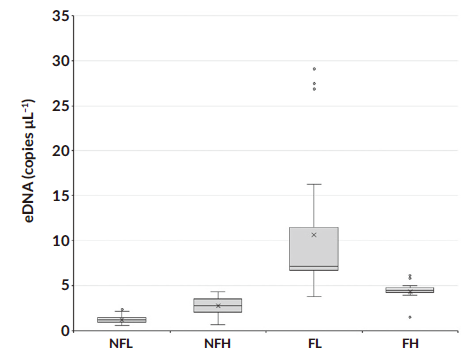
      The expected result was that the concentration increased in the order of NFL, NFH, FL and FH as metabolic rate increased. However, it showed the highest value at FL.


    • The result that eDNA concentration under non-feeding condition was higher at high water temperature is quite predicable because the amount of secretion increased as metabolism changed by high water temperature.

      On the contrary, during feeding condition, eDNA concentration was higher at low temperature. This might be explained by feeding after the long-term fasting period causing a steep increase in eDNA emission.

      It has been reported that starvation causes an increase in nutrient carrier (peptide transporter 1) and digestive enzyme (trypsinogen) in Japanese eels (Ahn et al., 2013)


    • Generalized linear model (GLM) suggested that both “feeding” and “temperature” affected eDNA concentrations significantly.

      There was also an interaction between “feeding” and “temperature” (P < 0.001).


    • On the other hand, the volume of filtration did not affect the concentration of eDNA.

      From the data of qPCR below, the deviations among samples were large in some experimental treatments, even with the same individuals, in the same environment, and filtered in the same amount of water.


    • Unlike water temperature or salinity, eDNA in water is uneven. Therefore, it is important to take multiple samples to avoid incorrect analysis.

    • In nature, more complex factors are involved in survey of eDNA than in controlled aquariums.

      DNA released from living organisms has different degradation rates due to biological (microbial community, extracellular enzymes, etc.) and abiotic (water temperature, salinity, pH, light, oxygen, etc.) effects. The concentration also degraded by time distance from the release source (Barnes et al., 2014; Deiner & Altermatt, 2014).

      Careful approach (e.g. understanding of the physiology of target species, environmental features of their habitats, water chemistry) is needed if quantification of eDNA is to be used to estimate the biomass, especially when comparing biomass across the region or season.