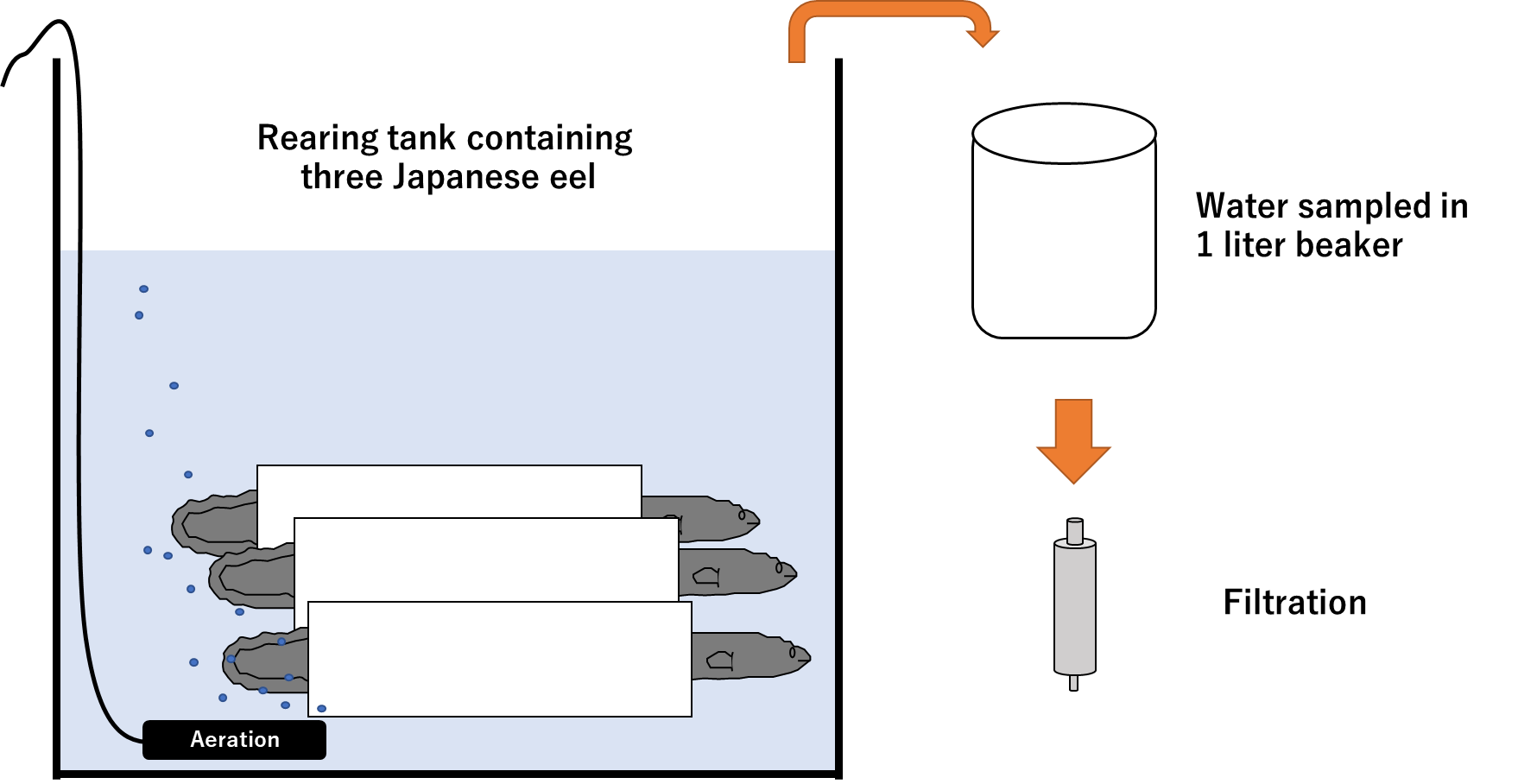
Three eels were kept in a 40-L water tank and aerated for water quality control and water circulation.
(To make sure that the eDNA changed by rearing condition, not by individual differences, the same individual was used throughout the rearing experiment period.)
Eels were fasted for a month before rearing experiment started and acclimatized in a water tank with a set temperature of 15℃(measured
water temperature 16-17℃).
→ Non-Feeding & Low temperature : NFL
After water sampling, the water temperature was
set to 25℃ (measured water temperature 22-23℃) while fasting, and acclimatize for 2 weeks.
→ Non-Feeding & High temperature : NFH
After water sampling, feeding was started, the
water temperature was returned to a low water temperature (measured water
temperature 16-17℃), and acclimatized for 2 weeks.
→ Feeding & Low temperature : FL
After water sampling, the water temperature was raised
(measured water temperature 22-23℃) while feeding, and acclimatize for 2 weeks.
→ Feeding & High temperature : FH