セクションアウトライン

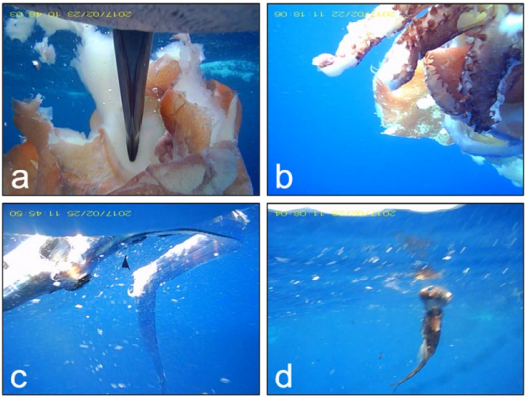
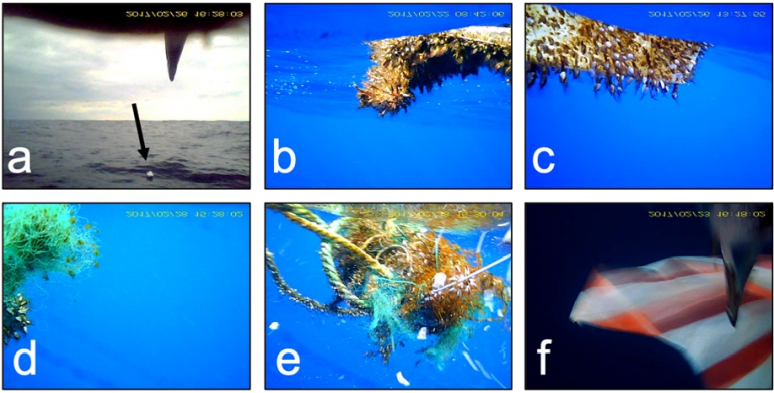
    •    On Torishima Island in the Izu Islands, about 580 km south of Tokyo, the research team attached GPS-loggers (which record the location at 2-minute intervals) and video-loggers (which record 3-second videos at 2-minute intervals during daylight hours) onto black-footed albatrosses, Phoebastria nigripes, while they ware breeding (Fig. 1). We collected and analyzed location information and 8,492 video data from 13 birds. As a result, a total of 16 pieces of marine debris, including styrofoam and fishing gear floating on the sea surface, were filmed by nine of the birds (Fig. 2). While they sometimes passed over the debris (Fig. 2a), they sometimes landed near it, and one of them was shown actually pecking at a red and white plastic sheet with its beak (Fig. 2f). They were also recorded foraging for natural food (squids and fishes) (Fig. 3).

    • Examples of marine debris recorded by video-loggers fitted on black-footed albatrosses

    • Figure 2
      Examples of marine debris recorded by video-loggers fitted on black-footed albatrosses. Styrofoam (a), plastic with barnacles (b), styrofoam with barnacles (c), fishing net with barnacles (d), entangled rope and fishing net (e), and a black-footed albatross pecking at a plastic sheet (f). (a) and (b)-(f) were recorded during flight and landing, respectively, and were cropped as images. (a) shows the beak and a part of the chest of the individual with the recorder.

    • クロアシアホウドリに装着したビデオ記録計によって記録されたイカ類(a,b)と魚類(c,d)の例

    • Figure 3
      Examples of squids (a, b) and fishes (c, d) recorded by video-loggers attached to black-footed albatrosses. (a) shows the beak of the individual with the recorder. The images are cropped from the videos recorded during landing.

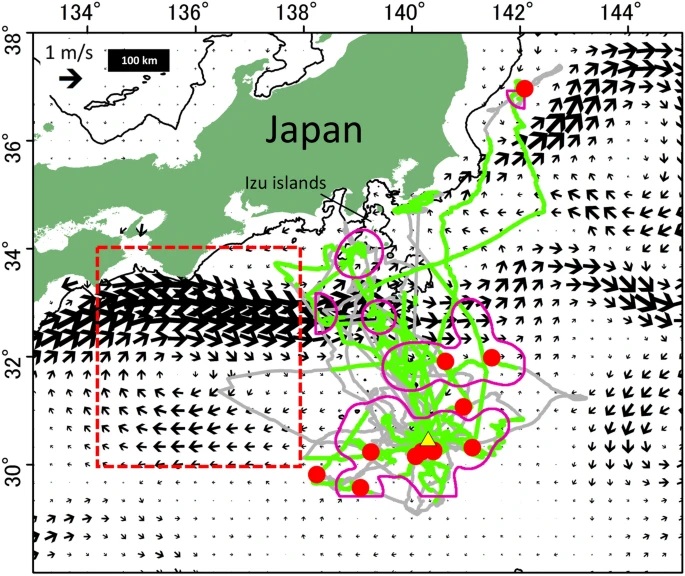
    •    Next, we defined the locations where the images of marine debris were recorded as the locations where the black-footed albatrosses "encountered" the debris. We identified the locations by comparing the time when the images were recorded with the GPS location information. In the same way, we also identified the foraging areas and analyzed the overlap between them (Fig. 4). As a result, we found that the black-footed albatrosses foraged in several areas around the Izu Islands (purple lines in Fig. 4). The highest number of encounters with debris was recorded in waters with weak currents south of the Kuroshio Current (red circles in Fig. 4). Comparing the locations, the debris encountered was within the foraging areas. Therefore, those areas are considered to have a high potential risk of debris ingestion and entanglement in fishing nets.

    • Distribution of marine floating debris and black-footed albatrosses' foraging areas

    • Figure 4
      Distribution of marine floating debris (red circles) encountered by black-footed albatrosses at sea in relation to their foraging area (purple lines: estimated by locations where the birds fed on squid or fish). GPS tracks of 23 foraging trips made by 13 birds from Torishima (yellow triangle) are shown by gray lines, with green sections symbolizing when concomitant video records were available. Black arrows show surface ocean current during the field survey.

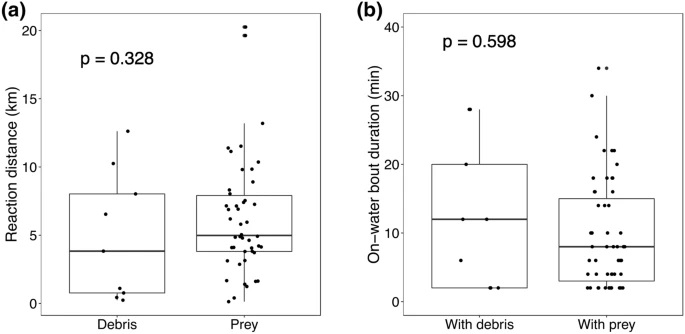
    •    Furthermore, to determine when the black-footed albatrosses found the debris, we used data from the 9 times they landed near the debris. The location of the debris was analyzed by considering the time of detection as the time when the migration trajectory changed the most in the 30 minutes before reaching the location of the debris. Previous studies have suggested that albatrosses use their sense of sight and smell (the smell emitted by marine organisms such as barnacles attached to debris) to recognize marine debris. The analysis revealed that the black-footed albatrosses spotted debris an average of 4.9 km in front of them and actively flew toward the debris from there (Fig. 5a). In addition, once they were attracted by the debris and landed, they stayed there for an average of 12 minutes. This is about the same amount of time as they spend foraging for natural food (squids and fishes) (Fig. 5b). Therefore, increased encounters with marine debris may not only increase the risk of ingestion and entanglement but may also limit the amount of time spent foraging for natural prey.

    • Comparison of the behavioral response of black-footed albatrosses to debris and prey

    • Figure 5
      Comparison of the behavioral response of black-footed albatrosses to debris and prey (squids and fishes). Reaction distance toward debris and prey (a). On-water bout durations between those with debris and prey (b).