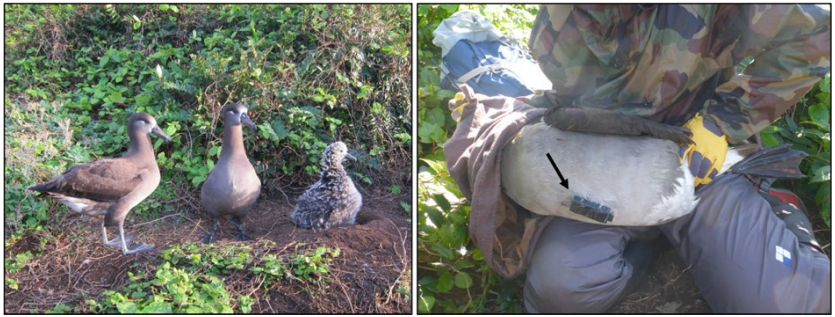
A joint research team of the Yamashina Institute for Ornithology, Nagoya University, the University of Tokyo, Tokyo University of Agriculture and Technology, and Hokkaido University, led by Bungo Nishizawa of the National Institute of Polar Research (also a research fellow of JSPS), has conducted a biologging study of the black-footed albatross (Fig. 1) to investigate the distribution of large marine debris and the attraction process of the black-footed Albatross to marine debris.
Black-footed albatrosses which breed on Torishima Island in the Izu Islands migrate over a wide area of the open ocean in search of squids and fishes as food. The research team attached GPS- and video-loggers to 13 black-footed albatrosses and analyzed the acquired data, which revealed that about 70% of the birds (9 out of 13) had "encountered" marine debris such as styrofoam, plastic pieces, and fishing nets. One of the birds was actually filmed pecking at the debris. Furthermore, the distribution of debris was found to be concentrated in the waters with weak currents on the south side of the Kuroshio Current, which is the main foraging area for this species, and this is considered to be a place where there is a particularly high risk of accidental ingestion of debris and sea birds becoming entangled in fishing nets. Furthermore, we found that black-footed albatrosses that landed near debris found it on average about 5 km before, and once they landed near the debris, they stayed there for about 12 minutes. This is about the same amount of time they spend foraging each time, indicating that being attracted to a lot of debris may reduce their chances of encountering their natural prey.
The results were published online in the international journal Scientific Reports on May 25, 2021.