

Schematic diagram of MIWA sampler and observation of Funka Bay
セクションアウトライン
-
-
This is how the MIWA sampler works.
A butyl rubber stopper is attached to a glass bottle, and two stainless steel tubes are inserted into the stopper. When put into water, seawater enters the bottle due to the difference in water pressure. To protect the glass, a protective net (yellow) is wrapped around it. In order to throw the sampler as far as possible, we used a fishing rod that targets big fish. It seems that it is difficult to use this unless you are quite a fishing fanatic.
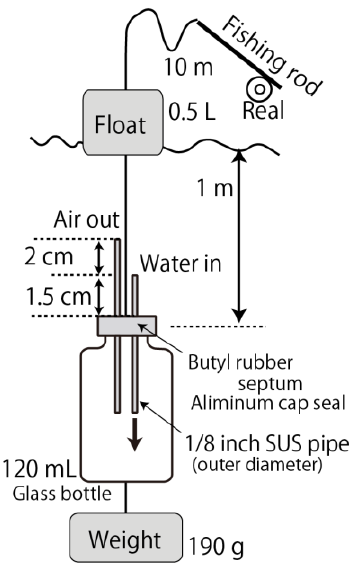
Reproduced from Fig. 2 of the following reference
-
Collect seawater from the coast around Funka Bay in Hokkaido
Funka Bay has a radius of about 30 kilometers. To cover the surrounding coast in one day, we leave Hakodate in the morning and take the expressway to each location. If we can complete the sampling at each shore in 30 minutes, we can return to Hakodate in the evening. The MIWA sampler is essential to collect water from the coast in such a short time.
We collected seawater from Sunasaki to Muroran, as shown on the coastline in the figure below.
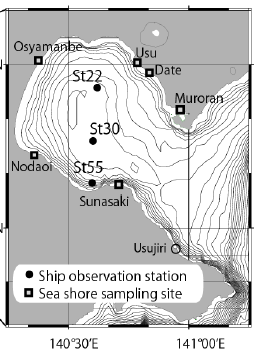
Reproduced from Fig. 1 in the following reference
This is the result of collecting seawater from the coast and measuring the concentration of bromoform. Bromoform is a type of organic halogen gas released by large algae (kelp) that live on the coast. The concentration was found to be high on the coast of Usu, where kelp thrives.
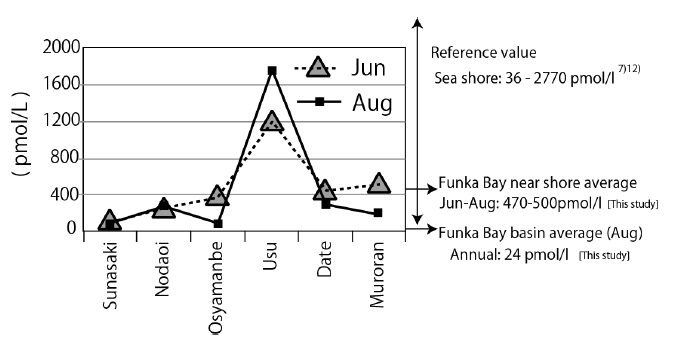
Reproduced from Fig. 5 in the following reference
We'd like to continue observing the water at the coast, but we are on pause because I can't find a fishing enthusiast (and analysis enthusiast) who can operate the MIWA sampler.
-
Reference: Ooki et al., Seasonal Variations of Bromoform Distribution in the Funka Bay, BUNSEKI KAGAKU (
62) 12, 1071-1078 (2013) DOI:10.2116/bunsekikagaku.62.1071 -
Bromoform is considered to be produced by an enzymatic reaction in macroalgae. Learn more about the functional components of macroalgae at the link above.
-