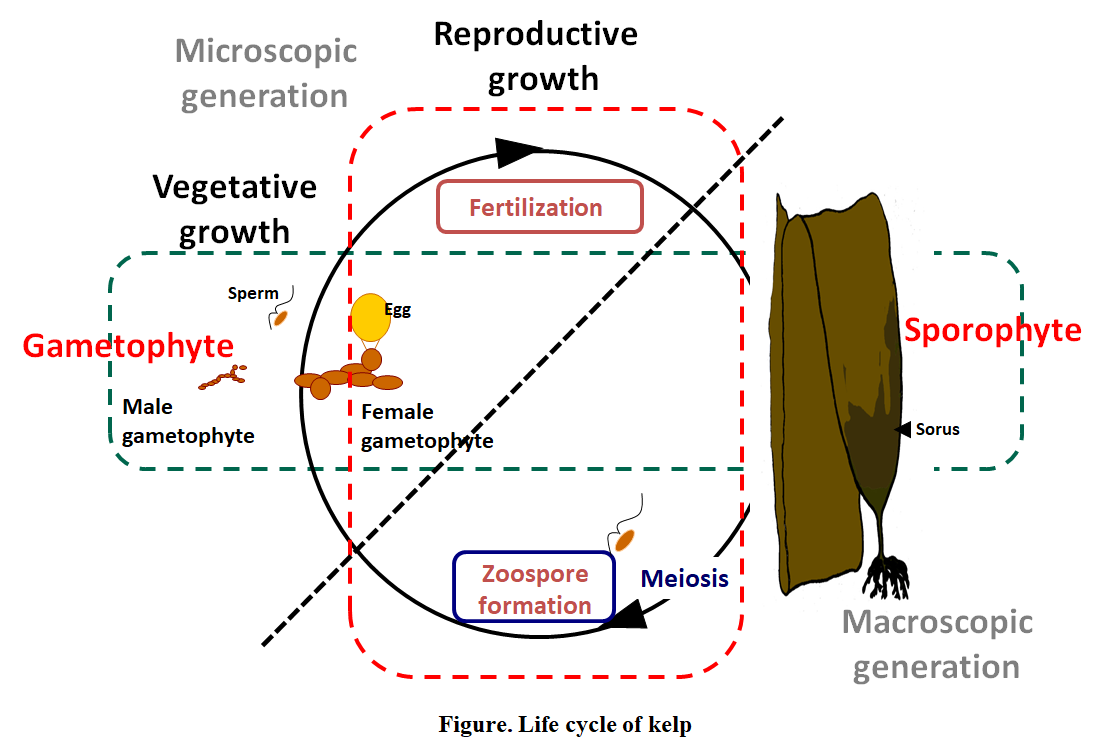
Kelps have a microscopic generation (gametophytes) andmacroscopic
generation (sporophytes), and we cultivate and harvest the macroscopic
generation for use.
Sporophyte
maturation is a vital phenomenon essential not only for supporting reproduction
in natural seaweed beds and maintaining seaweed beds,but also for
securing the seed stock required for the mass seedling production for seaweed cultivation.
Therefore,
we are conducting research on the various conditions and mechanisms that lead
to the success of sporophyte maturation, as well as the development of
artificial control technology.
The kelp we see in our
daily life corresponds to the macroscopic generation (called sporophytes) in the
kelp life cycle.
The maturation of the
macroscopic generation plays an important role in the transition from the macroscopic
generation to microgeneration (gametophytes).
The surface of the body
rises as the sporophyte matures, forming a group of reproductive organs called the sorus.
In the process, meiosis produces germ cells with two flagella, called zoospores.
The released zoosporestransition
to the microgeneration (gametophytes) by landing on a new substrate.
The gametophyte
generation is sexual, and the male and female gametophytes mature, returning to
macroscopic generation after the fertilization of each germ cell.