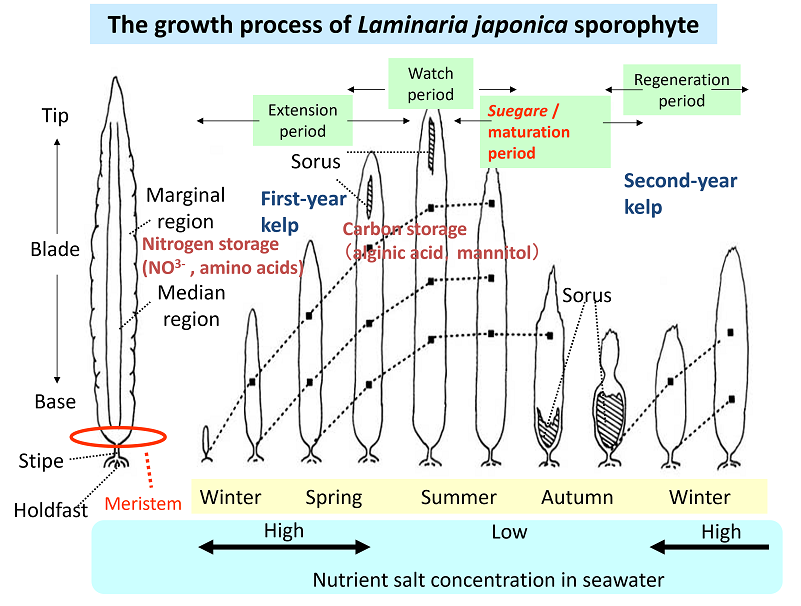
Once the stored nutrients are exhausted, recovery in the stronger
light available from spring to summer promotes the accumulation of
polysaccharides, such as alginic acid.
As the stored nutrients are exhausted, they wither from the tip
(Suegare or Sakigare in Japanese), and then reach the maturation stage to form a reproductive
organ (sorus).
The timing and degree of its formation greatly affect the
biomass of the next generation.
The zoospores released from the sorus have
chemotaxis, settling in a better microscopic environment, although the area
available is narrow.
Then, they become male and female gametophytes, returning to the sporophyte generation
after the fertilization of the germ cells.
The withering tissues at the tip serve as a supply
source of resources for the sorus parts and meristem, and as a result, they die
without reaching maturity.
Thus, the tip indeed plays the role of “keeping the base alive
by cutting themselves.”
The meristem of the surviving base regenerates with the benefit
of the Oyashio and grows as an individual in the second year.