

Environmental DNA
セクションアウトライン
-
-
All environments such as water, soil, and air, contain DNA derived from the individual organism. This is called environmental DNA (eDNA). Every organism contains DNA as genes. The eDNA analysis is a technology that was originally developed as a means of analyzing microorganisms such as bacteria, as any environment naturally contains their DNA. Molecular biology techniques were developed to directly examine the DNA of microorganisms in the environment, replacing traditional culture analysis in the 1990s. The development of the eDNA analysis has elucidated the existence of various microorganisms in different environments and play important roles in their respective ecosystem.
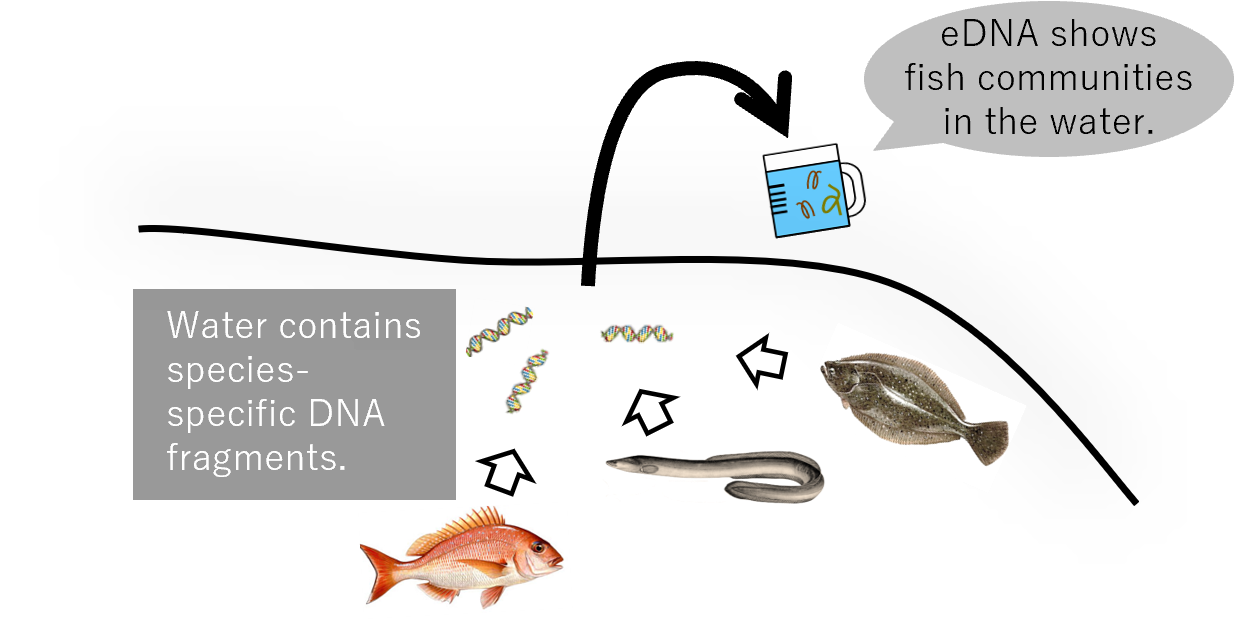 Water also contains DNA released from macro-organisms in the form of excrements, such as feces and secretions. Unlike microorganisms, the eDNA of macroorganisms is DNA isolated from living organisms. It was discovered in 2014 that such a small amount of DNA outside of the living organism can be detected. Because each species has specific DNA, the eDNA analysis allows us to obtain accurate information on the biological communities in an ecosystem. For example, you can find species of organisms that inhabit a certain area. Biomass and the number of organisms might be estimated from the concentration of DNA if it correlates with biomass. This method is particularly useful for surveying the distribution of species with small populations, such as endangered species and endemic species, as you do not capture or kill the organisms. Moreover, it is possible to identify the species in marine protected areas, where you cannot conduct direct biological surveys.
-