

About the oceanic iodine cycle
單元大綱
-
-
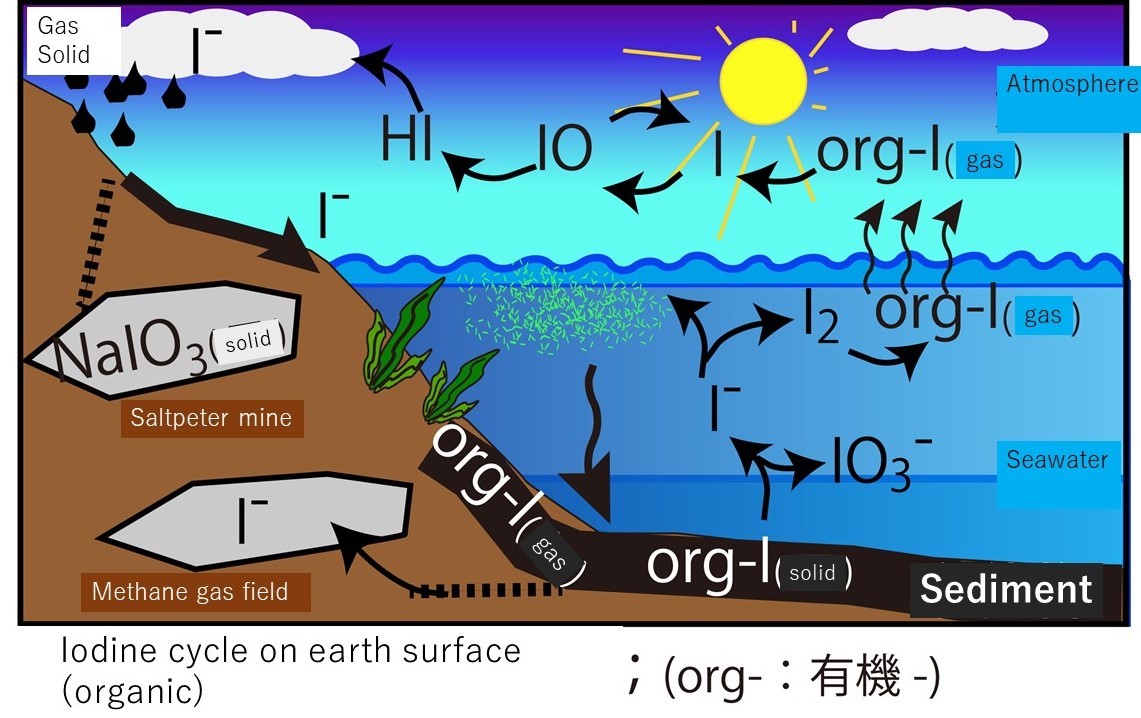
The illustration below shows an image of the iodine cycle centered on the ocean and atmosphere. Most of the mobile iodine on the surface of the earth exists as inorganic iodine in seawater. Oxygen is abundant in seawater (i.e., it is oxidative), so inorganic iodine exists stably as an iodate (IO3-) ion. Iodate ions are reduced to iodide ions (I-) due to the activity of marine plants. They are useful for enzymatic reactions and bactericidal actions in living organisms as an organic iodine compound. Only a small portion of the organic iodine used in living organisms has a low molecular weight and is volatile (volatile = gas). In other words, the ions are converted into organic iodine gas. If the seawater containing the organic iodine gas is in contact with the atmosphere, the organic iodine gas will be released into the atmosphere. In addition to being released as organic iodine gas, some amount is thought to be released as iodine molecules (I2) from the ocean surface. When organic iodine and iodine molecules are released into the atmosphere, they rapidly photolyze and release iodine atoms into the atmosphere. The iodine atom plays a role in catalytically destroying ozone in the troposphere. Iodine atoms destroy the ozone and are eventually deposited on the earth's surface with rain and return to the sea. Some amounts of iodide ion do not return to the sea and are fixed in the crust. Some marine plants containing iodine are additionally deposited on the seabed and buried in the ground.
This is an overview of the iodine cycle on the earth's surface (over a relatively short period). The illustration below shows a picture of organic iodine (org-I) moving at the boundary between marine sediments and seawater and between the ocean and atmosphere. Organic iodine and organic iodine gas are thought to be the important iodine carriers. Marine plants produce organic iodine. In other words, marine plants are thought to drive the terrestrial iodine cycle. The details will be provided in the next course.
-