

About the terrestrial iodine cycle
章节大纲
-
-
Most terrestrial iodine is in the crust. Iodine in igneous rocks is thought to have been fixed in the crust since ancient times. It is highly concentrated in the saltpeter mined in the Atacama Desert in Chile, South America. It is also abundant in marine sediments and in sedimentary rocks that were isolated in the crust. These comprise over 99% of the iodine on earth. However, the iodine in the crust is almost entirely fixed and immobile (it only dissolves through weathering when coming into contact with river water or groundwater, and it is only slightly released as volcanic gas).
About 99% of the mobile iodine on earth exists as inorganic iodine in seawater. The largest movement of iodine is due to the power of living organisms (marine plants). Around 12×1012 g of iodine is consumed by marine plants annually, and about the same amount returns to seawater. Around 5×10¹¹ g of iodine moves annually between the ocean and the atmosphere. This will be described later, but the release of iodine from the ocean to the atmosphere is also thought to involve marine plants. Marine plants are said to drive the iodine cycle of the earth in this way.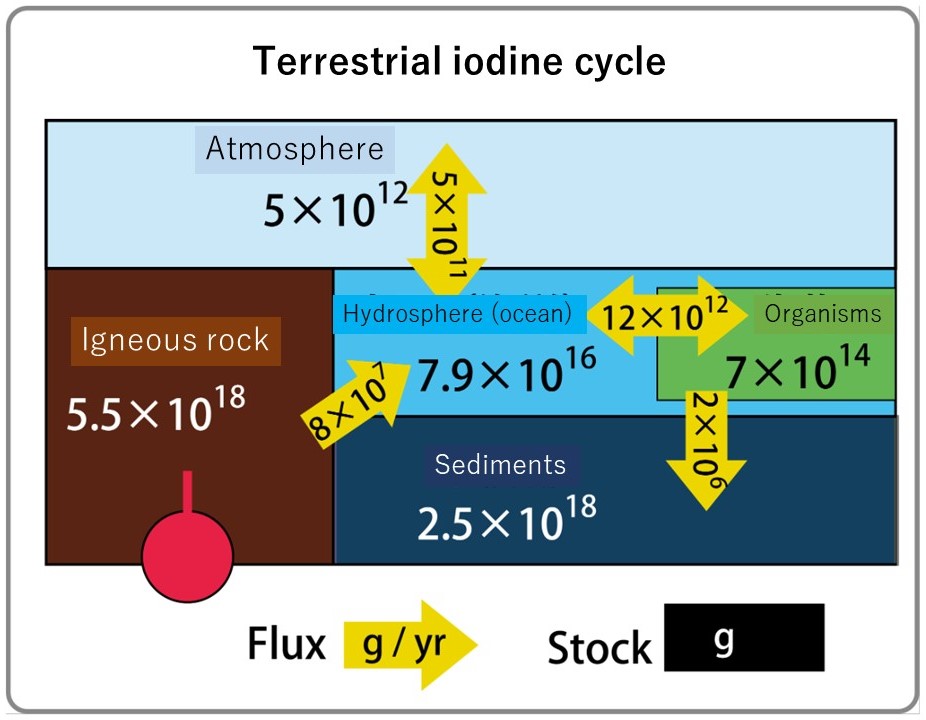
Fuge and Jhonson (1980) The geochemistry of iodine -a review, The environmental geochemistry and health, 8(2), 31-54.
The inflows and outflows should normally be balanced when describing the material cycle. However, the above figure is not balanced. This is probably due to the uncertainty in the estimation of the iodine cycle.
-